Harrison Laura A, Ahn Curie, Adolphs Ralph
Computation & Neural Systems, California Institute of Technology, Pasadena, California, United States of America.
Biology, California Institute of Technology, Pasadena, California, United States of America.
PLoS One. 2015 Aug 21;10(8):e0133682. doi: 10.1371/journal.pone.0133682. eCollection 2015.
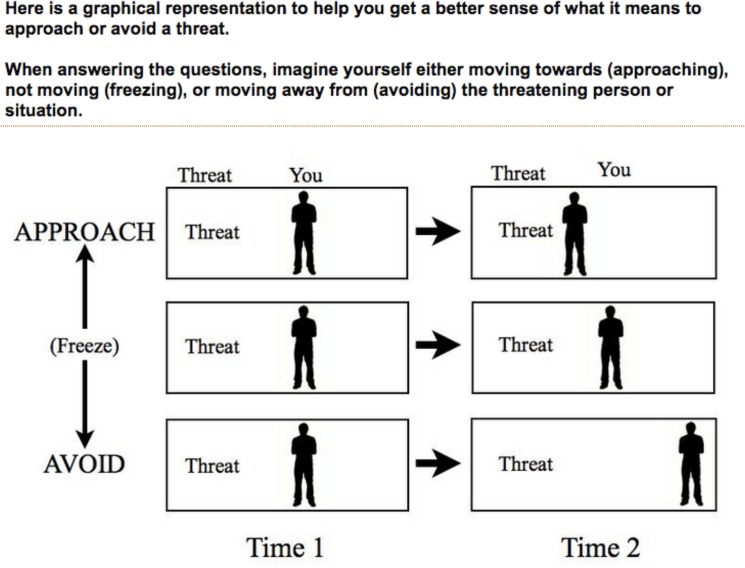
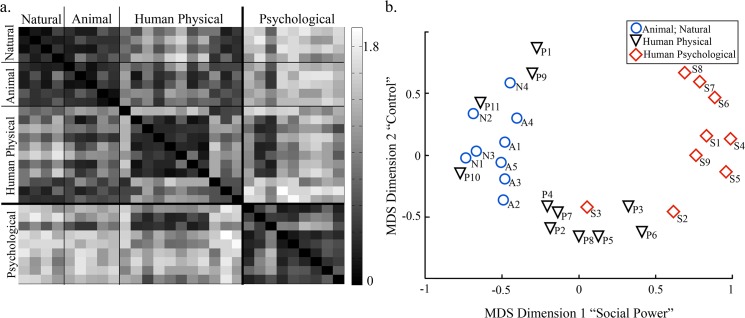
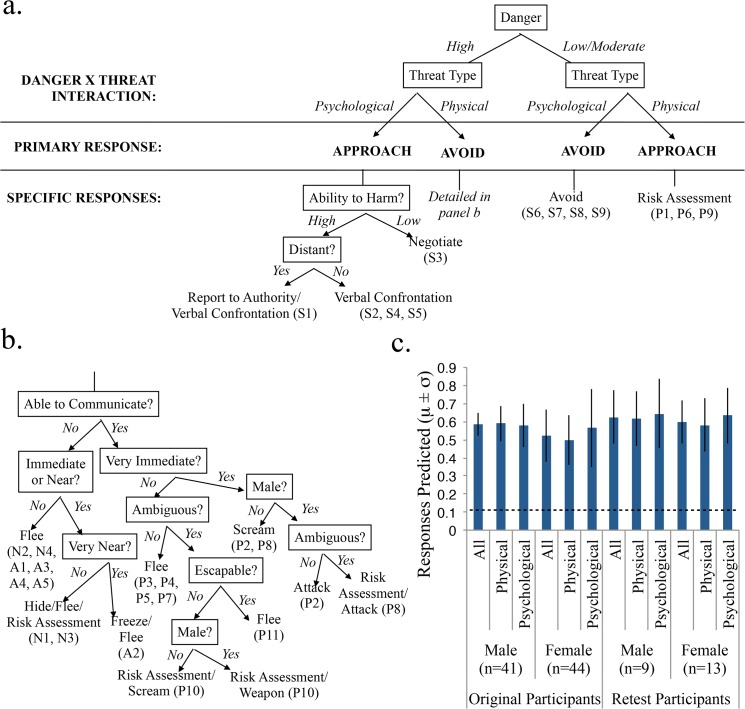
How humans react to threats is a topic of broad theoretical importance, and also relevant for understanding anxiety disorders. Many animal threat reactions exhibit a common structure, a finding supported by human evaluations of written threat scenarios that parallel patterns of rodent defensive behavior to actual threats. Yet the factors that underlie these shared behavioral patterns remain unclear. Dimensional accounts rooted in Darwin's conception of antithesis explain many defensive behaviors. Across species, it is also clear that defensive reactions depend on specific situational factors, a feature long emphasized by psychological appraisal theories. Our study sought to extend prior investigations of human judgments of threat to a broader set of threats, including natural disasters, threats from animals, and psychological (as opposed to physical) threats. Our goal was to test whether dimensional and specific patterns of threat evaluation replicate across different threat classes. 85 healthy adult subjects selected descriptions of defensive behaviors that indicated how they would react to 29 threatening scenarios. Scenarios differed with respect to ten factors, e.g., perceived dangerousness or escapability. Across scenarios, we correlated these factor ratings with the pattern of defensive behaviors subjects endorsed. A decision tree hierarchically organized these correlation patterns to successfully predict each scenario's most common reaction, both for the original sample of subjects and a separate replication group (n = 22). At the top of the decision tree, degree of dangerousness interacted with threat type (physical or psychological) to predict dimensional approach/avoidance behavior. Subordinate nodes represented specific defensive responses evoked by particular contexts. Our ecological approach emphasizes the interplay of situational factors in evoking a broad range of threat reactions. Future studies could test predictions made by our results to help understand pathological threat processing, such as seen in anxiety disorders, and could begin to test underlying neural mechanisms.
人类如何应对威胁是一个具有广泛理论重要性的话题,对于理解焦虑症也很有意义。许多动物的威胁反应呈现出一种共同结构,这一发现得到了人类对书面威胁情景评估的支持,这些情景与啮齿动物对实际威胁的防御行为模式相似。然而,这些共同行为模式背后的因素仍不清楚。源于达尔文对立概念的维度理论解释了许多防御行为。跨物种来看,防御反应显然也取决于特定的情境因素,这是心理评估理论长期以来所强调的一个特征。我们的研究旨在将先前关于人类对威胁判断的调查扩展到更广泛的威胁类别,包括自然灾害、动物威胁以及心理(而非身体)威胁。我们的目标是测试威胁评估的维度模式和特定模式是否能在不同威胁类别中重现。85名健康成年受试者选择了表明他们对29种威胁情景会如何反应的防御行为描述。情景在十个因素方面存在差异,例如感知到的危险性或可逃避性。在所有情景中,我们将这些因素评分与受试者认可的防御行为模式进行关联。一个决策树对这些关联模式进行分层组织,以成功预测每个情景中最常见的反应,无论是对于原始受试者样本还是一个单独的复制组(n = 22)。在决策树的顶部,危险性程度与威胁类型(身体或心理)相互作用,以预测维度上的接近/回避行为。下属节点代表特定情境引发的特定防御反应。我们的生态学方法强调情境因素在引发广泛威胁反应中的相互作用。未来的研究可以测试我们结果所做出的预测,以帮助理解病理性威胁处理,如在焦虑症中所见,并可以开始测试潜在的神经机制。