Hertwig Christian, Steins Veronika, Reineke Kai, Rademacher Antje, Klocke Michael, Rauh Cornelia, Schlüter Oliver
Leibniz Institute for Agricultural Engineering Potsdam-Bornim, Germany.
Department of Food Biotechnology and Food Process Engineering, Berlin University of Technology Berlin, Germany.
Front Microbiol. 2015 Aug 6;6:774. doi: 10.3389/fmicb.2015.00774. eCollection 2015.
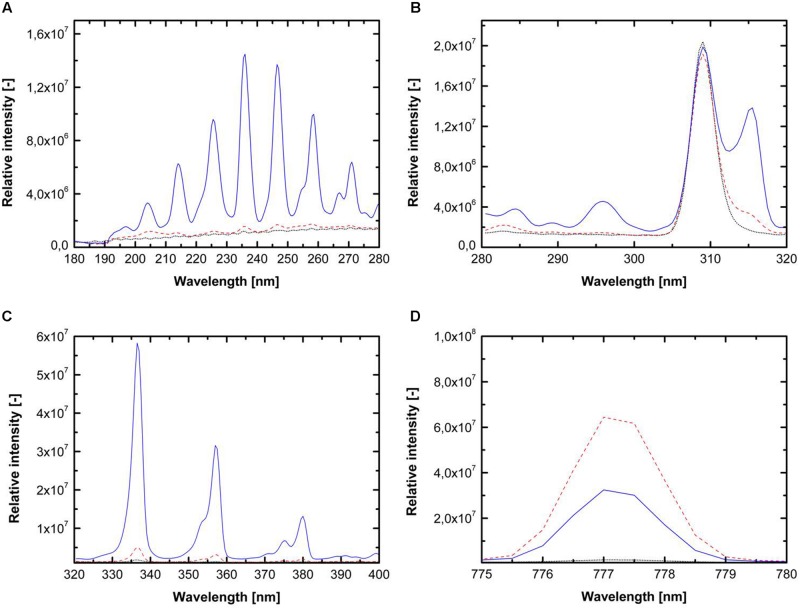
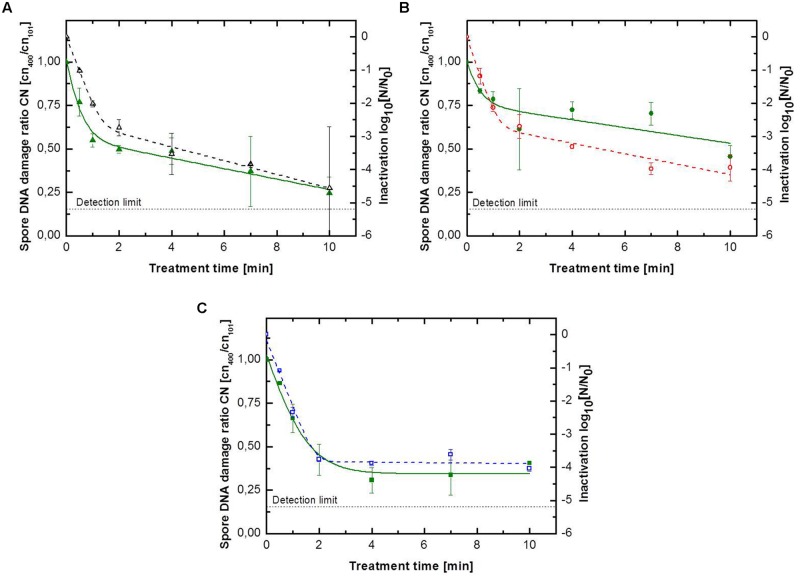
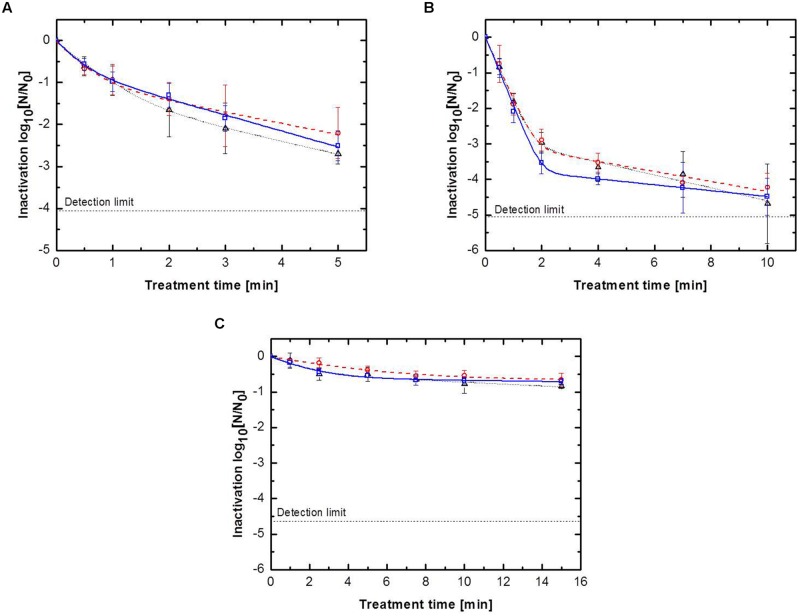
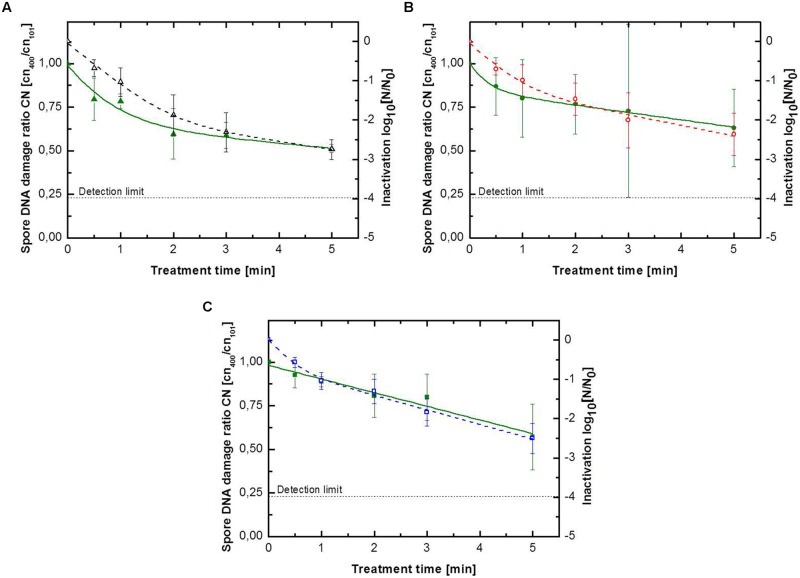
This study investigated the inactivation efficiency of cold atmospheric pressure plasma treatment on Bacillus subtilis endospores dependent on the used feed gas composition and on the surface, the endospores were attached on. Glass petri-dishes, glass beads, and peppercorns were inoculated with the same endospore density and treated with a radio frequency plasma jet. Generated reactive species were detected using optical emission spectroscopy. A quantitative polymerase chain reaction (qPCR) based ratio detection system was established to monitor the DNA damage during the plasma treatment. Argon + 0.135% vol. oxygen + 0.2% vol. nitrogen as feed gas emitted the highest amounts of UV-C photons and considerable amount of reactive oxygen and nitrogen species. Plasma generated with argon + 0.135% vol. oxygen was characterized by the highest emission of reactive oxygen species (ROS), whereas the UV-C emission was negligible. The use of pure argon showed a negligible emission of UV photons and atomic oxygen, however, the emission of vacuum (V)UV photons was assumed. Similar maximum inactivation results were achieved for the three feed gas compositions. The surface structure had a significant impact on the inactivation efficiency of the plasma treatment. The maximum inactivation achieved was between 2.4 and 2.8 log10 on glass petri-dishes and 3.9 to 4.6 log10 on glass beads. The treatment of peppercorns resulted in an inactivation lower than 1.0 log10. qPCR results showed a significant DNA damage for all gas compositions. Pure argon showed the highest results for the DNA damage ratio values, followed by argon + 0.135% vol. oxygen + 0.2% vol. nitrogen. In case of argon + 0.135% vol. oxygen the inactivation seems to be dominated by the action of ROS. These findings indicate the significant role of VUV and UV photons in the inactivation process of B. subtilis endospores.
本研究调查了冷大气压等离子体处理对枯草芽孢杆菌芽孢的灭活效率,该效率取决于所用的进料气体成分以及芽孢所附着的表面。在玻璃培养皿、玻璃珠和胡椒粒上接种相同密度的芽孢,并用射频等离子体射流进行处理。使用光发射光谱法检测产生的活性物种。建立了基于定量聚合酶链反应(qPCR)的比率检测系统,以监测等离子体处理过程中的DNA损伤。以氩气 + 0.135%(体积)氧气 + 0.2%(体积)氮气作为进料气体时,发射的UV - C光子量最高,同时还产生了大量的活性氧和氮物种。以氩气 + 0.135%(体积)氧气产生的等离子体的特征是活性氧物种(ROS)的发射量最高,而UV - C发射可忽略不计。使用纯氩气时,UV光子和原子氧的发射可忽略不计,不过推测有真空(V)UV光子的发射。三种进料气体成分均获得了相似的最大灭活结果。表面结构对等离子体处理的灭活效率有显著影响。在玻璃培养皿上实现的最大灭活率在2.4至2.8个对数10之间,在玻璃珠上为3.9至4.6个对数10。对胡椒粒的处理导致的灭活率低于1.0个对数10。qPCR结果表明,所有气体成分均导致了显著的DNA损伤。纯氩气的DNA损伤比率值最高,其次是氩气 + 0.135%(体积)氧气 + 0.2%(体积)氮气。在氩气 + 0.135%(体积)氧气的情况下,灭活似乎主要由ROS的作用主导。这些发现表明VUV和UV光子在枯草芽孢杆菌芽孢的灭活过程中起着重要作用。