Cowgill Karen D, Bishop Jennifer, Norgaard Amanda K, Rubens Craig E, Gravett Michael G
College of Nursing, Seattle University, Seattle, WA, USA.
Department of Global Health, University of Washington, Seattle, WA, USA.
BMC Pregnancy Childbirth. 2015 Aug 26;15:193. doi: 10.1186/s12884-015-0592-2.
Obstetric fistula (OF) is a serious consequence of prolonged, obstructed labor in settings where emergency obstetric care is limited, but there are few reliable, population-based estimates of the rate of OF. Stillbirth (SB) is another serious consequence of prolonged, obstructed labor, yet the frequency of SB in women with OF is poorly described. Here, we review these data.
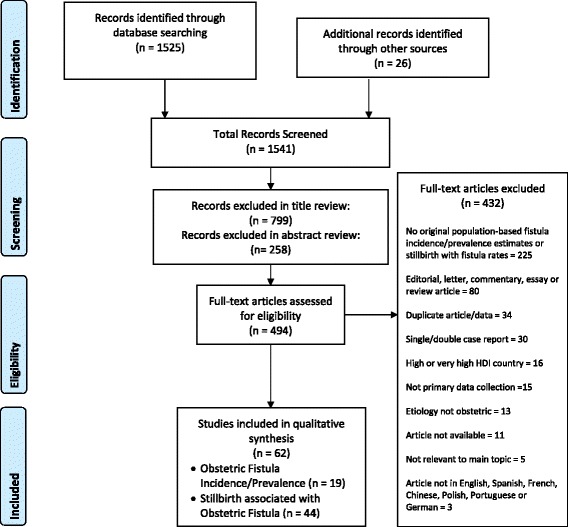
We searched electronic databases and grey literature for articles on OF in low-resource countries published between January 1, 1995, and November 16, 2014, and selected for inclusion 19 articles with original population-based OF incidence or prevalence data and 44 with reports of frequency of SB associated with OF.
OF estimates came from medium- and low-HDI countries in South Asia and Africa, and varied considerably; incidence estimates ranged from 0 to 4.09 OF cases per 1000 deliveries, while prevalence estimates were judged more prone to bias and ranged from 0 to 81.0 OF cases per 1000 women. Reported frequency of SB associated with OF ranged from 32.3 % to 100 %, with estimates from the largest studies around 92 %. Study methods and quality were inconsistent.
Reliable data on OF and associated SB in low-resource countries are lacking, underscoring the relative invisibility of these issues. Sound numbers are needed to guide policy and funding responses to these neglected conditions of poverty.
产科瘘是在产科急诊护理有限的情况下,产程延长且受阻所导致的严重后果,但基于人群的产科瘘发病率可靠估计数据很少。死产是产程延长且受阻的另一个严重后果,然而关于产科瘘女性中死产发生率的描述却很少。在此,我们对这些数据进行综述。
我们检索了电子数据库和灰色文献,查找1995年1月1日至2014年11月16日期间发表的关于资源匮乏国家产科瘘的文章,选择纳入19篇有基于人群的产科瘘发病率或患病率原始数据的文章,以及44篇有与产科瘘相关的死产发生率报告的文章。
产科瘘的估计数据来自南亚和非洲中等和低人类发展指数国家,且差异很大;发病率估计范围为每1000例分娩中有0至4.09例产科瘘病例,而患病率估计更容易出现偏差,范围为每1000名女性中有0至81.0例产科瘘病例。报告的与产科瘘相关的死产发生率范围为32.3%至100%,最大规模研究的估计约为92%。研究方法和质量不一致。
资源匮乏国家缺乏关于产科瘘及相关死产的可靠数据,凸显了这些问题相对不为人知的情况。需要可靠的数据来指导针对这些被忽视的贫困状况的政策和资金应对措施。