Msanne Joseph, Chen Ming, Luttgeharm Kyle D, Bradley Amanda M, Mays Elizabeth S, Paper Janet M, Boyle Daniel L, Cahoon Rebecca E, Schrick Kathrin, Cahoon Edgar B
Center for Plant Science Innovation and Department of Biochemistry, University of Nebraska-Lincoln, E318 Beadle Center, Lincoln, NE, 68588, USA.
School of Natural Resources, University of Nebraska-Lincoln, 807 Hardin Hall, Lincoln, NE, 68583, USA.
Plant J. 2015 Oct;84(1):188-201. doi: 10.1111/tpj.13000.
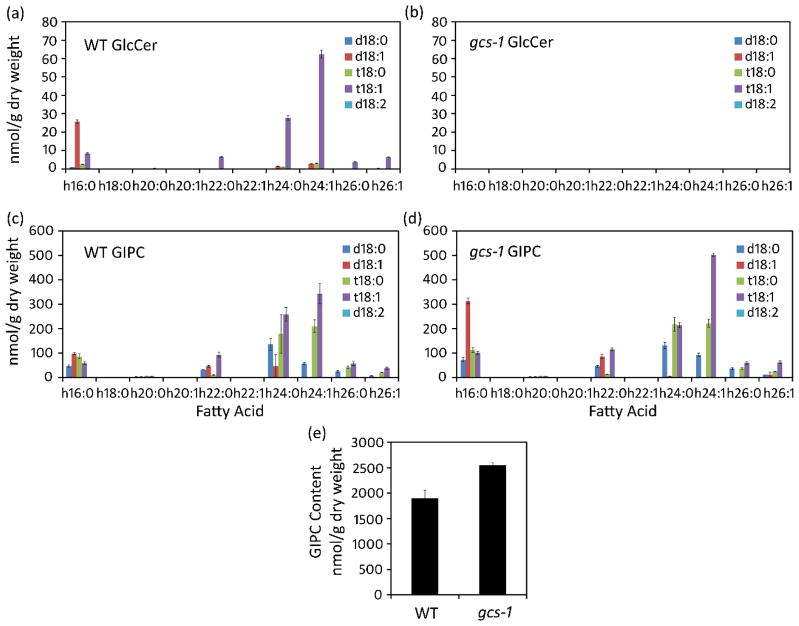
Glucosylceramides (GlcCer), glucose-conjugated sphingolipids, are major components of the endomembrane system and plasma membrane in most eukaryotic cells. Yet the quantitative significance and cellular functions of GlcCer are not well characterized in plants and other multi-organ eukaryotes. To address this, we examined Arabidopsis lines that were lacking or deficient in GlcCer by insertional disruption or by RNA interference (RNAi) suppression of the single gene for GlcCer synthase (GCS, At2g19880), the enzyme that catalyzes GlcCer synthesis. Null mutants for GCS (designated 'gcs-1') were viable as seedlings, albeit strongly reduced in size, and failed to develop beyond the seedling stage. Heterozygous plants harboring the insertion allele exhibited reduced transmission through the male gametophyte. Undifferentiated calli generated from gcs-1 seedlings and lacking GlcCer proliferated in a manner similar to calli from wild-type plants. However, gcs-1 calli, in contrast to wild-type calli, were unable to develop organs on differentiation media. Consistent with a role for GlcCer in organ-specific cell differentiation, calli from gcs-1 mutants formed roots and leaves on media supplemented with the glucosylated sphingosine glucopsychosine, which was readily converted to GlcCer independent of GCS. Underlying these phenotypes, gcs-1 cells had altered Golgi morphology and fewer cisternae per Golgi apparatus relative to wild-type cells, indicative of protein trafficking defects. Despite seedling lethality in the null mutant, GCS RNAi suppression lines with ≤2% of wild-type GlcCer levels were viable and fertile. Collectively, these results indicate that GlcCer are essential for cell-type differentiation and organogenesis, and plant cells produce amounts of GlcCer in excess of that required for normal development.
葡糖神经酰胺(GlcCer)是葡萄糖共轭鞘脂,是大多数真核细胞内膜系统和质膜的主要成分。然而,GlcCer在植物和其他多细胞真核生物中的定量意义和细胞功能尚未得到很好的表征。为了解决这个问题,我们通过插入破坏或RNA干扰(RNAi)抑制葡糖神经酰胺合酶(GCS,At2g19880)的单基因,研究了缺乏或缺陷GlcCer的拟南芥株系,GCS是催化GlcCer合成的酶。GCS的无效突变体(命名为“gcs-1”)在幼苗期是存活的,尽管其大小显著减小,并且无法发育到幼苗期之后。携带插入等位基因的杂合植物通过雄配子体的传递减少。由gcs-1幼苗产生且缺乏GlcCer的未分化愈伤组织以与野生型植物愈伤组织相似的方式增殖。然而,与野生型愈伤组织相比,gcs-1愈伤组织在分化培养基上无法形成器官。与GlcCer在器官特异性细胞分化中的作用一致,gcs-1突变体的愈伤组织在补充了糖基化鞘氨醇葡萄糖神经鞘氨醇的培养基上形成根和叶,该物质可独立于GCS而容易地转化为GlcCer。在这些表型的基础上,相对于野生型细胞,gcs-1细胞的高尔基体形态发生改变,每个高尔基体的潴泡数量减少,这表明存在蛋白质运输缺陷。尽管无效突变体在幼苗期致死,但GlcCer水平≤野生型2%的GCS RNAi抑制株系是存活且可育的。总体而言,这些结果表明GlcCer对于细胞类型分化和器官发生至关重要,并且植物细胞产生的GlcCer量超过正常发育所需的量。