Gomersall Tim, Astell Arlene, Nygård Louise, Sixsmith Andrew, Mihailidis Alex, Hwang Amy
School of Health & Related Research, University of Sheffield, Sheffield, UK.
Department of Neurobiology, Care Sciences, and Society, Karolinska Institutet, Stockholm, Sweden.
Gerontologist. 2015 Oct;55(5):892-912. doi: 10.1093/geront/gnv067. Epub 2015 Aug 27.
Mild Cognitive Impairment (MCI) is a diagnosis proposed to describe an intermediate state between normal cognitive aging and dementia. MCI has been criticised for its conceptual fuzziness, its ambiguous relationship to dementia, and the tension it creates between medical and sociological understandings of "normal aging".
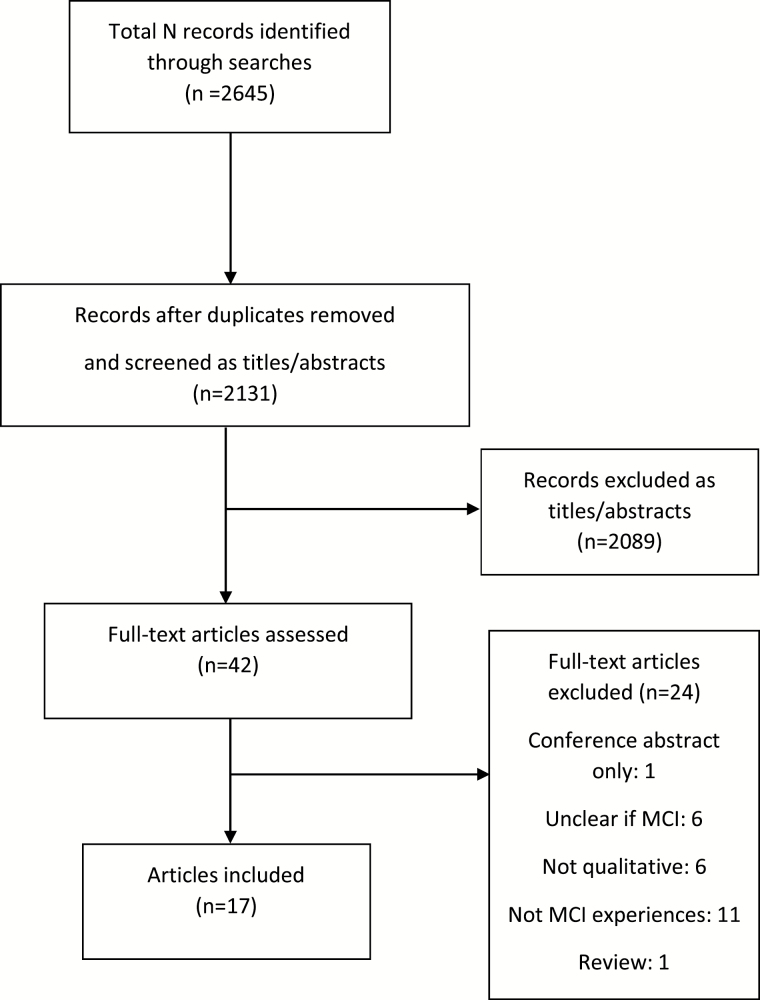
We examined the published qualitative literature on experiences of being diagnosed and living with MCI using metasynthesis as the methodological framework.
Two overarching conceptual themes were developed. The first, MCI and myself-in-time, showed that a diagnosis of MCI could profoundly affect a person's understanding of their place in the world. This impact appears to be mediated by multiple factors including a person's social support networks, which daily activities are affected, and subjective interpretations of the meaning of MCI. The second theme, Living with Ambiguity, describes the difficulties people experienced in making sense of their diagnosis. Uncertainty arose, in part, from lack of clarity and consistency in the information received by people with MCI, including whether they are even told MCI is the diagnosis.
We conclude by suggesting an ethical tension is always at play when a MCI diagnosis is made. Specifically, earlier support and services afforded by a diagnosis may come at the expense of a person's anxiety about the future, with continued uncertainty about how his or her concerns and needs can be addressed.
轻度认知障碍(MCI)是一种用于描述正常认知衰老与痴呆之间中间状态的诊断。MCI因其概念模糊、与痴呆的关系不明确以及在医学和社会学对“正常衰老”的理解之间产生的矛盾而受到批评。
我们以元综合为方法框架,审视了已发表的关于MCI诊断及患病经历的定性文献。
形成了两个总体概念主题。第一个主题“MCI与当下的自我”表明,MCI诊断会深刻影响一个人对自己在世界中位置的理解。这种影响似乎由多种因素介导,包括个人的社会支持网络、哪些日常活动受到影响以及对MCI含义的主观解读。第二个主题“生活在不确定性中”描述了人们在理解自己的诊断时所经历的困难。不确定性部分源于MCI患者所接收信息缺乏清晰度和一致性,包括他们是否被告知MCI就是诊断结果。
我们通过指出在做出MCI诊断时始终存在伦理矛盾来得出结论。具体而言,诊断所带来的早期支持和服务可能以个人对未来的焦虑为代价,且对于如何解决其担忧和需求仍存在持续的不确定性。