Choi Hyun Woo, Kim Jong Soo, Hong Yean Ju, Song Hyuk, Seo Han Geuk, Do Jeong Tae
Department of Animal Biotechnology, College of Animal Bioscience and Technology, Konkuk University, Seoul, 143-701, Republic of Korea.
Sci Rep. 2015 Aug 28;5:13559. doi: 10.1038/srep13559.
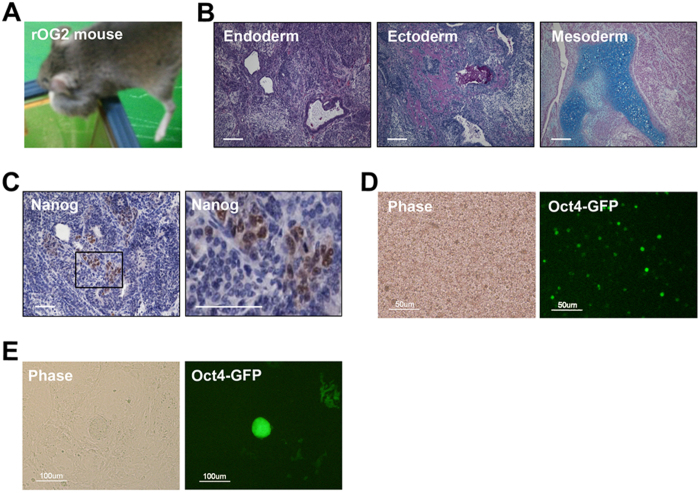
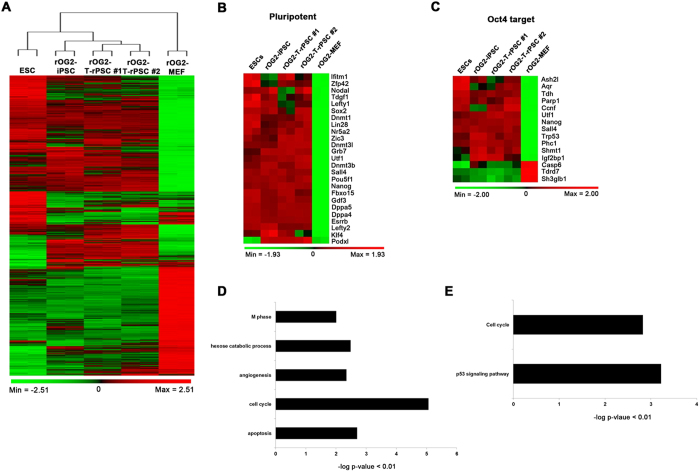
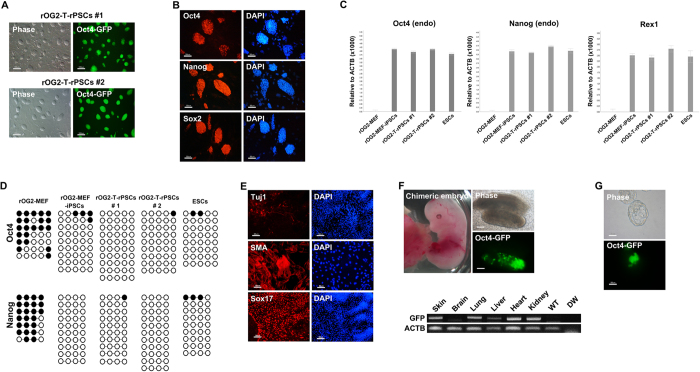
Recently, induced pluripotent stem cells (iPSCs) have been generated in vivo from reprogrammable mice. These in vivo iPSCs display features of totipotency, i.e., they differentiate into the trophoblast lineage, as well as all 3 germ layers. Here, we developed a new reprogrammable mouse model carrying an Oct4-GFP reporter gene to facilitate the detection of reprogrammed pluripotent stem cells. Without doxycycline administration, some of the reprogrammable mice developed aggressively growing teratomas that contained Oct4-GFP(+) cells. These teratoma-derived in vivo PSCs were morphologically indistinguishable from ESCs, expressed pluripotency markers, and could differentiate into tissues of all 3 germ layers. However, these in vivo reprogrammed PSCs were more similar to in vitro iPSCs than ESCs and did not contribute to the trophectoderm of the blastocysts after aggregation with 8-cell embryos. Therefore, the ability to differentiate into the trophoblast lineage might not be a unique characteristic of in vivo iPSCs.
最近,已从可重编程小鼠体内生成了诱导多能干细胞(iPSC)。这些体内iPSC表现出全能性特征,即它们可分化为滋养层谱系以及所有三个胚层。在此,我们开发了一种携带Oct4-GFP报告基因的新型可重编程小鼠模型,以促进对重编程多能干细胞的检测。在不给予强力霉素的情况下,一些可重编程小鼠长出了生长迅速的畸胎瘤,其中含有Oct4-GFP(+)细胞。这些源自畸胎瘤的体内PSC在形态上与ESC无法区分,表达多能性标志物,并且可分化为所有三个胚层的组织。然而,这些体内重编程的PSC与体外iPSC比ESC更为相似,在与8细胞胚胎聚集后,它们不会对囊胚的滋养外胚层产生贡献。因此,分化为滋养层谱系的能力可能不是体内iPSC的独特特征。