Nanomedicine Lab, Faculty of Biology, Medicine and Health, AV Hill Building, The University of Manchester, Manchester M13 9PT, UK; UCL School of Pharmacy, Faculty of Life Sciences, University College London (UCL), London WC1N 1AX, UK.
Nanomedicine Lab, Faculty of Biology, Medicine and Health, AV Hill Building, The University of Manchester, Manchester M13 9PT, UK.
Mol Ther. 2019 Jan 2;27(1):59-75. doi: 10.1016/j.ymthe.2018.10.014. Epub 2018 Oct 24.
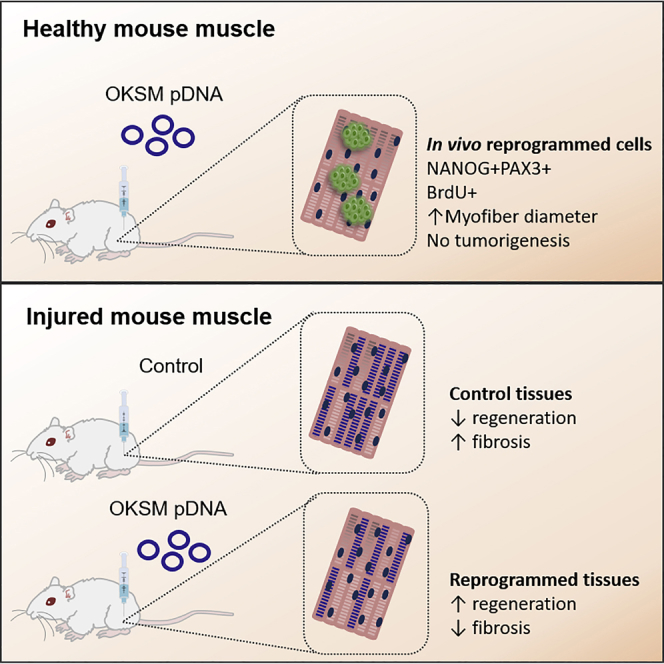
Overexpression of Oct3/4, Klf4, Sox2, and c-Myc (OKSM) transcription factors can de-differentiate adult cells in vivo. While sustained OKSM expression triggers tumorigenesis through uncontrolled proliferation of toti- and pluripotent cells, transient reprogramming induces pluripotency-like features and proliferation only temporarily, without teratomas. We sought to transiently reprogram cells within mouse skeletal muscle with a localized injection of plasmid DNA encoding OKSM (pOKSM), and we hypothesized that the generation of proliferative intermediates would enhance tissue regeneration after injury. Intramuscular pOKSM administration rapidly upregulated pluripotency (Nanog, Ecat1, and Rex1) and early myogenesis genes (Pax3) in the healthy gastrocnemius of various strains. Mononucleated cells expressing such markers appeared in clusters among myofibers, proliferated only transiently, and did not lead to dysplasia or tumorigenesis for at least 120 days. Nanog was also upregulated in the gastrocnemius when pOKSM was administered 7 days after surgically sectioning its medial head. Enhanced tissue regeneration after reprogramming was manifested by the accelerated appearance of centronucleated myofibers and reduced fibrosis. These results suggest that transient in vivo reprogramming could develop into a novel strategy toward the acceleration of tissue regeneration after injury, based on the induction of transiently proliferative, pluripotent-like cells in situ. Further research to achieve clinically meaningful functional regeneration is warranted.
过表达 Oct3/4、Klf4、Sox2 和 c-Myc(OKSM)转录因子可以在体内去分化成体细胞。虽然持续表达 OKSM 会通过未受控制的全能和多能细胞增殖引发肿瘤发生,但瞬时重编程仅会暂时诱导出多能样特征和增殖,而不会形成畸胎瘤。我们试图通过在小鼠骨骼肌内局部注射编码 OKSM 的质粒 DNA(pOKSM)来瞬时重编程细胞,并假设增殖中间产物的产生将增强损伤后的组织再生。在各种品系的健康比目鱼肌中,肌肉内 pOKSM 给药可迅速上调多能性(Nanog、Ecat1 和 Rex1)和早期成肌基因(Pax3)。表达此类标记物的单核细胞出现在肌纤维之间的簇中,仅短暂增殖,并且在至少 120 天内不会导致发育不良或肿瘤发生。当在手术切除其内侧头部后 7 天给予 pOKSM 时,Nanog 在比目鱼肌中也被上调。重编程后的增强组织再生表现为中心核肌纤维的出现加速和纤维化减少。这些结果表明,基于在原位诱导短暂增殖的多能样细胞,瞬时体内重编程可能成为一种加速损伤后组织再生的新策略。进一步的研究以实现有临床意义的功能再生是必要的。