Rigby Heather B, Rigby Matthew H, Caviness John N
Department of Neurology, Movement Disorders Center, Mayo Clinic, Scottsdale, AZ, USA ; Division of Neurology, Dalhousie University, Halifax, NS, Canada.
Department of Surgery, Dalhousie University, Halifax, NS, Canada.
Tremor Other Hyperkinet Mov (N Y). 2015 Aug 25;5:324. doi: 10.7916/D8S75FHK. eCollection 2015.
Orthostatic tremor (OT) is defined by the presence of a high-frequency (13-18 Hz) tremor of the legs upon standing associated with a feeling of unsteadiness. However, some patients have discharge frequencies of <13 Hz, so-called "slow OT". The aim of this study was to characterize patients with unsteadiness upon standing found to have <13 Hz tremor discharges on neurophysiologic testing.
A retrospective review was performed on all subjects with a diagnosis of OT who were referred to the Mayo Clinic, Scottsdale, AZ, between 1999 and 2013 for confirmation using neurophysiology.
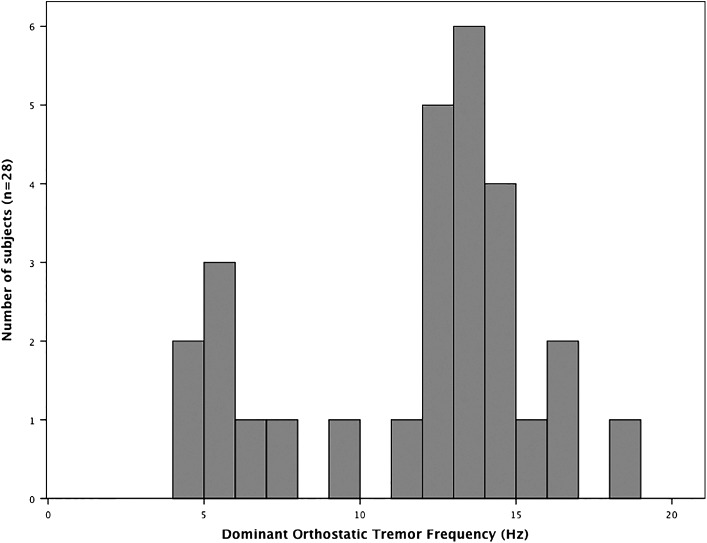
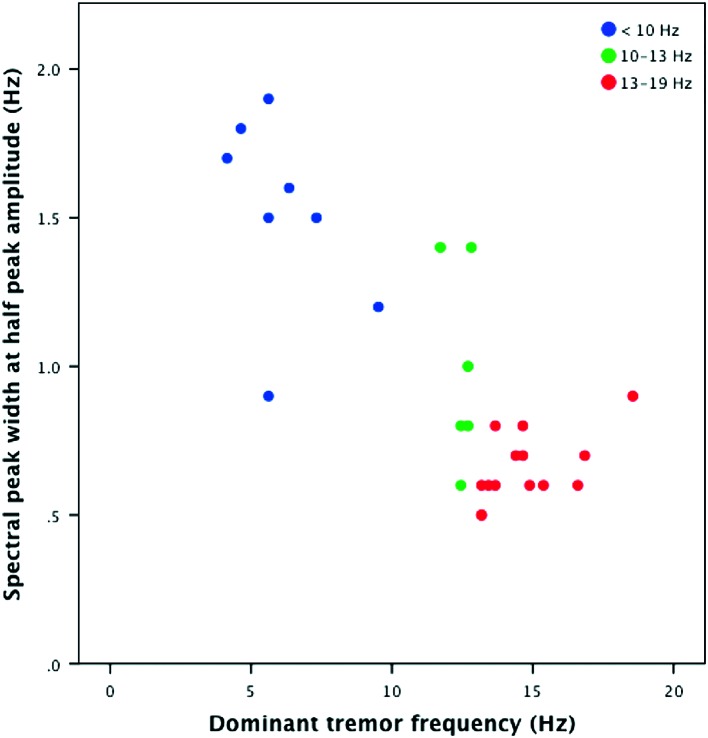
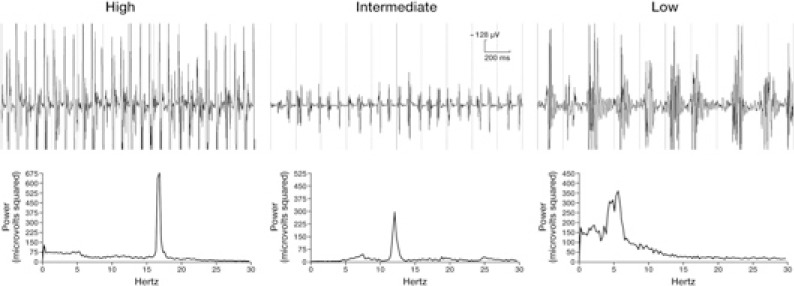
Fourteen of 28 subjects (50%) had OT discharges of <13 Hz, of whom eight had frequencies of <10 Hz and six had frequencies of 10-13 Hz. Lower frequency discharges tended to have a broader spectral peak, greater variability in discharge duration, and lower inter-muscular coherence. Subjects with <13 Hz OT had shorter mean disease duration at time of neurophysiology testing (2.00 years in <10 Hz group, 7.96 years 10-13 Hz group, and 11.43 years >13 Hz; p = 0.002). The proportion of subjects who experienced gait unsteadiness (85.7% vs. 66.6% vs. 21.4%; p = 0.016), falls (37.5% vs. 50% vs. 0%; p = 0.010), and had abnormal gait on examination (71.4% vs. 66.0% vs. 14.3%; p = 0.017) was greater in those with low and intermediate frequencies.
Slow tremor electromyography frequencies (<13 Hz) may characterize a substantial proportion of patients labeled as OT. These subjects may have greater gait involvement and higher likelihood of falls leading to earlier presentation to subspecialty care.
直立性震颤(OT)的定义是站立时腿部出现高频(13 - 18赫兹)震颤并伴有不稳定感。然而,一些患者的放电频率低于13赫兹,即所谓的“慢OT”。本研究的目的是对站立时不稳定且神经生理学检测发现有低于13赫兹震颤放电的患者进行特征描述。
对1999年至2013年间转诊至亚利桑那州斯科茨代尔市梅奥诊所确诊为OT的所有受试者进行回顾性研究,采用神经生理学方法进行确诊。
28名受试者中有14名(50%)OT放电频率低于13赫兹,其中8名频率低于10赫兹,6名频率为10 - 13赫兹。较低频率放电往往具有更宽的频谱峰值、放电持续时间的更大变异性以及更低的肌间相干性。低于13赫兹OT的受试者在神经生理学检测时的平均病程较短(低于10赫兹组为2.00年,10 - 13赫兹组为7.96年,高于13赫兹组为11.43年;p = 0.002)。低频和中频组中经历步态不稳(85.7%对66.6%对21.4%;p = 0.016)、跌倒(37.5%对50%对0%;p = 0.010)以及检查时步态异常(71.4%对66.0%对14.3%;p = 0.017)的受试者比例更高。
慢震颤肌电图频率(低于13赫兹)可能是相当一部分被标记为OT患者的特征。这些受试者可能步态受累更严重,跌倒可能性更高,导致更早寻求专科护理。