López-Góngora Mariana, Escartín Antonio, Martínez-Horta Saul, Fernández-Bobadilla Ramón, Querol Luis, Romero Sergio, Mañanas Miquel Àngel, Riba Jordi
Multiple Sclerosis Unit, Neurology Department, Hospital de la Santa Creu i Sant Pau, Universitat Autònoma de Barcelona, Barcelona, Spain; Departament de Medicina, Universitat Autónoma de Barcelona, Barcelona, Spain; Multiple Sclerosis Research Group, Biomedical Research Institute (IIB-Sant Pau), Barcelona, Spain.
Movement Disorders Unit, Neurology Department, Hospital de la Santa Creu i Sant Pau, Universitat Autònoma de Barcelona, Barcelona, Spain; Parkinson's Disease and Movement Disorders Research Group, Biomedical Research Institute (IIB-Sant Pau), Barcelona, Spain.
PLoS One. 2015 Aug 31;10(8):e0136786. doi: 10.1371/journal.pone.0136786. eCollection 2015.
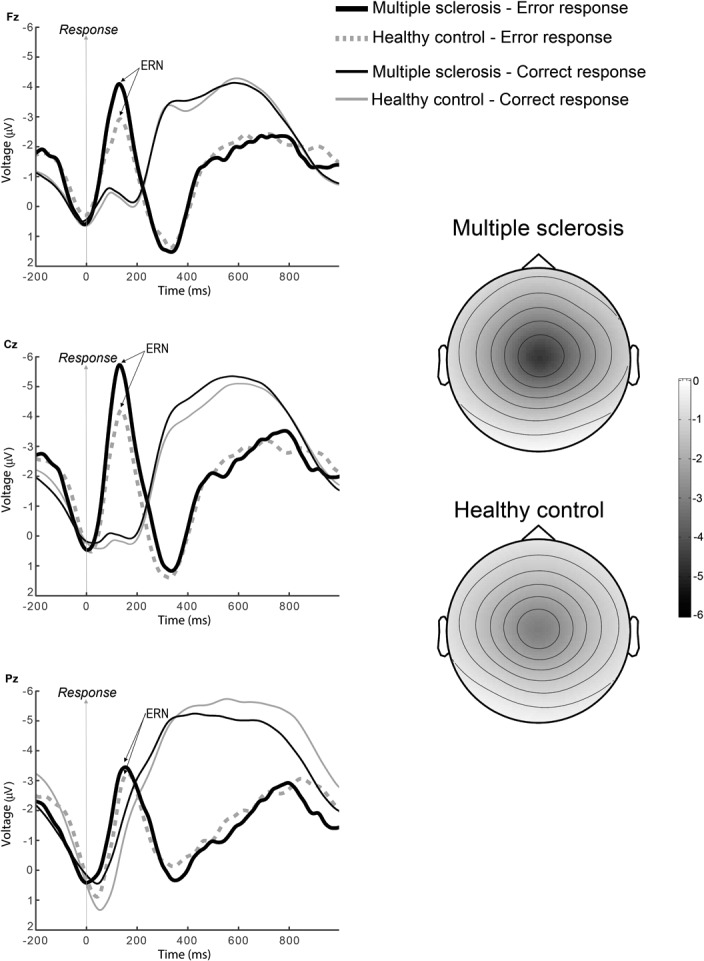
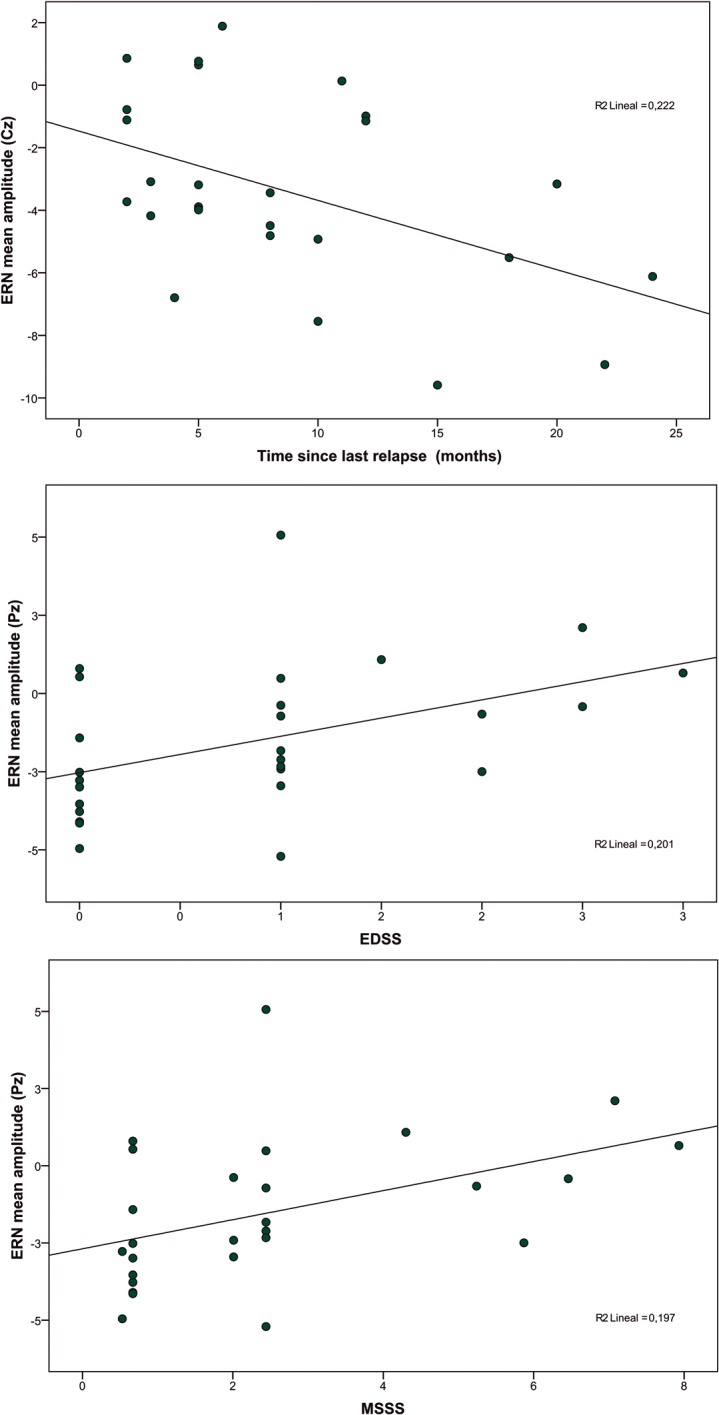
Multiple sclerosis (MS) is a chronic central nervous system disorder characterized by white matter inflammation, demyelination and neurodegeneration. Although cognitive dysfunction is a common manifestation, it may go unnoticed in recently-diagnosed patients. Prior studies suggest MS patients develop compensatory mechanisms potentially involving enhanced performance monitoring. Here we assessed the performance monitoring system in early-stage MS patients using the error-related negativity (ERN), an event-related brain potential (ERP) observed following behavioral errors. Twenty-seven early-stage MS patients and 31 controls were neuropsychologically assessed. Electroencephalography recordings were obtained while participants performed: a) a stop task and b) an auditory oddball task. Behavior and ERP measures were assessed. No differences in performance were found between groups in most neuropsychological tests or in behavior or ERP components in the auditory oddball task. However, the amplitude of the ERN associated with stop errors in the stop task was significantly higher in patients. ERN amplitude correlated positively with scores on the Expanded Disability Status Scale and the Multiple Sclerosis Severity Score, and negatively with the time since last relapse. Patients showed higher neuronal recruitment in tasks involving performance monitoring. Results suggest the development of compensatory brain mechanisms in early-stage MS and reflect the sensitivity of the ERN to detect these changes.
多发性硬化症(MS)是一种慢性中枢神经系统疾病,其特征为白质炎症、脱髓鞘和神经退行性变。尽管认知功能障碍是一种常见表现,但在新诊断的患者中可能未被注意到。先前的研究表明,MS患者会发展出潜在涉及增强性能监测的代偿机制。在此,我们使用错误相关负波(ERN)评估了早期MS患者的性能监测系统,ERN是行为错误后观察到的一种事件相关脑电位(ERP)。对27名早期MS患者和31名对照者进行了神经心理学评估。在参与者执行以下任务时记录脑电图:a)停止任务和b)听觉Oddball任务。评估了行为和ERP指标。在大多数神经心理学测试中,或在听觉Oddball任务的行为或ERP成分方面,两组之间在表现上未发现差异。然而,患者在停止任务中与停止错误相关的ERN波幅显著更高。ERN波幅与扩展残疾状态量表和多发性硬化症严重程度评分的得分呈正相关,与上次复发后的时间呈负相关。患者在涉及性能监测的任务中表现出更高的神经元募集。结果表明早期MS中存在代偿性脑机制的发展,并反映了ERN检测这些变化的敏感性。