Groppa Sergiu, Gonzalez-Escamilla Gabriel, Eshaghi Arman, Meuth Sven G, Ciccarelli Olga
Imaging and Neurostimulation, Department of Neurology, University Medical Center of the Johannes Gutenberg University Mainz, Mainz 55131, Germany.
Department of Neuroinflammation, Queen Square Multiple Sclerosis Centre, UCL Queen Square Institute of Neurology, Faculty of Brain Sciences, University College London, London WC1E 6BT, UK.
Brain Commun. 2021 Oct 7;3(4):fcab237. doi: 10.1093/braincomms/fcab237. eCollection 2021.
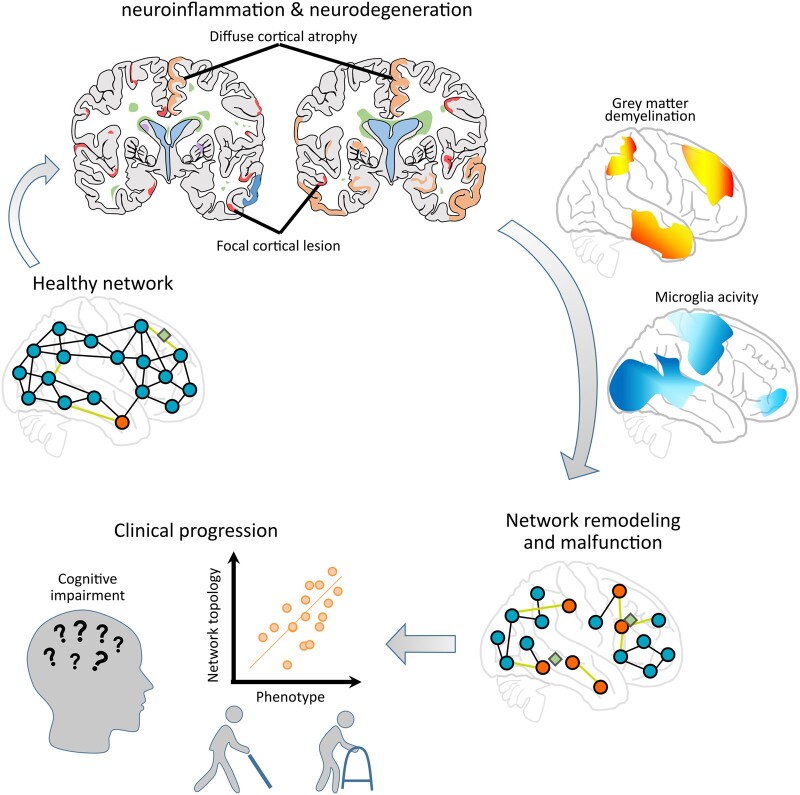
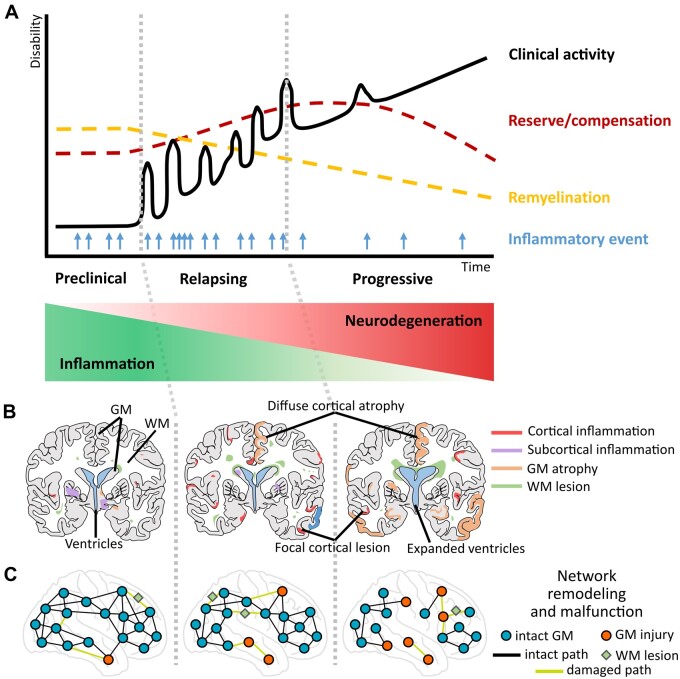
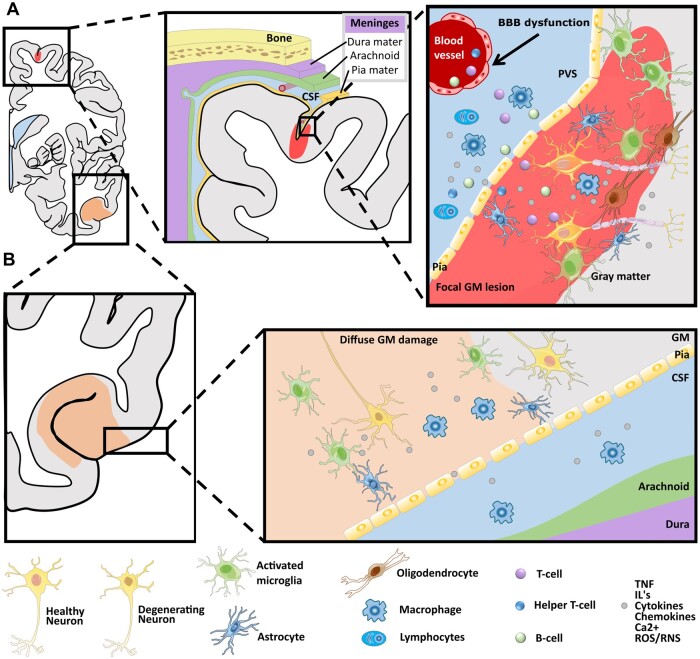
Inflammatory demyelination characterizes the initial stages of multiple sclerosis, while progressive axonal and neuronal loss are coexisting and significantly contribute to the long-term physical and cognitive impairment. There is an unmet need for a conceptual shift from a dualistic view of multiple sclerosis pathology, involving either inflammatory demyelination or neurodegeneration, to integrative dynamic models of brain reorganization, where, glia-neuron interactions, synaptic alterations and grey matter pathology are longitudinally envisaged at the whole-brain level. Functional and structural MRI can delineate network hallmarks for relapses, remissions or disease progression, which can be linked to the pathophysiology behind inflammatory attacks, repair and neurodegeneration. Here, we aim to unify recent findings of grey matter circuits dynamics in multiple sclerosis within the framework of molecular and pathophysiological hallmarks combined with disease-related network reorganization, while highlighting advances from animal models ( and ) and human clinical data (imaging and histological). We propose that MRI-based brain networks characterization is essential for better delineating ongoing pathology and elaboration of particular mechanisms that may serve for accurate modelling and prediction of disease courses throughout disease stages.
炎症性脱髓鞘是多发性硬化症初始阶段的特征,而轴突和神经元的进行性丧失同时存在,并对长期的身体和认知障碍有显著影响。目前迫切需要从多发性硬化症病理学的二元观点(即要么是炎症性脱髓鞘,要么是神经退行性变)转向大脑重组的综合动态模型,在该模型中,胶质细胞与神经元的相互作用、突触改变和灰质病理学在全脑水平上被纵向设想。功能和结构磁共振成像可以描绘复发、缓解或疾病进展的网络特征,这些特征可以与炎症攻击、修复和神经退行性变背后的病理生理学联系起来。在此,我们旨在将多发性硬化症中灰质回路动力学的最新发现统一在分子和病理生理学特征与疾病相关网络重组相结合的框架内,同时突出动物模型(以及)和人类临床数据(成像和组织学)的进展。我们提出,基于磁共振成像的脑网络特征对于更好地描绘正在进行的病理学以及阐述可能有助于在疾病各个阶段对疾病进程进行准确建模和预测的特定机制至关重要。