Han Jin-Hee, Li Jian, Wang Bo, Lee Seong-Kyun, Nyunt Myat Htut, Na Sunghun, Park Jeong-Hyun, Han Eun-Taek
Department of Medical Environmental Biology and Tropical Medicine, School of Medicine, Kangwon National University, Chuncheon 200-701, Korea.
Department of Parasitology, College of Basic Medicine, Hubei University of Medicine, Shiyan, Hubei 442000, China.
Korean J Parasitol. 2015 Aug;53(4):403-11. doi: 10.3347/kjp.2015.53.4.403. Epub 2015 Aug 25.
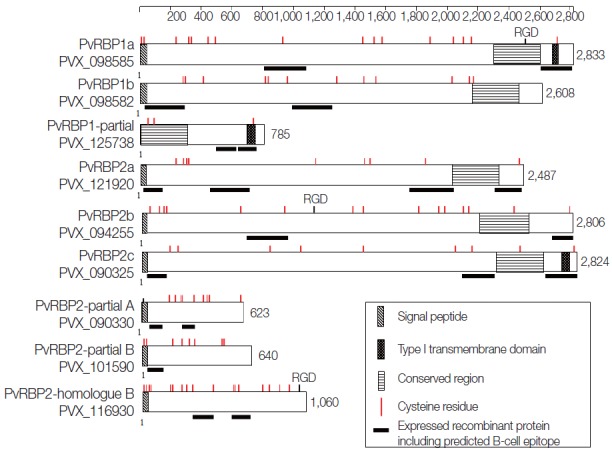
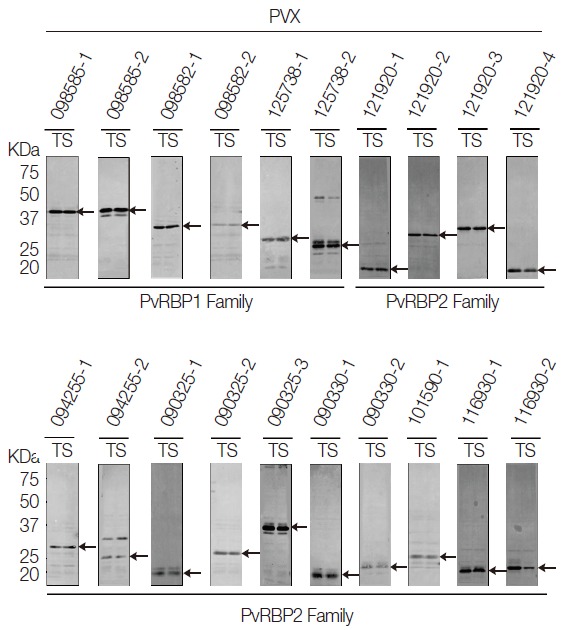
Plasmodium falciparum can invade all stages of red blood cells, while Plasmodium vivax can invade only reticulocytes. Although many P. vivax proteins have been discovered, their functions are largely unknown. Among them, P. vivax reticulocyte binding proteins (PvRBP1 and PvRBP2) recognize and bind to reticulocytes. Both proteins possess a C-terminal hydrophobic transmembrane domain, which drives adhesion to reticulocytes. PvRBP1 and PvRBP2 are large (> 326 kDa), which hinders identification of the functional domains. In this study, the complete genome information of the P. vivax RBP family was thoroughly analyzed using a prediction server with bioinformatics data to predict B-cell epitope domains. Eleven pvrbp family genes that included 2 pseudogenes and 9 full or partial length genes were selected and used to express recombinant proteins in a wheat germ cell-free system. The expressed proteins were used to evaluate the humoral immune response with vivax malaria patients and healthy individual serum samples by protein microarray. The recombinant fragments of 9 PvRBP proteins were successfully expressed; the soluble proteins ranged in molecular weight from 16 to 34 kDa. Evaluation of the humoral immune response to each recombinant PvRBP protein indicated a high antigenicity, with 38-88% sensitivity and 100% specificity. Of them, N-terminal parts of PvRBP2c (PVX_090325-1) and PvRBP2 like partial A (PVX_090330-1) elicited high antigenicity. In addition, the PvRBP2-like homologue B (PVX_116930) fragment was newly identified as high antigenicity and may be exploited as a potential antigenic candidate among the PvRBP family. The functional activity of the PvRBP family on merozoite invasion remains unknown.
恶性疟原虫可侵入红细胞的所有阶段,而间日疟原虫仅能侵入网织红细胞。尽管已发现许多间日疟原虫蛋白,但其功能大多未知。其中,间日疟原虫网织红细胞结合蛋白(PvRBP1和PvRBP2)可识别并结合网织红细胞。这两种蛋白均具有一个C端疏水跨膜结构域,该结构域可驱动与网织红细胞的黏附。PvRBP1和PvRBP2分子量较大(> 326 kDa),这阻碍了功能结构域的鉴定。在本研究中,利用带有生物信息学数据的预测服务器对间日疟原虫RBP家族的完整基因组信息进行了深入分析,以预测B细胞表位结构域。选择了11个pvrbp家族基因,其中包括2个假基因和9个全长或部分长度基因,并用于在无细胞小麦胚系统中表达重组蛋白。通过蛋白质微阵列,利用间日疟患者和健康个体的血清样本对表达的蛋白进行体液免疫反应评估。成功表达了9种PvRBP蛋白的重组片段;可溶性蛋白的分子量范围为16至34 kDa。对每种重组PvRBP蛋白的体液免疫反应评估显示出高抗原性,敏感性为38 - 88%,特异性为100%。其中,PvRBP2c(PVX_090325 - 1)和类PvRBP2部分A(PVX_090330 - 1)的N端部分引发了高抗原性。此外,类PvRBP2同源物B(PVX_116930)片段被新鉴定为具有高抗原性,可能成为PvRBP家族中潜在的抗原候选物。PvRBP家族对裂殖子入侵的功能活性仍未知。