Sadeh N, Spielberg J M, Logue M W, Wolf E J, Smith A K, Lusk J, Hayes J P, Sperbeck E, Milberg W P, McGlinchey R E, Salat D H, Carter W C, Stone A, Schichman S A, Humphries D E, Miller M W
National Center for PTSD, Behavioral Science Division, VA Boston Healthcare System, Boston, MA, USA.
Department of Psychiatry, Boston University School of Medicine, Boston, MA, USA.
Mol Psychiatry. 2016 Mar;21(3):357-63. doi: 10.1038/mp.2015.134. Epub 2015 Sep 1.
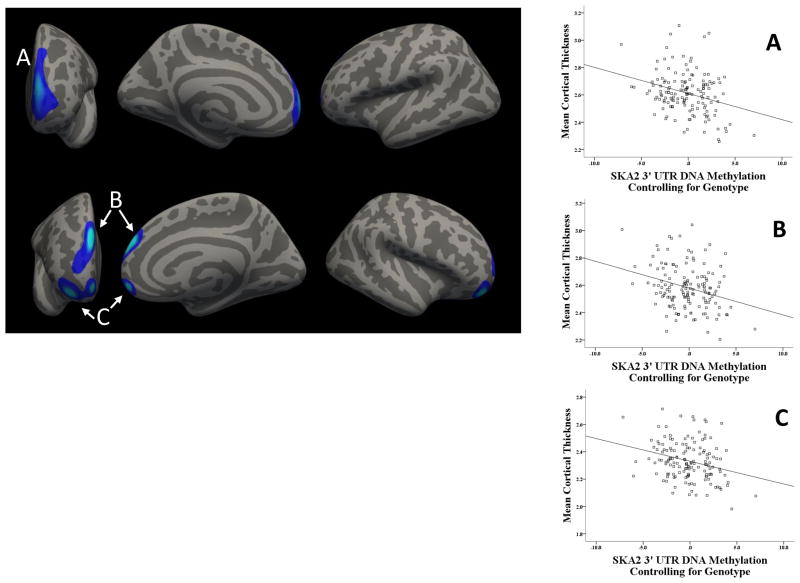
Methylation of the SKA2 (spindle and kinetochore-associated complex subunit 2) gene has recently been identified as a promising biomarker of suicide risk. Based on this finding, we examined associations between SKA2 methylation, cortical thickness and psychiatric phenotypes linked to suicide in trauma-exposed veterans. About 200 trauma-exposed white non-Hispanic veterans of the recent conflicts in Iraq and Afghanistan (91% male) underwent clinical assessment and had blood drawn for genotyping and methylation analysis. Of all, 145 participants also had neuroimaging data available. Based on previous research, we examined DNA methylation at the cytosine-guanine locus cg13989295 as well as DNA methylation adjusted for genotype at the methylation-associated single nucleotide polymorphism (rs7208505) in relationship to whole-brain cortical thickness, posttraumatic stress disorder symptoms (PTSD) and depression symptoms. Whole-brain vertex-wise analyses identified three clusters in prefrontal cortex that were associated with genotype-adjusted SKA2 DNA methylation (methylation(adj)). Specifically, DNA methylation(adj) was associated with bilateral reductions of cortical thickness in frontal pole and superior frontal gyrus, and similar effects were found in the right orbitofrontal cortex and right inferior frontal gyrus. PTSD symptom severity was positively correlated with SKA2 DNA methylation(adj) and negatively correlated with cortical thickness in these regions. Mediation analyses showed a significant indirect effect of PTSD on cortical thickness via SKA2 methylation status. Results suggest that DNA methylation(adj) of SKA2 in blood indexes stress-related psychiatric phenotypes and neurobiology, pointing to its potential value as a biomarker of stress exposure and susceptibility.
SKA2(纺锤体和动粒相关复合体亚基2)基因的甲基化最近被确定为自杀风险的一个有前景的生物标志物。基于这一发现,我们研究了创伤后应激障碍退伍军人中SKA2甲基化、皮质厚度与自杀相关精神症状之间的关联。约200名近期参与伊拉克和阿富汗冲突、有过创伤经历的非西班牙裔白人退伍军人(91%为男性)接受了临床评估,并抽取血液进行基因分型和甲基化分析。其中,145名参与者还拥有神经影像学数据。基于先前的研究,我们研究了胞嘧啶-鸟嘌呤位点cg13989295处的DNA甲基化以及在甲基化相关单核苷酸多态性(rs7208505)处根据基因型调整后的DNA甲基化与全脑皮质厚度、创伤后应激障碍症状(PTSD)和抑郁症状之间的关系。全脑逐顶点分析在前额叶皮质中确定了三个与基因型调整后的SKA2 DNA甲基化(甲基化(adj))相关的簇。具体而言,甲基化(adj)与额极和额上回皮质厚度的双侧减少相关,在右侧眶额皮质和右侧额下回也发现了类似的效应。PTSD症状严重程度与SKA2 DNA甲基化(adj)呈正相关,与这些区域的皮质厚度呈负相关。中介分析显示,PTSD通过SKA2甲基化状态对皮质厚度有显著的间接影响。结果表明,血液中SKA2的DNA甲基化(adj)反映了与应激相关的精神症状和神经生物学特征,表明其作为应激暴露和易感性生物标志物的潜在价值。