Ramôa Carolina P, Hiler Marzena M, Spindle Tory R, Lopez Alexa A, Karaoghlanian Nareg, Lipato Thokozeni, Breland Alison B, Shihadeh Alan, Eissenberg Thomas
Center for the Study of Tobacco Products, Virginia Commonwealth University, Richmond, Virginia, USA Department of Psychology, Virginia Commonwealth University, Richmond, Virginia, USA.
Department of Mechanical Engineering, American University of Beirut, Beirut, Lebanon.
Tob Control. 2016 Apr;25(e1):e6-9. doi: 10.1136/tobaccocontrol-2015-052447. Epub 2015 Aug 31.
Electronic cigarettes (ECIGs) aerosolise a liquid that usually contains propylene glycol and/or vegetable glycerine, flavourants and the dependence-producing drug, nicotine, in various concentrations. This laboratory study examined the relationship between liquid nicotine concentration and plasma nicotine concentration and puffing behaviour in experienced ECIG users.
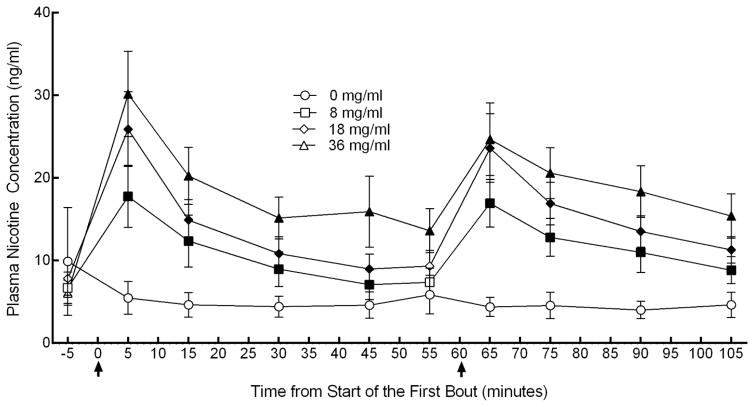
Sixteen ECIG-experienced participants used a 3.3-Volt ECIG battery attached to a 1.5-Ohm dual-coil 'cartomiser' loaded with 1 mL of a flavoured propylene glycol/vegetable glycerine liquid to complete four sessions, at least 2 days apart, that differed by nicotine concentration (0, 8, 18 or 36 mg/mL). In each session, participants completed two 10-puff ECIG-use bouts (30 s puff interval) separated by 60 min. Venous blood was sampled to determine plasma nicotine concentration. Puff duration, volume and average flow rate were measured.
Immediately after bout 1, mean plasma nicotine concentration was 5.5 ng/mL (SD=7.7) for 0 mg/mL liquid, with significantly (p<0.05) higher mean concentrations observed for the 8 (mean=17.8 ng/mL, SD=14.6), 18 (mean=25.9 ng/mL, SD=17.5) and 36 mg/mL (mean=30.2 ng/mL; SD=20.0) concentrations; a similar pattern was observed for bout 2. For bout 1, at 36 mg/mL, the mean post- minus pre-bout difference was 24.1 ng/mL (SD=18.3). Puff topography data were consistent with previous results and revealed few reliable differences across conditions.
This study demonstrates a relationship between ECIG liquid nicotine concentration and user plasma nicotine concentration in experienced ECIG users. Nicotine delivery from some ECIGs may exceed that of a combustible cigarette. The rationale for this higher level of nicotine delivery is uncertain.
电子烟将一种液体雾化,这种液体通常含有丙二醇和/或蔬菜甘油、调味剂以及会使人产生依赖的药物尼古丁,且尼古丁浓度各不相同。这项实验室研究考察了有经验的电子烟使用者的液体尼古丁浓度与血浆尼古丁浓度及抽吸行为之间的关系。
16名有电子烟使用经验的参与者使用一个3.3伏的电子烟电池,该电池连接一个1.5欧姆的双线圈“雾化器”,雾化器中装有1毫升加味丙二醇/蔬菜甘油液体,以完成四个阶段的实验,每个阶段至少间隔2天,各阶段的尼古丁浓度不同(0、8、18或36毫克/毫升)。在每个阶段,参与者完成两组每组10口的电子烟抽吸过程(抽吸间隔30秒),两组之间间隔60分钟。采集静脉血以测定血浆尼古丁浓度。测量抽吸持续时间、体积和平均流速。
在第一轮抽吸结束后立即检测发现,对于0毫克/毫升液体,平均血浆尼古丁浓度为5.5纳克/毫升(标准差=7.7),而对于8毫克/毫升(平均=17.8纳克/毫升,标准差=14.6)、18毫克/毫升(平均=25.9纳克/毫升,标准差=17.5)和36毫克/毫升(平均=30.2纳克/毫升;标准差=20.0)浓度的液体,平均血浆尼古丁浓度显著更高(p<0.05);第二轮抽吸也观察到类似模式。在第一轮抽吸中,对于36毫克/毫升的液体,抽吸后与抽吸前的平均差值为24.1纳克/毫升(标准差=18.3)。抽吸特征数据与先前结果一致,且未显示出各条件之间有可靠的差异。
本研究证明了有经验的电子烟使用者的电子烟液体尼古丁浓度与使用者血浆尼古丁浓度之间的关系。一些电子烟的尼古丁输送量可能超过可燃香烟。这种更高水平尼古丁输送的原理尚不确定。