Bradley Heather, Viall Abigail H, Wortley Pascale M, Dempsey Antigone, Hauck Heather, Skarbinski Jacek
Division of HIV/AIDS Prevention, Centers for Disease Control and Prevention, Atlanta, Georgia.
HIV/AIDS Bureau, Health Resources and Services Administration, Rockville, Maryland.
Clin Infect Dis. 2016 Jan 1;62(1):90-98. doi: 10.1093/cid/civ708. Epub 2015 Aug 30.
The Ryan White HIV/AIDS Program (RWHAP) provides persons infected with human immunodeficiency virus (HIV) with services not covered by other healthcare payer types. Limited data exist to inform policy decisions about the most appropriate role for RWHAP under the Patient Protection and Affordable Care Act (ACA).
We assessed associations between RWHAP assistance and antiretroviral therapy (ART) prescription and viral suppression. We used data from the Medical Monitoring Project, a surveillance system assessing characteristics of HIV-infected adults receiving medical care in the United States. Interview and medical record data were collected in 2009-2013 from 18 095 patients.
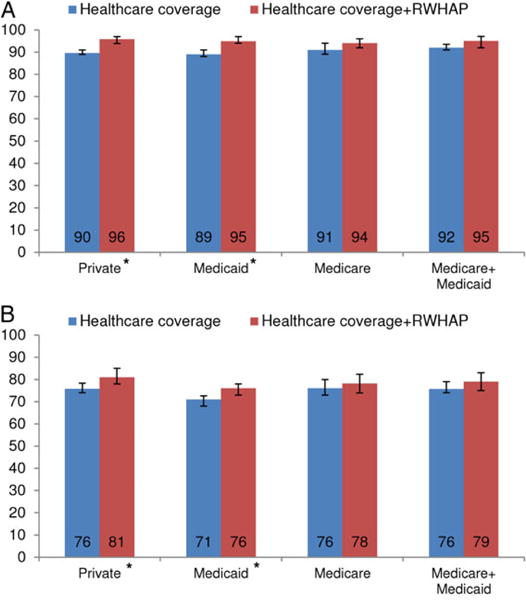
Nearly 41% of patients had RWHAP assistance; 15% relied solely on RWHAP assistance for HIV care. Overall, 91% were prescribed ART, and 75% were virally suppressed. Uninsured patients receiving RWHAP assistance were significantly more likely to be prescribed ART (52% vs 94%; P < .01) and virally suppressed (39% vs 77%; P < .01) than uninsured patients without RWHAP assistance. Patients with private insurance and Medicaid were 6% and 7% less likely, respectively, to be prescribed ART than those with RWHAP only (P < .01). Those with private insurance and Medicaid were 5% and 12% less likely, respectively, to be virally suppressed (P ≤ .02) than those with RWHAP only. Patients whose private or Medicaid coverage was supplemented by RWHAP were more likely to be prescribed ART and virally suppressed than those without RWHAP supplementation (P ≤ .01).
Uninsured and underinsured HIV-infected persons receiving RWHAP assistance were more likely to be prescribed ART and virally suppressed than those with other types of healthcare coverage.
瑞安·怀特艾滋病项目(RWHAP)为感染人类免疫缺陷病毒(HIV)的人提供其他医疗支付类型未涵盖的服务。关于在《患者保护与平价医疗法案》(ACA)下RWHAP最适当作用的政策决策,可用数据有限。
我们评估了RWHAP援助与抗逆转录病毒疗法(ART)处方及病毒抑制之间的关联。我们使用了医疗监测项目的数据,该监测系统评估在美国接受医疗护理的HIV感染成年人的特征。2009年至2013年从18095名患者收集了访谈和病历数据。
近41%的患者获得了RWHAP援助;15%的患者在HIV护理方面完全依赖RWHAP援助。总体而言,91%的患者接受了ART处方,75%的患者病毒得到抑制。获得RWHAP援助的未参保患者比未获得RWHAP援助的未参保患者接受ART处方的可能性显著更高(52%对94%;P <.01),病毒得到抑制的可能性也显著更高(39%对77%;P <.01)。有私人保险和医疗补助的患者接受ART处方的可能性分别比仅获得RWHAP援助的患者低6%和7%(P <.01)。有私人保险和医疗补助的患者病毒得到抑制的可能性分别比仅获得RWHAP援助的患者低5%和12%(P≤.02)。与未获得RWHAP补充的患者相比,其私人保险或医疗补助由RWHAP补充的患者接受ART处方和病毒得到抑制的可能性更高(P≤.01)。
与其他类型医疗覆盖的患者相比,获得RWHAP援助的未参保和保险不足的HIV感染者接受ART处方和病毒得到抑制的可能性更高。