Kroemeke Aleksandra, Zając-Gawlak Izabela, Pośpiech Dariusz, Gába Aleš, Přidalová Miroslava, Pelclová Jana
Department of Psychology, University of Social Sciences and Humanities, Warsaw, Poland.
Department of Physical Education, The Jerzy Kukuczka Academy of Physical Education, Katowice, Poland.
Prz Menopauzalny. 2014 Sep;13(4):227-32. doi: 10.5114/pm.2014.44998. Epub 2014 Sep 9.
To verify relationships between physical activity (steps per day) and obesity (components of body composition) among postmenopausal women.
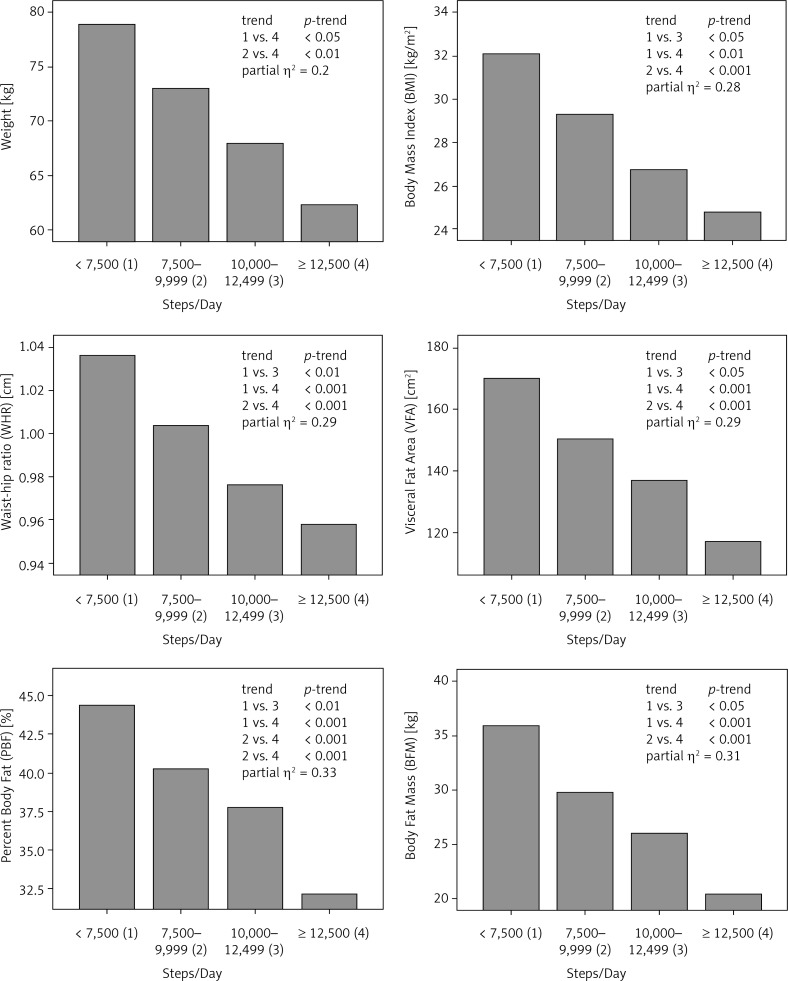
Physical activity (ActiGraph GT1M accelerometer; worn for 7 days) and obesity (body composition analyzer InBody 720) were assessed among 79 healthy postmenopausal women (age 63.25 ± 5.51 years; range: 51-81 years). In order to determine differences in body composition in women with different levels of physical activity, one-way analysis of covariance (ANCOVA) was conducted, with age of participants as a covariate.
Significant intergroup differences in almost all analyzed components of the body composition (weight, body mass index, waist-hip ratio, visceral fat area, body fat mass and percent of body fat) were obtained. Highly active women (≥ 12,500 steps/day) had lower weight and adiposity parameters than those that represented low (< 7,500 steps/day) or somewhat active (7,500-9,999 steps/day) groups. Besides, a noteworthy difference between active (10,000-12,499 steps/day) and low active women was recorded. Noticeably, only in the most active group was the BMI within normal ranges.
The higher physical activity, the lower obesity in postmenopausal women. The recommended 10,000 steps/day seems insufficient for this age group. Based on the obtained results, postmenopausal women should walk at least 12,500 steps per day to improve their health.
验证绝经后女性的身体活动(每日步数)与肥胖(身体成分组成部分)之间的关系。
对79名健康绝经后女性(年龄63.25±5.51岁;范围:51 - 81岁)进行身体活动(使用ActiGraph GT1M加速度计,佩戴7天)和肥胖(使用InBody 720人体成分分析仪)评估。为了确定不同身体活动水平女性的身体成分差异,以参与者年龄作为协变量进行单因素协方差分析(ANCOVA)。
几乎所有分析的身体成分组成部分(体重、体重指数、腰臀比、内脏脂肪面积、身体脂肪量和体脂百分比)均存在显著的组间差异。高身体活动水平的女性(≥12,500步/天)的体重和肥胖参数低于低身体活动水平(<7,500步/天)或中等身体活动水平(7,500 - 9,999步/天)的女性。此外,记录到身体活动水平为10,000 - 12,499步/天的女性与低身体活动水平女性之间存在显著差异。值得注意的是,只有最活跃的组的BMI在正常范围内。
绝经后女性身体活动水平越高,肥胖程度越低。对于这个年龄组,建议的每日10,000步似乎不足。根据所得结果,绝经后女性应每天至少步行12,500步以改善健康状况。