Xu Yunlu, Gong Tao, Munday Jeremy N
Department of Electrical and Computer Engineering, University of Maryland, College Park, MD 20740, USA.
Institute for Research in Electronics and Applied Physics, University of Maryland, College Park, MD 20740, USA.
Sci Rep. 2015 Sep 2;5:13536. doi: 10.1038/srep13536.
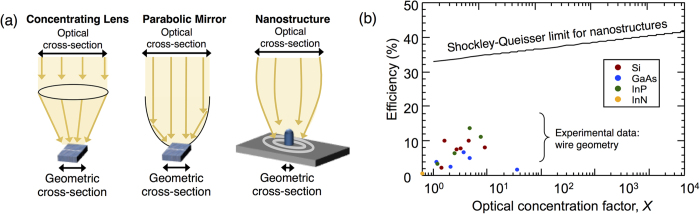
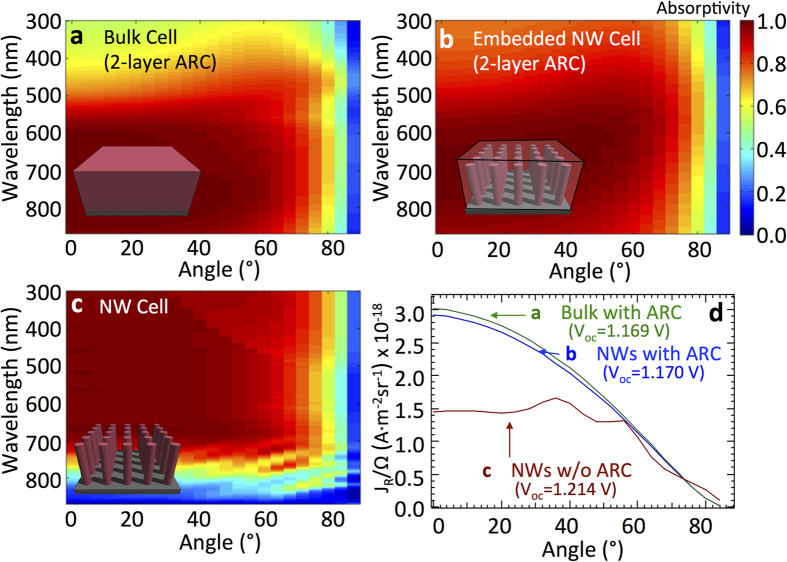
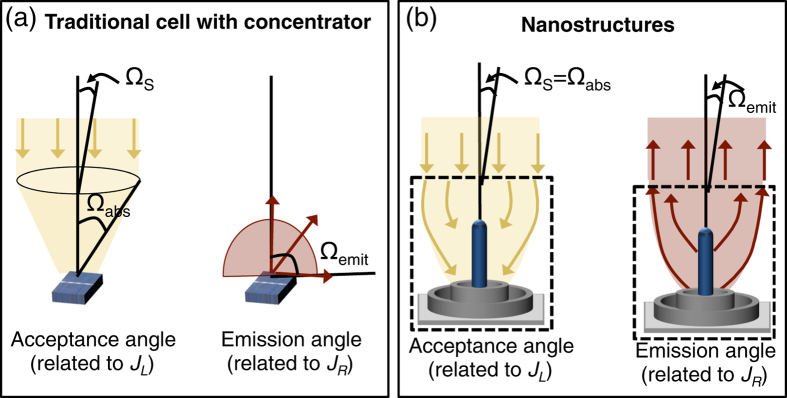
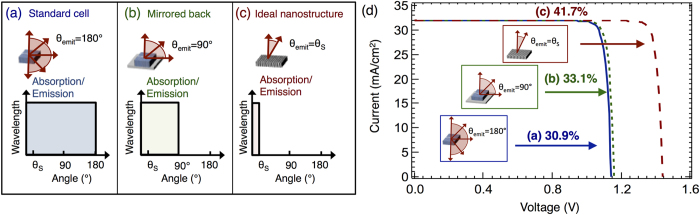
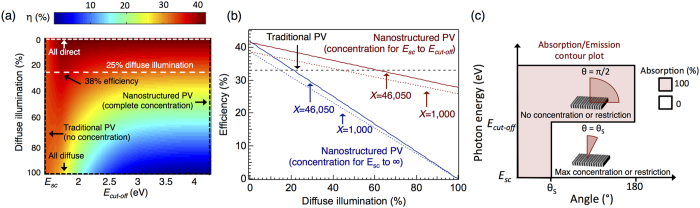
The Shockley-Queisser limit describes the maximum solar energy conversion efficiency achievable for a particular material and is the standard by which new photovoltaic technologies are compared. This limit is based on the principle of detailed balance, which equates the photon flux into a device to the particle flux (photons or electrons) out of that device. Nanostructured solar cells represent a novel class of photovoltaic devices, and questions have been raised about whether or not they can exceed the Shockley-Queisser limit. Here we show that single-junction nanostructured solar cells have a theoretical maximum efficiency of ∼42% under AM 1.5 solar illumination. While this exceeds the efficiency of a non-concentrating planar device, it does not exceed the Shockley-Queisser limit for a planar device with optical concentration. We consider the effect of diffuse illumination and find that with optical concentration from the nanostructures of only × 1,000, an efficiency of 35.5% is achievable even with 25% diffuse illumination. We conclude that nanostructured solar cells offer an important route towards higher efficiency photovoltaic devices through a built-in optical concentration.
肖克利-奎塞尔极限描述了特定材料可实现的最大太阳能转换效率,是用于比较新型光伏技术的标准。这个极限基于细致平衡原理,该原理将进入器件的光子通量与离开该器件的粒子通量(光子或电子)等同起来。纳米结构太阳能电池代表了一类新型光伏器件,人们对它们是否能超过肖克利-奎塞尔极限提出了疑问。在此我们表明,单结纳米结构太阳能电池在AM 1.5太阳光照下理论最大效率约为42%。虽然这超过了非聚光平面器件的效率,但并未超过具有光学聚光的平面器件的肖克利-奎塞尔极限。我们考虑了漫射光的影响,发现仅通过纳米结构实现1000倍的光学聚光,即使有25%的漫射光,也能实现35.5%的效率。我们得出结论,纳米结构太阳能电池通过内置光学聚光为实现更高效率的光伏器件提供了一条重要途径。