Tomita Yohei, Kurihara Toshihide, Uchida Atsuro, Nagai Norihiro, Shinoda Hajime, Tsubota Kazuo, Ozawa Yoko
Department of Ophthalmology, Keio University School of Medicine, Tokyo, Japan.
Sci Rep. 2015 Sep 2;5:13256. doi: 10.1038/srep13256.
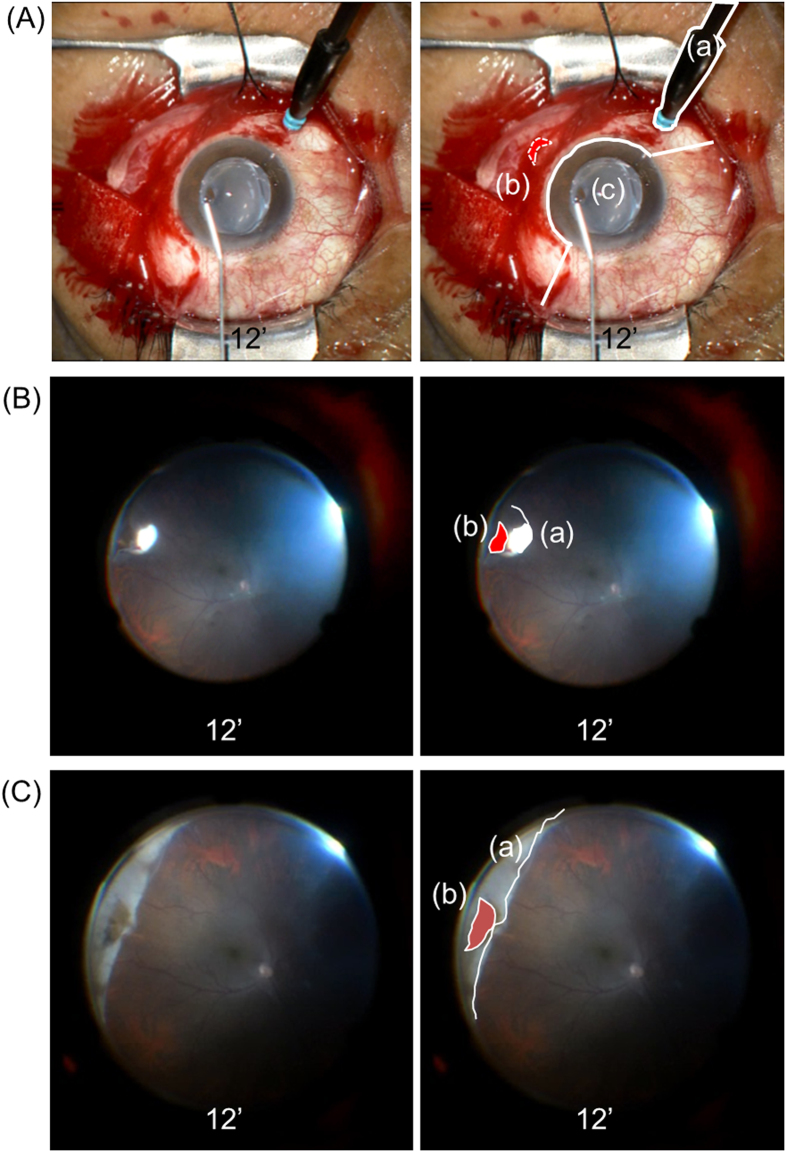
Wide-angle viewing systems (WAVSs) were originally established for pars plana vitrectomy. However, their application to scleral buckling surgery was recently reported. In this study, we compared the outcomes of scleral buckling using a noncontact WAVS with that of scleral buckling using conventional indirect ophthalmoscopy for rhegmatogenous retinal detachment. The clinical records of 39 eyes (39 patients) with rhegmatogenous retinal detachment primarily treated between November 2012 and June 2014 at the Vitreo-Retina Surgical Division Clinic at the Department of Ophthalmology, Keio University Hospital were retrospectively reviewed. Scleral bucking was performed using WAVS with surgical placement of an endoilluminator in 16 eyes and indirect ophthalmoscopy in 23 eyes. The patients in these groups were consecutive over different intervals. The preoperative demographics, success rate of retinal reattachment, intraoperative findings, and postoperative complications were evaluated. There were no significant differences in pre- or postoperative conditions between groups, and similar surgical outcomes were achieved with the WAVS and conventional procedures. However, compared with the conventional procedure, the WAVS procedure resulted in fewer intraoperative corneal epithelial disorders (p = 0.049) and decreased the surgical duration of segmental buckling (p = 0.02); therefore, it may be suggested as an effective alternative procedure.
广角观察系统(WAVS)最初是为玻璃体视网膜切除术而建立的。然而,最近有报道称其可应用于巩膜扣带术。在本研究中,我们比较了使用非接触式WAVS进行巩膜扣带术与使用传统间接检眼镜进行巩膜扣带术治疗孔源性视网膜脱离的效果。回顾性分析了2012年11月至2014年6月间在庆应义塾大学医院眼科玻璃体视网膜手术科门诊接受初次治疗的39例(39只眼)孔源性视网膜脱离患者的临床记录。16只眼使用带有内置照明器的WAVS进行巩膜扣带术,23只眼使用间接检眼镜进行巩膜扣带术。这些组中的患者在不同时间段内连续入选。评估了术前人口统计学特征、视网膜复位成功率、术中发现及术后并发症。两组术前或术后情况无显著差异,WAVS和传统手术取得了相似的手术效果。然而,与传统手术相比,WAVS手术导致术中角膜上皮病变较少(p = 0.049),并缩短了节段性扣带的手术时间(p = 0.02);因此,它可能是一种有效的替代手术方法。