Khan Shahid N, Charlier Cyril, Augustyniak Rafal, Salvi Nicola, Déjean Victoire, Bodenhausen Geoffrey, Lequin Olivier, Pelupessy Philippe, Ferrage Fabien
Département de Chimie, École Normale Supérieure-PSL Research University, Paris, France; Sorbonne Universités, UPMC Univ Paris 06, LBM, Paris, France; Centre National de la Recherche Scientifique, UMR 7203 LBM, Paris, France.
Institut des Sciences et Ingénierie Chimiques, École Polytechnique Fédérale de Lausanne, BCH, Lausanne, Switzerland.
Biophys J. 2015 Sep 1;109(5):988-99. doi: 10.1016/j.bpj.2015.06.069.
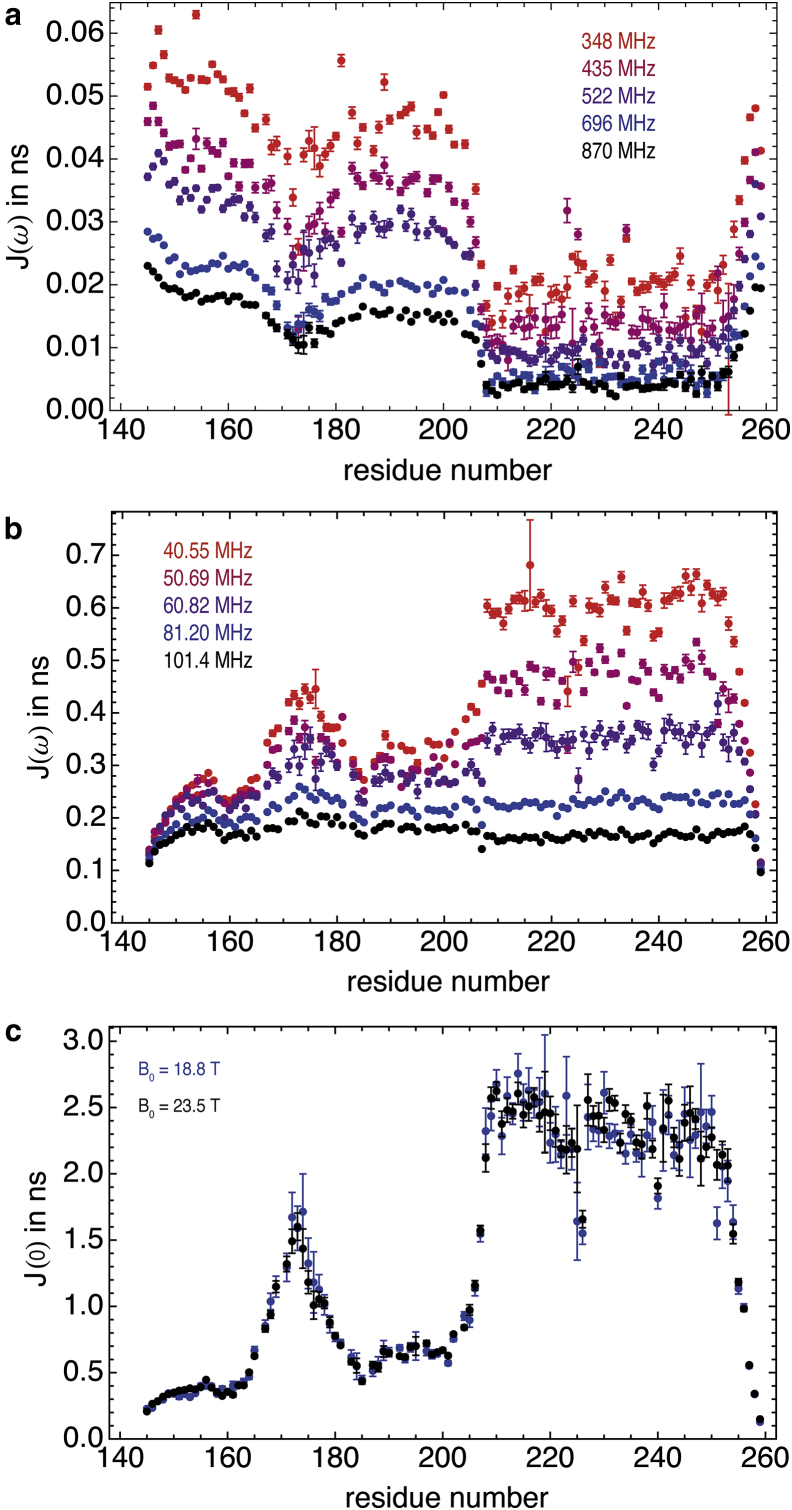
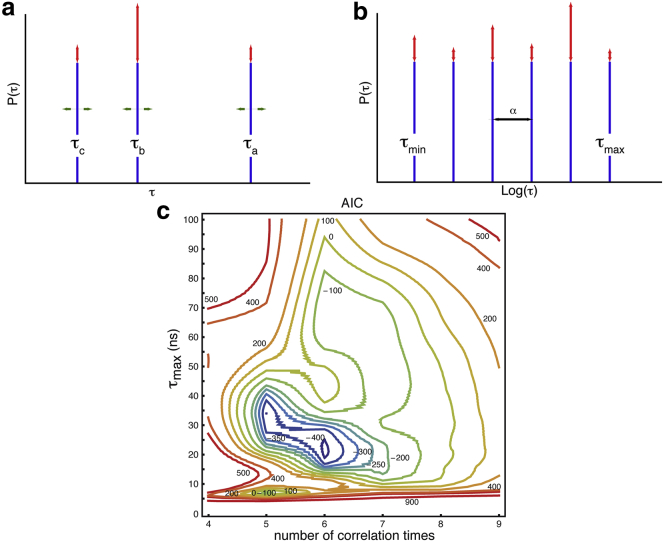
Intrinsically disordered proteins and intrinsically disordered regions (IDRs) are ubiquitous in the eukaryotic proteome. The description and understanding of their conformational properties require the development of new experimental, computational, and theoretical approaches. Here, we use nuclear spin relaxation to investigate the distribution of timescales of motions in an IDR from picoseconds to nanoseconds. Nitrogen-15 relaxation rates have been measured at five magnetic fields, ranging from 9.4 to 23.5 T (400-1000 MHz for protons). This exceptional wealth of data allowed us to map the spectral density function for the motions of backbone NH pairs in the partially disordered transcription factor Engrailed at 11 different frequencies. We introduce an approach called interpretation of motions by a projection onto an array of correlation times (IMPACT), which focuses on an array of six correlation times with intervals that are equidistant on a logarithmic scale between 21 ps and 21 ns. The distribution of motions in Engrailed varies smoothly along the protein sequence and is multimodal for most residues, with a prevalence of motions around 1 ns in the IDR. We show that IMPACT often provides better quantitative agreement with experimental data than conventional model-free or extended model-free analyses with two or three correlation times. We introduce a graphical representation that offers a convenient platform for a qualitative discussion of dynamics. Even when relaxation data are only acquired at three magnetic fields that are readily accessible, the IMPACT analysis gives a satisfactory characterization of spectral density functions, thus opening the way to a broad use of this approach.
内在无序蛋白和内在无序区域(IDR)在真核生物蛋白质组中普遍存在。对其构象性质的描述和理解需要开发新的实验、计算和理论方法。在此,我们利用核自旋弛豫来研究一个IDR中从皮秒到纳秒时间尺度的运动分布。已在五个磁场(从9.4到23.5 T,质子频率为400 - 1000 MHz)下测量了氮-15弛豫率。这些异常丰富的数据使我们能够绘制出部分无序转录因子Engrailed中主链NH对在11个不同频率下运动的谱密度函数。我们引入了一种称为通过投影到相关时间阵列上解释运动(IMPACT)的方法,该方法聚焦于六个相关时间的阵列,其间隔在对数尺度上在21皮秒和21纳秒之间等距分布。Engrailed中的运动分布沿蛋白质序列平滑变化,并且对于大多数残基是多峰的,在IDR中1纳秒左右的运动占主导。我们表明,与具有两个或三个相关时间的传统无模型或扩展无模型分析相比,IMPACT通常能与实验数据提供更好的定量一致性。我们引入了一种图形表示法,为动力学的定性讨论提供了一个方便的平台。即使仅在三个易于获取的磁场下获取弛豫数据,IMPACT分析也能对谱密度函数给出令人满意的表征,从而为广泛使用这种方法开辟了道路。