Lychou Sara E, Gustafsson Göran G, Ljungman Gustaf E
Department of Women's and Children's Health, Uppsala University, Uppsala, Sweden.
Childhood Cancer Research Unit, Karolinska Institute, Stockholm, Sweden.
Acta Paediatr. 2016 Jan;105(1):74-81. doi: 10.1111/apa.13172. Epub 2015 Nov 4.
Positive outcomes for paediatric rhabdomyosarcoma (RMS) were high in Sweden during the 1990s, but the last decade has seen decreasing trends in overall survival rates. We investigated the incidence, patient and disease characteristics, treatment and outcome of RMS to see whether any reason could be found for this decline.
This study included 210 children under the age of 15 who were diagnosed with RMS and whose details were recorded in the population-based Swedish Childhood Cancer Registry from 1984 to 2010.
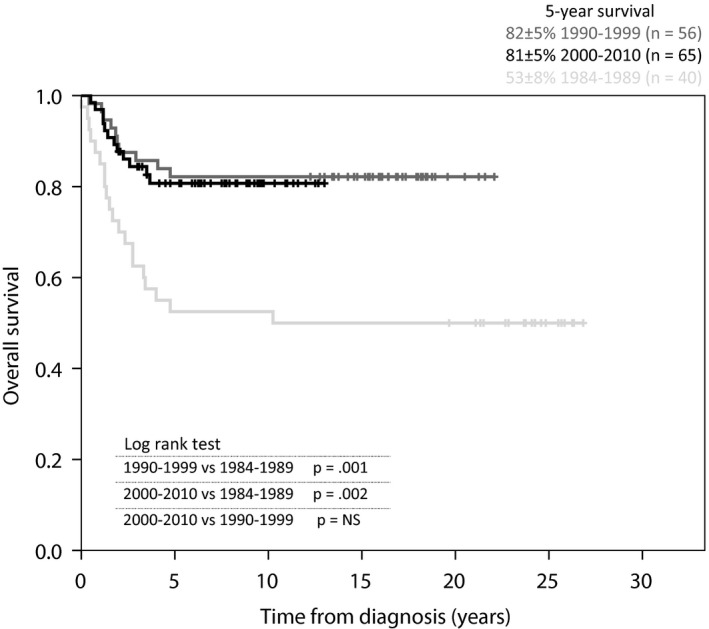
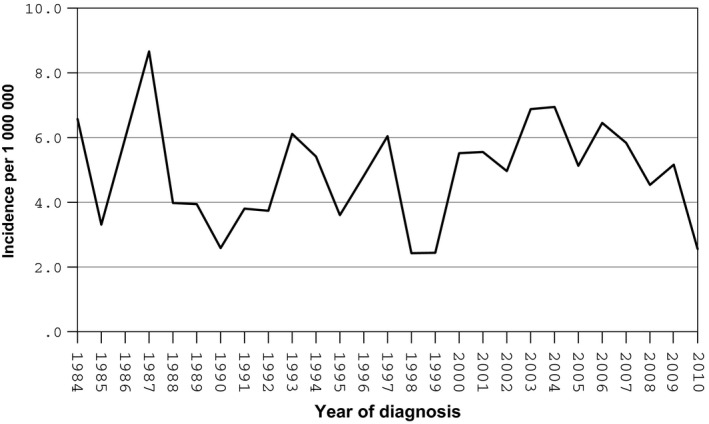
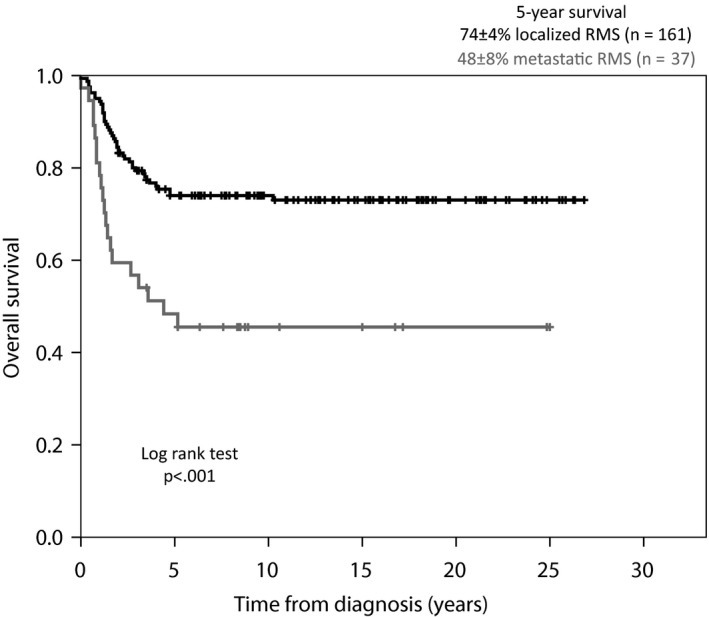
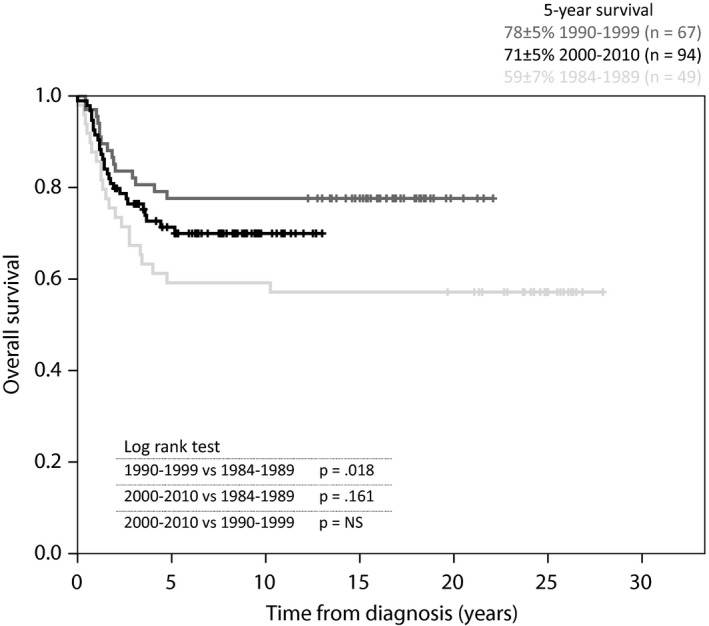
The overall annual incidence of RMS was 4.9 per million, and the 5-year overall survival rates were 59 ± 7% in 1984-1989, 78 ± 5% in 1990-1999 and 71 ± 5% in 2000-2010. When patients with localised disease were analysed separately, there was no difference in the 5-year survival rates between 1990 and 1999 (82 ± 5%) and 2000-2010 (81 ± 5%), but the outcome in 1984-1989 (53 ± 8%) was significantly worse. The prevalence of metastatic disease was unexpectedly high during 2000-2010 (28%, p = 0.010), compared to an overall mean of 18% for the whole study period.
Our results suggest that a higher rate of metastatic disease may explain the declining trend in overall survival rates in paediatric RMS in Sweden over the last decade.
20世纪90年代瑞典小儿横纹肌肉瘤(RMS)的阳性预后率较高,但在过去十年中总体生存率呈下降趋势。我们调查了RMS的发病率、患者及疾病特征、治疗方法和预后情况,以探寻导致这种下降的原因。
本研究纳入了210名15岁以下被诊断为RMS的儿童,其详细信息记录于1984年至2010年基于人群的瑞典儿童癌症登记处。
RMS的总体年发病率为每百万4.9例,1984 - 1989年的5年总体生存率为59±7%,1990 - 1999年为78±5%,2000 - 2010年为71±5%。当单独分析局限性疾病患者时,1990年至1999年(82±5%)和2000 - 2010年(81±5%)的5年生存率无差异,但1984 - 1989年(53±8%)的预后明显更差。与整个研究期间18%的总体平均水平相比,2000 - 2010年转移性疾病的患病率意外地高(28%,p = 0.010)。
我们的结果表明,转移性疾病发生率较高可能解释了过去十年瑞典小儿RMS总体生存率下降的趋势。