Hirsch A G, Yan X S, Sundaresan A S, Tan B K, Schleimer R P, Kern R C, Kennedy T L, Greene J S, Schwartz B S
Center for Health Research, Geisinger Health System, Danville, PA, USA.
Research Development and Dissemination, Sutter Health, San Franciso.
Allergy. 2015 Dec;70(12):1613-21. doi: 10.1111/all.12759. Epub 2015 Sep 25.
Chronic rhinosinusitis (CRS) has a broad range of comorbidities. Due to a lack of longitudinal studies, it is not known whether these comorbidities cause CRS, are promoted by CRS, or share a systemic disease process with CRS.
The objective of this study was to determine the risk of incident disease within 5 years after a new diagnosis of CRS with nasal polyps (CRSwNP) and without nasal polyps (CRSsNP).
We conducted a case-control study nested within the longitudinal cohort of primary care patients in the Geisinger Clinic using electronic health record data. We evaluated incident disease over 5 years in newly diagnosed CRSwNP and CRSsNP cases compared to controls using multivariable Cox regression models.
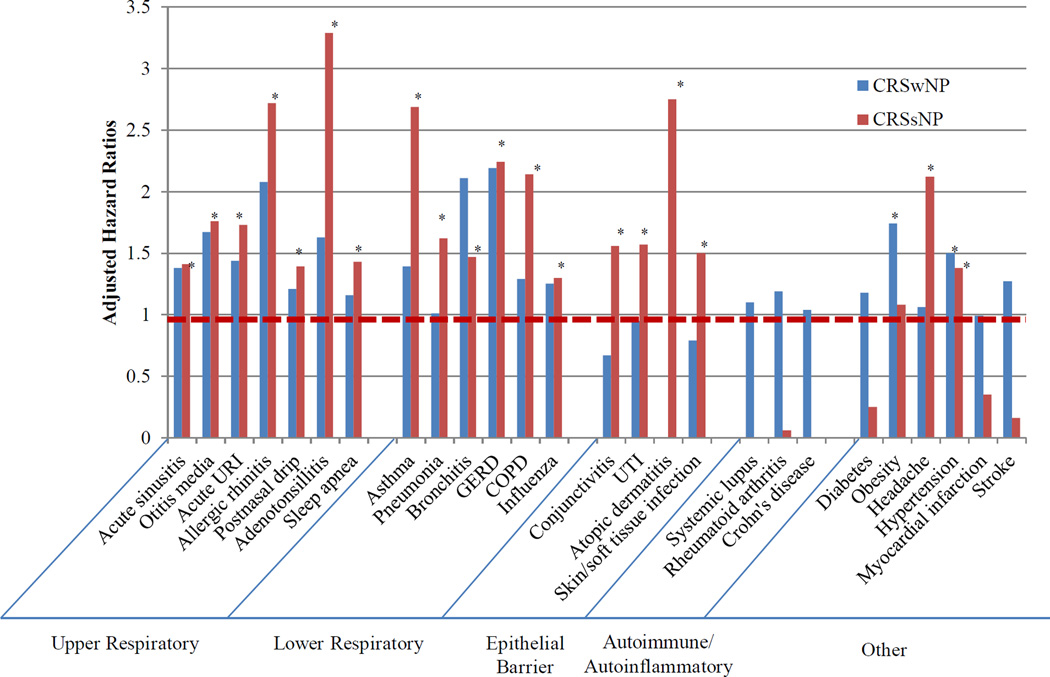
CRSsNP (n = 3612) cases were at greater risk (HR, 95% confidence interval) than controls for incidence of: upper airway diseases, including adenotonsillitis (3.29, 2.41-4.50); lower aerodigestive tract diseases, including asthma (2.69, 2.14-3.38); epithelial conditions, including atopic dermatitis (2.75, 1.23-6.16); and hypertension (1.38, 1.19-1.61). CRSwNP (n = 241) cases were at greater risk for obesity than controls (1.74, 1.08-2.80), but CRSwNP was not associated with other diseases.
The risk of other diseases associated with CRS adds to the burden of an already highly burdensome condition, and suggests either that CRS promotes onset of other diseases or is an indicator of systemic disease processes. Different patterns of association with diseases by CRS phenotype may be due to CRSwNP sample size limitations or reflect a different pattern of disease onset by phenotype. These findings have implications for screening guidelines and care of CRS patients.
慢性鼻-鼻窦炎(CRS)有广泛的合并症。由于缺乏纵向研究,尚不清楚这些合并症是导致CRS、由CRS促发,还是与CRS共享一个全身性疾病过程。
本研究的目的是确定新诊断的伴有鼻息肉的慢性鼻-鼻窦炎(CRSwNP)和不伴有鼻息肉的慢性鼻-鼻窦炎(CRSsNP)患者在5年内发生疾病的风险。
我们利用电子健康记录数据,在盖辛格诊所初级保健患者的纵向队列中开展了一项病例对照研究。我们使用多变量Cox回归模型,评估新诊断的CRSwNP和CRSsNP病例与对照组相比5年内发生的疾病。
CRSsNP(n = 3612)病例发生以下疾病的风险高于对照组(风险比,95%置信区间):上呼吸道疾病,包括腺样体扁桃体炎(3.29,2.41 - 4.50);下气道消化道疾病,包括哮喘(2.69,2.14 - 3.38);上皮疾病,包括特应性皮炎(2.75,1.23 - 6.16);以及高血压(1.38,1.19 - 1.61)。CRSwNP(n = 241)病例发生肥胖的风险高于对照组(1.74,1.08 - 2.80),但CRSwNP与其他疾病无关。
与CRS相关的其他疾病风险增加了这种本已负担沉重疾病的负担,这表明CRS要么促进其他疾病的发生,要么是全身性疾病过程的一个指标。CRS表型与疾病的不同关联模式可能是由于CRSwNP样本量限制,或者反映了不同表型的疾病发病模式。这些发现对CRS患者的筛查指南和治疗具有启示意义。