Hardy Joseph L, Nelson Rolf A, Thomason Moriah E, Sternberg Daniel A, Katovich Kiefer, Farzin Faraz, Scanlon Michael
Department of Research and Development, Lumos Labs, San Francisco, California, United States of America.
Department of Psychology, Wheaton College, Norton, Massachusetts, United States of America.
PLoS One. 2015 Sep 2;10(9):e0134467. doi: 10.1371/journal.pone.0134467. eCollection 2015.
A variety of studies have demonstrated gains in cognitive ability following cognitive training interventions. However, other studies have not shown such gains, and questions remain regarding the efficacy of specific cognitive training interventions. Cognitive training research often involves programs made up of just one or a few exercises, targeting limited and specific cognitive endpoints. In addition, cognitive training studies typically involve small samples that may be insufficient for reliable measurement of change. Other studies have utilized training periods that were too short to generate reliable gains in cognitive performance.
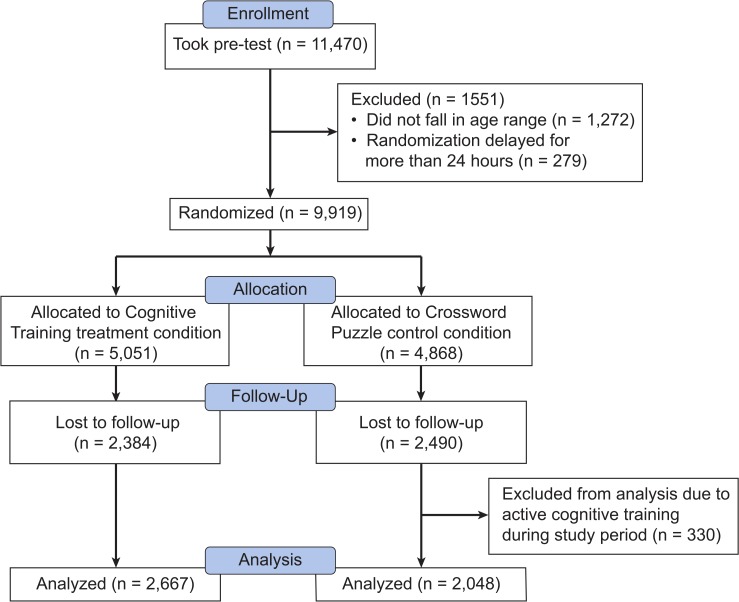
The present study evaluated an online cognitive training program comprised of 49 exercises targeting a variety of cognitive capacities. The cognitive training program was compared to an active control condition in which participants completed crossword puzzles. All participants were recruited, trained, and tested online (N = 4,715 fully evaluable participants). Participants in both groups were instructed to complete one approximately 15-minute session at least 5 days per week for 10 weeks.
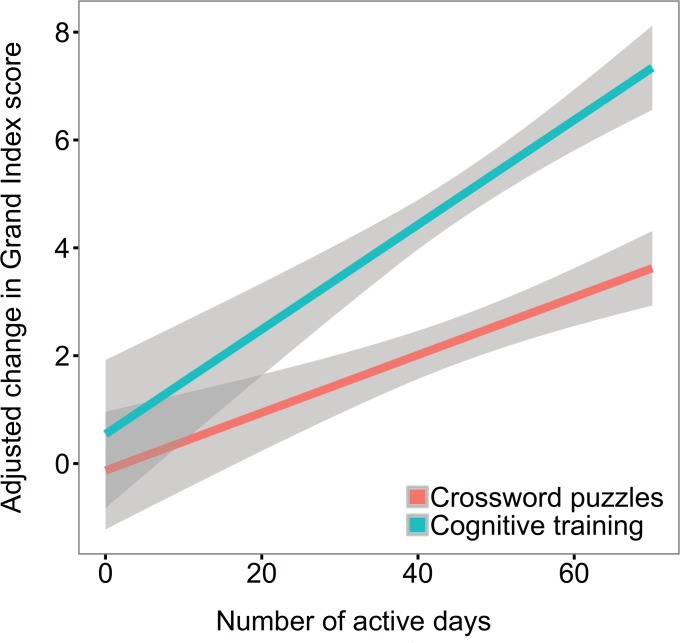
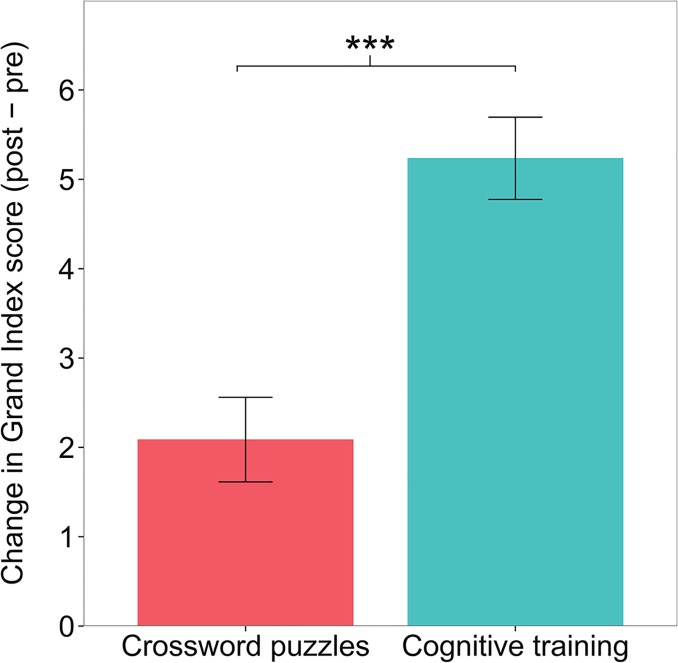
Participants randomly assigned to the treatment group improved significantly more on the primary outcome measure, an aggregate measure of neuropsychological performance, than did the active control group (Cohen's d effect size = 0.255; 95% confidence interval = [0.198, 0.312]). Treatment participants showed greater improvements than controls on speed of processing, short-term memory, working memory, problem solving, and fluid reasoning assessments. Participants in the treatment group also showed greater improvements on self-reported measures of cognitive functioning, particularly on those items related to concentration compared to the control group (Cohen's d = 0.249; 95% confidence interval = [0.191, 0.306]).
Taken together, these results indicate that a varied training program composed of a number of tasks targeted to different cognitive functions can show transfer to a wide range of untrained measures of cognitive performance.
ClinicalTrials.gov NCT-02367898.
多项研究表明,认知训练干预后认知能力有所提高。然而,其他研究并未显示出此类提高,且特定认知训练干预的效果仍存在疑问。认知训练研究通常涉及仅由一项或几项练习组成的项目,针对有限且特定的认知终点。此外,认知训练研究通常涉及小样本,可能不足以可靠地测量变化。其他研究使用的训练期过短,无法在认知表现上产生可靠的提高。
本研究评估了一个在线认知训练项目,该项目由49项针对多种认知能力的练习组成。将该认知训练项目与一个积极对照条件进行比较,在对照条件下参与者完成填字游戏。所有参与者均通过在线方式招募、训练和测试(N = 4715名可完全评估的参与者)。两组参与者均被指示每周至少5天,每次完成约15分钟的训练,持续10周。
随机分配到治疗组的参与者在主要结局指标(一种神经心理学表现的综合指标)上的改善明显大于积极对照组(科恩d效应量 = 0.255;95%置信区间 = [0.198, 0.312])。在处理速度、短期记忆、工作记忆、问题解决和流体推理评估方面,治疗组参与者比对照组有更大的改善。治疗组参与者在自我报告的认知功能测量上也比对照组有更大的改善,特别是在与注意力相关的项目上(科恩d = 0.249;95%置信区间 = [0.191, 0.306])。
综上所述,这些结果表明,一个由针对不同认知功能的多项任务组成的多样化训练项目可以在广泛的未训练认知表现测量中显示出迁移效果。
ClinicalTrials.gov NCT - 02367898。