Neiman Jayme, Giuseffi Karl, Smith Kevin, French Jeffrey, Waismel-Manor Israel, Hibbing John
Department of Political Science, University of Northern Iowa, Cedar Falls, Iowa, United States of America.
Department of Political Science, University of Nebraska-Lincoln, Lincoln, Nebraska, United States of America.
PLoS One. 2015 Sep 3;10(9):e0135289. doi: 10.1371/journal.pone.0135289. eCollection 2015.
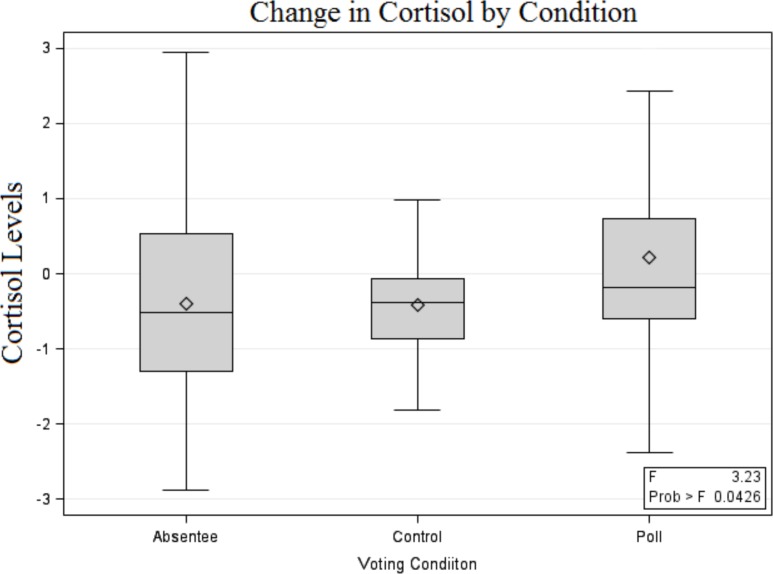
Previous research finds that voting is a socially stressful activity associated with increases in cortisol levels. Here we extend this research by investigating whether different voting modalities have differential effects on the stress response to voting. Results from a field experiment conducted during the 2012 presidential elections strongly suggest that traditional "at the polls" voting is more stressful, as measured by increases in cortisol levels, than voting at home by mail-in ballot or engaging in comparable non-political social activities. These findings imply that increased low-stress voting options such as mail-in ballots may increase political participation among individuals who are sensitive to social stressors.
先前的研究发现,投票是一项会带来社会压力的活动,与皮质醇水平升高有关。在此,我们通过调查不同的投票方式对投票时压力反应是否有不同影响来拓展这项研究。在2012年总统选举期间进行的一项实地实验结果有力地表明,以皮质醇水平升高来衡量,传统的“在投票站”投票比通过邮寄选票在家投票或参与类似的非政治社交活动压力更大。这些发现意味着,增加诸如邮寄选票等低压力投票选项可能会提高对社会压力源敏感的个人的政治参与度。