Department of Government and Political Theory Division, School of Political Science, University of Haifa, Haifa, Israel.
Department of Political Science, The Hebrew University of Jerusalem, Jerusalem, Israel.
PLoS One. 2023 Feb 21;18(2):e0280445. doi: 10.1371/journal.pone.0280445. eCollection 2023.
Over the past decade, researchers have been seeking to understand the consequences of adult attention-deficit/hyperactivity disorder (ADHD) for different types of everyday behaviors. In this study, we investigated the associations between ADHD and political participation and attitudes, as ADHD may impede their active participation in the polity.
This observational study used data from an online panel studying the adult Jewish population in Israel, collected prior the national elections of April 2019 (N = 1369). ADHD symptoms were assessed using the 6-item Adult ADHD Self-Report (ASRS-6). Political participation (traditional and digital), news consumption habits, and attitudinal measures were assessed using structured questionnaires. Multivariate linear regression analyses were conducted to analyze the association between ADHD symptoms (ASRS score <17) and reported political participation and attitudes.
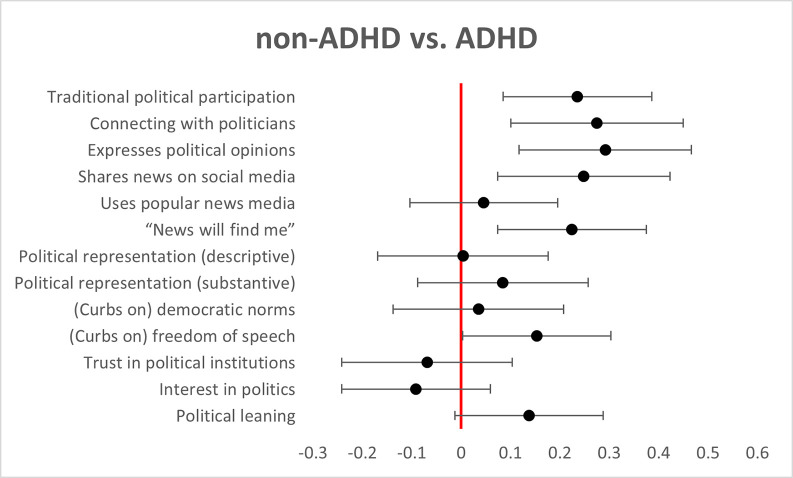
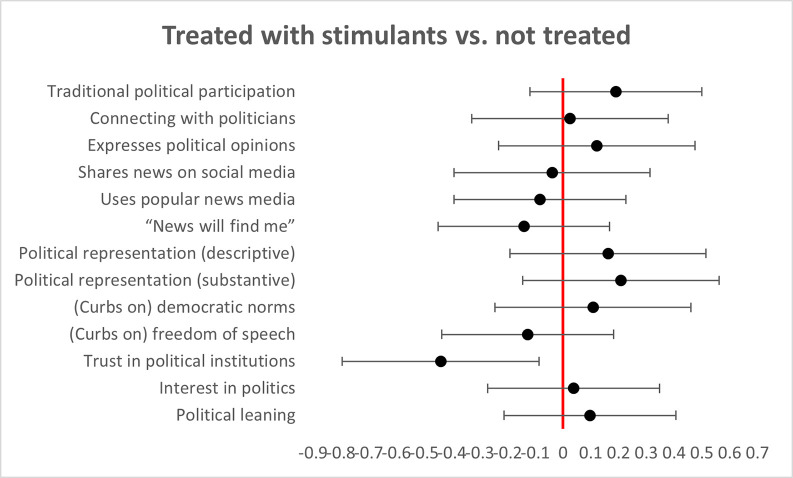
200 respondents (14.6%) screened positive for ADHD based on the ASRS-6. Our findings show that individuals with ADHD are more likely to participate in politics than individuals without ADHD symptoms (B = 0.303, SE = 0.10, p = .003). However, participants with ADHD are more likely to be passive consumers of news, waiting for current political news to reach them instead of actively searching for it (B = 0.172, SE = 0.60, p = .004). They are also more prone to support the idea of silencing other opinions (B = 0.226, SE = 0.10, p = .029). The findings hold when controlling for age, sex, level of education, income, political orientation, religiosity, and stimulant therapy for ADHD symptoms.
Overall, we find evidence that individuals with ADHD display a unique pattern of political activity, including greater participation and less tolerance of others' views, but not necessarily showing greater active interest in politics. Our findings add to a growing body of literature that examines the impact of ADHD on different types of everyday behaviors.
在过去的十年中,研究人员一直在努力了解成人注意力缺陷/多动障碍(ADHD)对不同类型日常行为的影响。在这项研究中,我们调查了 ADHD 与政治参与和态度之间的关联,因为 ADHD 可能会阻碍他们积极参与政治活动。
本观察性研究使用了一项针对以色列成年犹太人口的在线面板研究的数据,该研究是在 2019 年 4 月全国选举之前收集的(N=1369)。使用 6 项成人 ADHD 自我报告量表(ASRS-6)评估 ADHD 症状。使用结构化问卷评估政治参与(传统和数字)、新闻消费习惯和态度衡量指标。采用多元线性回归分析来分析 ADHD 症状(ASRS 评分<17)与报告的政治参与和态度之间的关联。
根据 ASRS-6,200 名受访者(14.6%)筛查出 ADHD 阳性。我们的研究结果表明,患有 ADHD 的个体比没有 ADHD 症状的个体更有可能参与政治活动(B=0.303,SE=0.10,p=0.003)。然而,患有 ADHD 的参与者更有可能是新闻的被动消费者,等待当前政治新闻传达到他们,而不是主动搜索新闻(B=0.172,SE=0.60,p=0.004)。他们也更倾向于支持压制他人观点的想法(B=0.226,SE=0.10,p=0.029)。在控制年龄、性别、教育水平、收入、政治取向、宗教信仰和 ADHD 症状的兴奋剂治疗后,研究结果仍然成立。
总的来说,我们有证据表明,患有 ADHD 的个体表现出一种独特的政治活动模式,包括更多的参与和对他人观点的更少容忍,但不一定表现出对政治更大的积极兴趣。我们的研究结果增加了越来越多的文献,这些文献研究了 ADHD 对不同类型日常行为的影响。