
SwissPalm:蛋白质棕榈酰化数据库。
SwissPalm: Protein Palmitoylation database.
作者信息
Blanc Mathieu, David Fabrice, Abrami Laurence, Migliozzi Daniel, Armand Florence, Bürgi Jérôme, van der Goot Françoise Gisou
机构信息
Global Health Institute, School of Life Sciences, Ecole Polytechnique Fédérale de Lausanne (EPFL), Lausanne, CH-1015, Switzerland.
Bioinformatics and biostatistics Core Facility, School of Life Sciences, Ecole Polytechnique Fédérale de Lausanne (EPFL), Lausanne, CH-1015, Switzerland.
出版信息
F1000Res. 2015 Jul 16;4:261. doi: 10.12688/f1000research.6464.1. eCollection 2015.
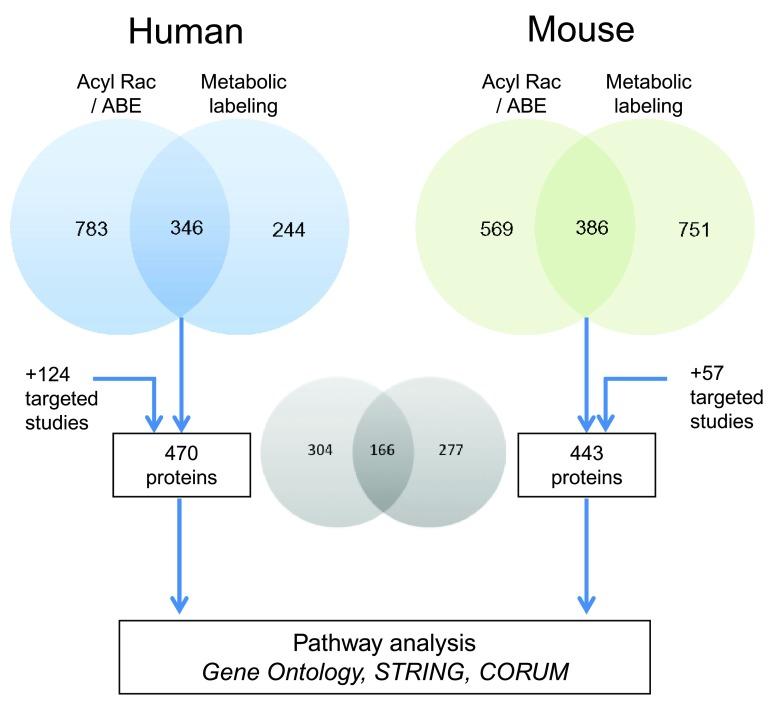
Protein S-palmitoylation is a reversible post-translational modification that regulates many key biological processes, although the full extent and functions of protein S-palmitoylation remain largely unexplored. Recent developments of new chemical methods have allowed the establishment of palmitoyl-proteomes of a variety of cell lines and tissues from different species. As the amount of information generated by these high-throughput studies is increasing, the field requires centralization and comparison of this information. Here we present SwissPalm ( http://swisspalm.epfl.ch), our open, comprehensive, manually curated resource to study protein S-palmitoylation. It currently encompasses more than 5000 S-palmitoylated protein hits from seven species, and contains more than 500 specific sites of S-palmitoylation. SwissPalm also provides curated information and filters that increase the confidence in true positive hits, and integrates predictions of S-palmitoylated cysteine scores, orthologs and isoform multiple alignments. Systems analysis of the palmitoyl-proteome screens indicate that 10% or more of the human proteome is susceptible to S-palmitoylation. Moreover, ontology and pathway analyses of the human palmitoyl-proteome reveal that key biological functions involve this reversible lipid modification. Comparative analysis finally shows a strong crosstalk between S-palmitoylation and other post-translational modifications. Through the compilation of data and continuous updates, SwissPalm will provide a powerful tool to unravel the global importance of protein S-palmitoylation.
蛋白质S-棕榈酰化是一种可逆的翻译后修饰,它调节着许多关键的生物学过程,尽管蛋白质S-棕榈酰化的全部范围和功能在很大程度上仍未被探索。新化学方法的最新进展使得建立来自不同物种的多种细胞系和组织的棕榈酰蛋白质组成为可能。随着这些高通量研究产生的信息量不断增加,该领域需要对这些信息进行集中和比较。在这里,我们展示了SwissPalm(http://swisspalm.epfl.ch),这是我们用于研究蛋白质S-棕榈酰化的开放、全面、人工策划的资源。它目前包含来自七个物种的5000多个S-棕榈酰化蛋白质命中结果,并包含500多个S-棕榈酰化的特定位点。SwissPalm还提供经过策划的信息和筛选器,以提高对真正阳性命中结果的信心,并整合S-棕榈酰化半胱氨酸得分、直系同源物和异构体多序列比对的预测。对棕榈酰蛋白质组筛选的系统分析表明,10%或更多的人类蛋白质组易受S-棕榈酰化影响。此外,对人类棕榈酰蛋白质组的本体和通路分析表明,关键的生物学功能涉及这种可逆的脂质修饰。比较分析最终显示S-棕榈酰化与其他翻译后修饰之间存在强烈的相互作用。通过数据的汇编和持续更新,SwissPalm将提供一个强大的工具来揭示蛋白质S-棕榈酰化的全球重要性。



 Zotero 插件