Frykberg Robert G, Banks Jaminelli
Phoenix VA Health Care System , Phoenix, Arizona.
Adv Wound Care (New Rochelle). 2015 Sep 1;4(9):560-582. doi: 10.1089/wound.2015.0635.
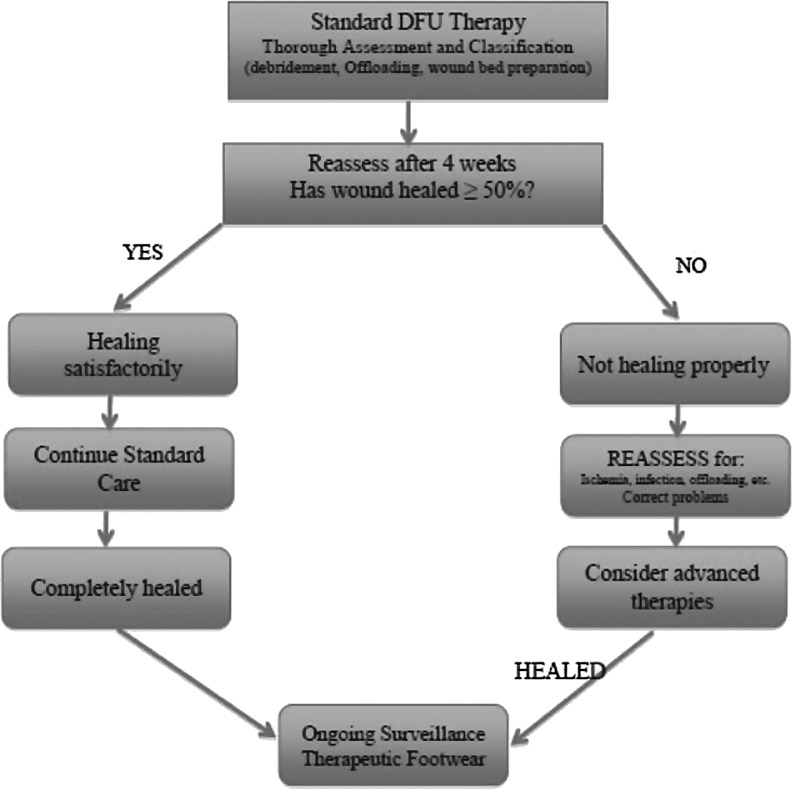
Chronic wounds include, but are not limited, to diabetic foot ulcers, venous leg ulcers, and pressure ulcers. They are a challenge to wound care professionals and consume a great deal of healthcare resources around the globe. This review discusses the pathophysiology of complex chronic wounds and the means and modalities currently available to achieve healing in such patients. Although often difficult to treat, an understanding of the underlying pathophysiology and specific attention toward managing these perturbations can often lead to successful healing. Overcoming the factors that contribute to delayed healing are key components of a comprehensive approach to wound care and present the primary challenges to the treatment of chronic wounds. When wounds fail to achieve sufficient healing after 4 weeks of standard care, reassessment of underlying pathology and consideration of the need for advanced therapeutic agents should be undertaken. However, selection of an appropriate therapy is often not evidence based. Basic tenets of care need to be routinely followed, and a systematic evaluation of patients and their wounds will also facilitate appropriate care. Underlying pathologies, which result in the failure of these wounds to heal, differ among various types of chronic wounds. A better understanding of the differences between various types of chronic wounds at the molecular and cellular levels should improve our treatment approaches, leading to better healing rates, and facilitate the development of new more effective therapies. More evidence for the efficacy of current and future advanced wound therapies is required for their appropriate use.
慢性伤口包括但不限于糖尿病足溃疡、下肢静脉溃疡和压疮。它们对伤口护理专业人员来说是一项挑战,并且在全球范围内消耗大量医疗资源。本综述讨论了复杂慢性伤口的病理生理学以及目前可用于此类患者实现愈合的方法和方式。尽管通常难以治疗,但了解潜在的病理生理学并特别关注处理这些干扰因素通常可导致伤口成功愈合。克服导致愈合延迟的因素是伤口护理综合方法的关键组成部分,也是慢性伤口治疗面临的主要挑战。当伤口在标准护理4周后未能实现充分愈合时,应重新评估潜在病理并考虑是否需要使用先进的治疗药物。然而,选择合适的治疗方法往往缺乏循证依据。需要常规遵循护理的基本原则,对患者及其伤口进行系统评估也将有助于提供适当的护理。导致这些伤口无法愈合的潜在病理在不同类型的慢性伤口中有所不同。在分子和细胞水平上更好地理解不同类型慢性伤口之间的差异,应能改进我们的治疗方法,提高愈合率,并促进开发新的更有效的治疗方法。需要更多关于当前和未来先进伤口治疗疗效的证据,以便合理使用这些治疗方法。