Li Chao, Liu Cheng, Ma Xiaoying, Wang Aidong, Duan Ruijun, Nawrath Christiane, Komatsuda Takao, Chen Guoxiong
Laboratory of Plant Stress Ecophysiology and Biotechnology, Cold and Arid Regions Environmental and Engineering Research Institute, Chinese Academy of Sciences , Lanzhou 730000 , China ; National Institute of Agrobiological Sciences , Tsukuba, Ibaraki 305-8602 , Japan.
National Institute of Agrobiological Sciences , Tsukuba, Ibaraki 305-8602 , Japan.
Breed Sci. 2015 Sep;65(4):327-32. doi: 10.1270/jsbbs.65.327. Epub 2015 Sep 1.
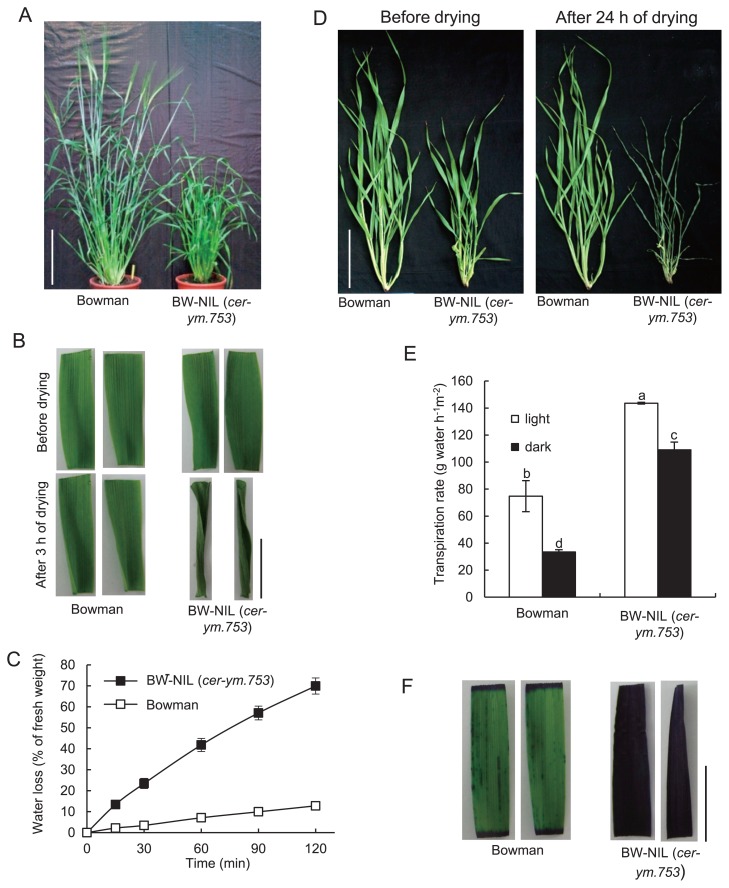
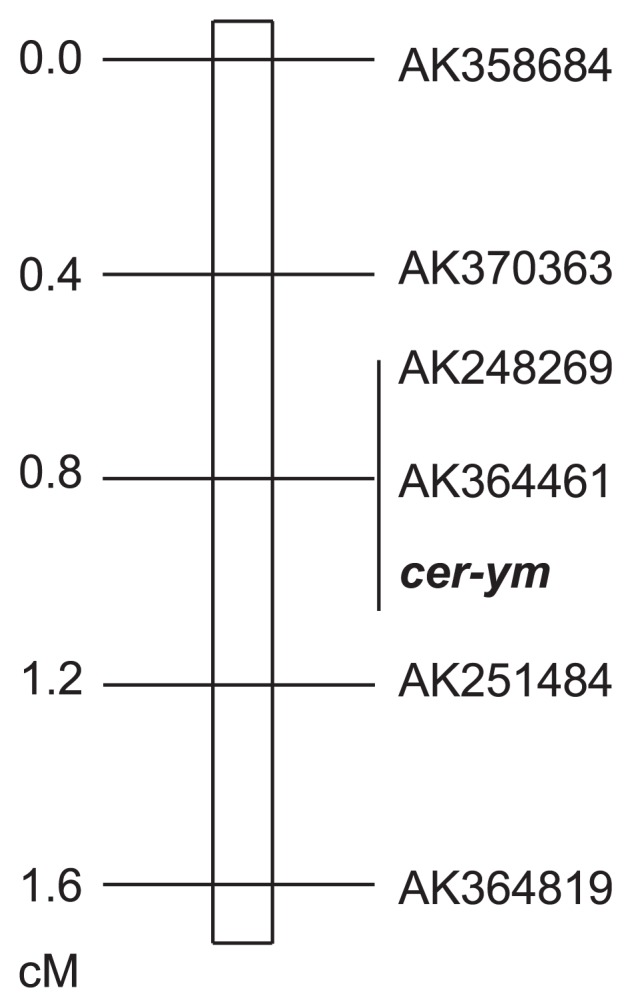
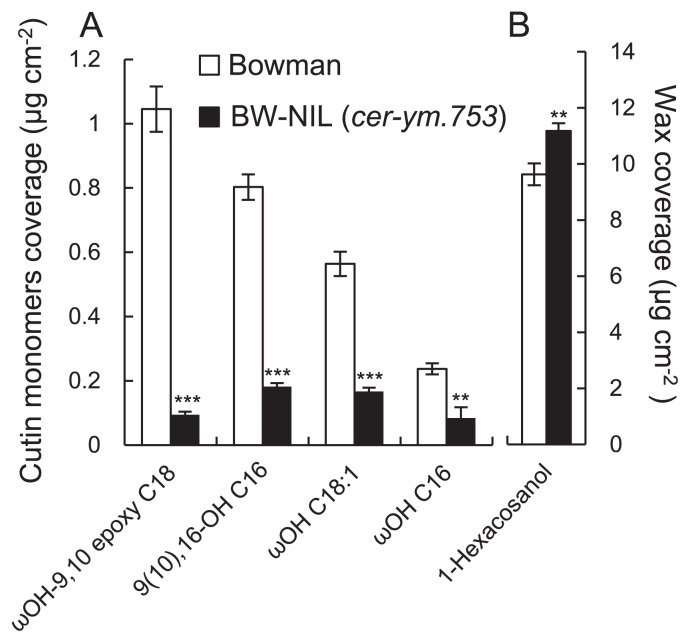
The cuticle covers the aerial parts of land plants, where it serves many important functions, including water retention. Here, a recessive cuticle mutant, eceriferum-ym (cer-ym), of Hordeum vulgare L. (barley) showed abnormally glossy spikes, sheaths, and leaves. The cer-ym mutant plant detached from its root system was hypersensitive to desiccation treatment compared with wild type plants, and detached leaves of mutant lost 41.8% of their initial weight after 1 h of dehydration under laboratory conditions, while that of the wild type plants lost only 7.1%. Stomata function was not affected by the mutation, but the mutant leaves showed increased cuticular permeability to water, suggesting a defective leaf cuticle, which was confirmed by toluidine blue staining. The mutant leaves showed a substantial reduction in the amounts of the major cutin monomers and a slight increase in the main wax component, suggesting that the enhanced cuticle permeability was a consequence of cutin deficiency. cer-ym was mapped within a 0.8 cM interval between EST marker AK370363 and AK251484, a pericentromeric region on chromosome 4H. The results indicate that the desiccation sensitivity of cer-ym is caused by a defect in leaf cutin, and that cer-ym is located in a chromosome 4H pericentromeric region.
角质层覆盖着陆生植物的地上部分,在那里它发挥着许多重要功能,包括保水。在此,大麦(Hordeum vulgare L.)的一个隐性角质层突变体eceriferum-ym(cer-ym)表现出穗、叶鞘和叶片异常有光泽。与野生型植株相比,从根系分离的cer-ym突变体植株对干燥处理高度敏感,在实验室条件下脱水1小时后,突变体的离体叶片失去了其初始重量的41.8%,而野生型植株仅失去7.1%。气孔功能不受该突变影响,但突变体叶片对水分的角质层透性增加,表明叶片角质层存在缺陷,这通过甲苯胺蓝染色得到证实。突变体叶片中主要角质单体的含量大幅减少,主要蜡质成分略有增加,这表明角质层透性增强是角质缺乏的结果。cer-ym被定位在EST标记AK370363和AK251484之间0.8 cM的区间内,位于4H染色体的着丝粒周围区域。结果表明,cer-ym的干燥敏感性是由叶片角质缺陷引起的,且cer-ym位于4H染色体的着丝粒周围区域。