Hong Jeong Hee, Lee Gilho, Choi Han Yong
Department of Urology, Dankook University College of Medicine, Cheonan, Korea.
Department of Urology, Samsung Medical Center, Sungkyunkwan University School of Medicine, Seoul, Korea.
Korean J Urol. 2015 Sep;56(9):656-65. doi: 10.4111/kju.2015.56.9.656. Epub 2015 Aug 31.
Curcumin is a nontoxic, chemopreventive agent possessing multifaceted functions. Our previous study showed that curcumin inhibits androgen receptor (AR) through modulation of Wnt/β-catenin signaling in LNCaP cells. Therefore, we investigated the in vivo effects of curcumin by using LNCaP xenografts.
LNCaP cells were subcutaneously inoculated in Balb/c nude mice. When the tumor volume reached greater than 100 mm(3), either curcumin (500 mg/kg body weight) or vehicle was administered through oral gavage three times weekly for 4 weeks. The expression of AR and intermediate products of Wnt/β-catenin were assessed.
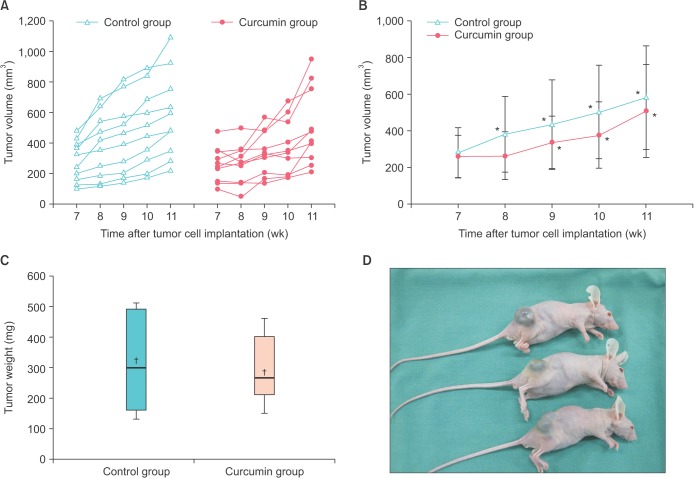
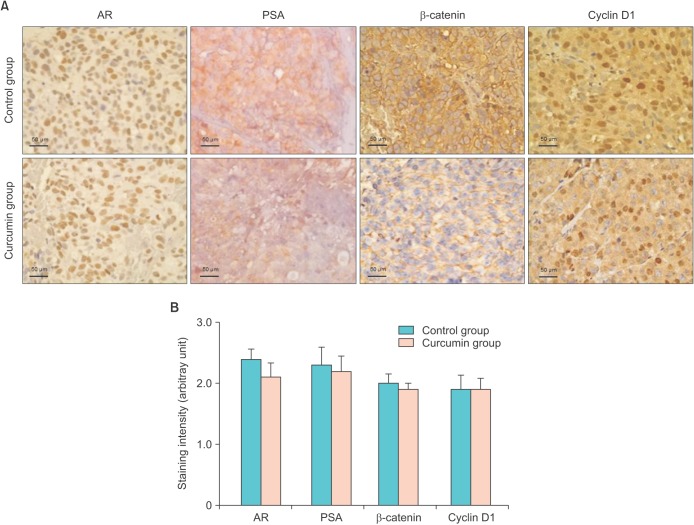
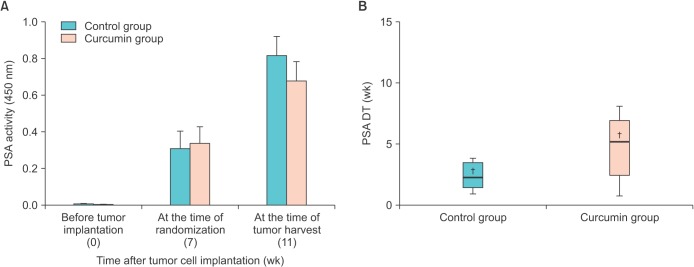
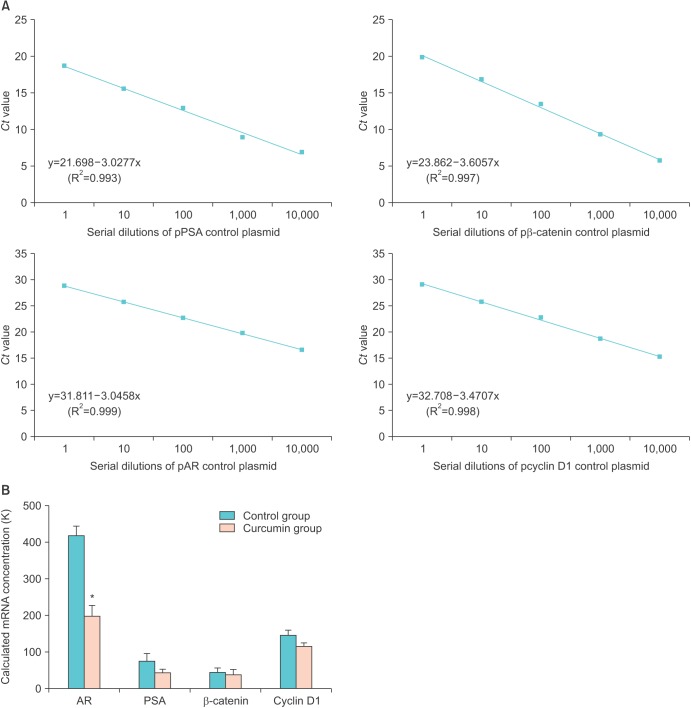
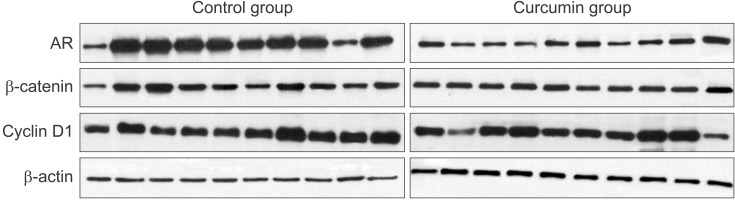
Curcumin had an inhibitory effect on tumor growth during the early period, which was followed by a slow increase in growth over time. Tumor growth was delayed about 27% in the curcumin group. The mean prostate-specific antigen (PSA) doubling time in the curcumin group was approximately twice that in the untreated group. Curcumin significantly decreased AR expression at both the mRNA and protein level. The PSA levels tended to be reduced in the curcumin group. However, there were no significant changes in expression of Wnt/β-catenin pathway intermediates.
This study revealed that curcumin initially interferes with prostate cancer growth by inhibiting AR activity and possibly by reducing PSA expression. Further research is needed to investigate the plausible mechanism of the antiandrogenic action of curcumin.
姜黄素是一种无毒的化学预防剂,具有多方面的功能。我们之前的研究表明,姜黄素通过调节LNCaP细胞中的Wnt/β-连环蛋白信号通路来抑制雄激素受体(AR)。因此,我们使用LNCaP异种移植模型研究了姜黄素的体内作用。
将LNCaP细胞皮下接种到Balb/c裸鼠体内。当肿瘤体积达到大于100立方毫米时,每周通过口服灌胃给予姜黄素(500毫克/千克体重)或赋形剂三次,持续4周。评估AR和Wnt/β-连环蛋白中间产物的表达。
姜黄素在早期对肿瘤生长有抑制作用,随后肿瘤生长随时间缓慢增加。姜黄素组的肿瘤生长延迟了约27%。姜黄素组前列腺特异性抗原(PSA)的平均倍增时间约为未治疗组的两倍。姜黄素在mRNA和蛋白质水平上均显著降低AR表达。姜黄素组的PSA水平有降低趋势。然而,Wnt/β-连环蛋白信号通路中间产物的表达没有显著变化。
本研究表明,姜黄素最初通过抑制AR活性并可能通过降低PSA表达来干扰前列腺癌的生长。需要进一步研究来探讨姜黄素抗雄激素作用的合理机制。