Kenway Bruno, Tam Yu Chuen, Vanat Zebunnisa, Harris Frances, Gray Roger, Birchall John, Carlyon Robert, Axon Patrick
The Addenbrooke's Hospital, Cambridge, UK.
Otol Neurotol. 2015 Sep;36(9):1472-9. doi: 10.1097/MAO.0000000000000845.
To assess differences in pitch-ranking ability across a range of speech understanding performance levels and as a function of electrode position.
An observational study of a cross-section of cochlear implantees.
Tertiary referral center for cochlear implantation.
A total of 22 patients were recruited. All three manufacturers' devices were included (MED-EL, Innsbruck, Austria, n = 10; Advanced Bionics, California, USA, n = 8; and Cochlear, Sydney, Australia, n = 4) and all patients were long-term users (more than 18 months). Twelve of these were poor performers (scores on BKB sentence lists <60%) and 10 were excellent performers (BKB >90%).
After measurement of threshold and comfort levels, and loudness balancing across the array, all patients underwent thorough pitch-ranking assessments at 80% of comfort levels.
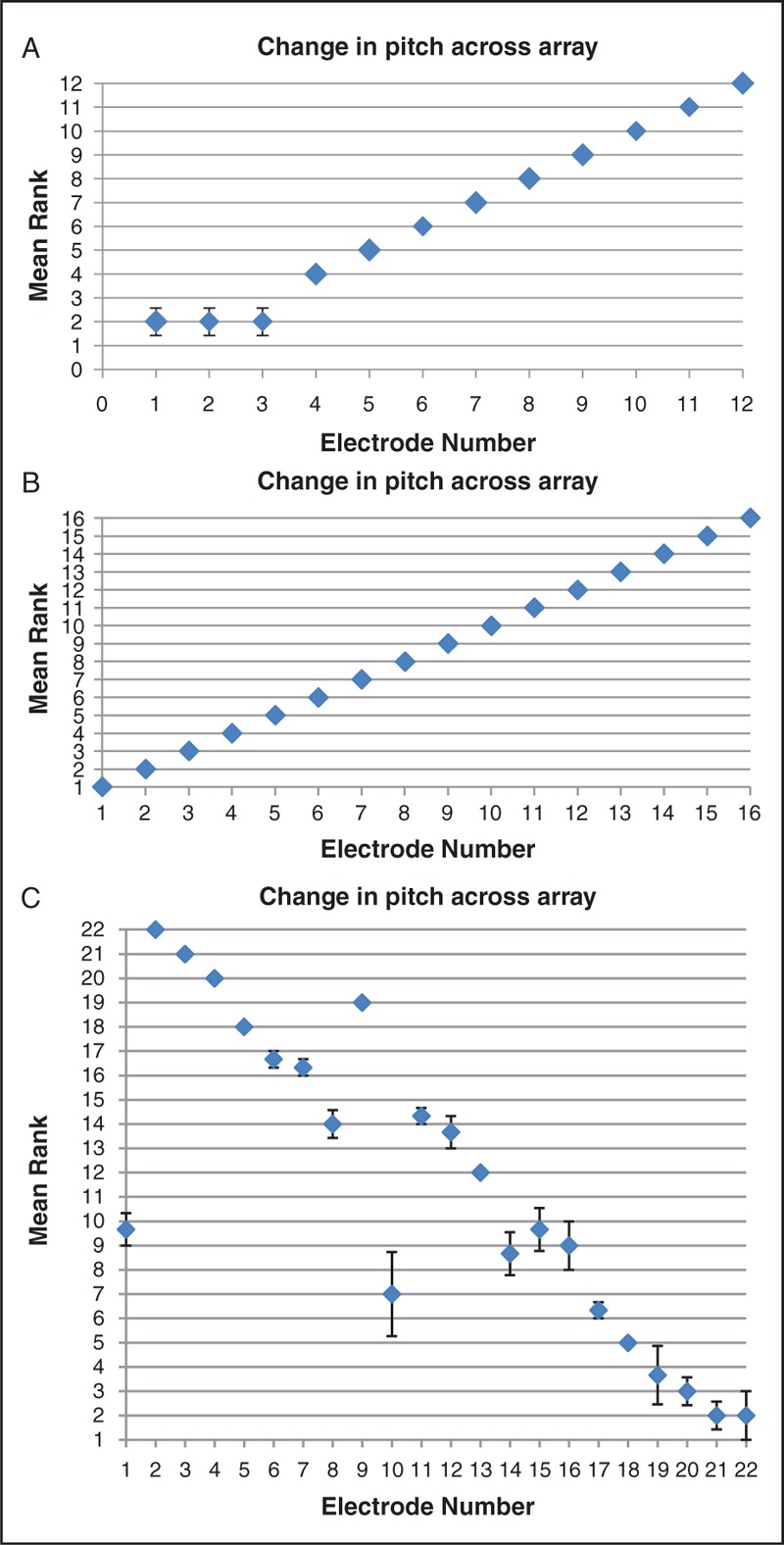
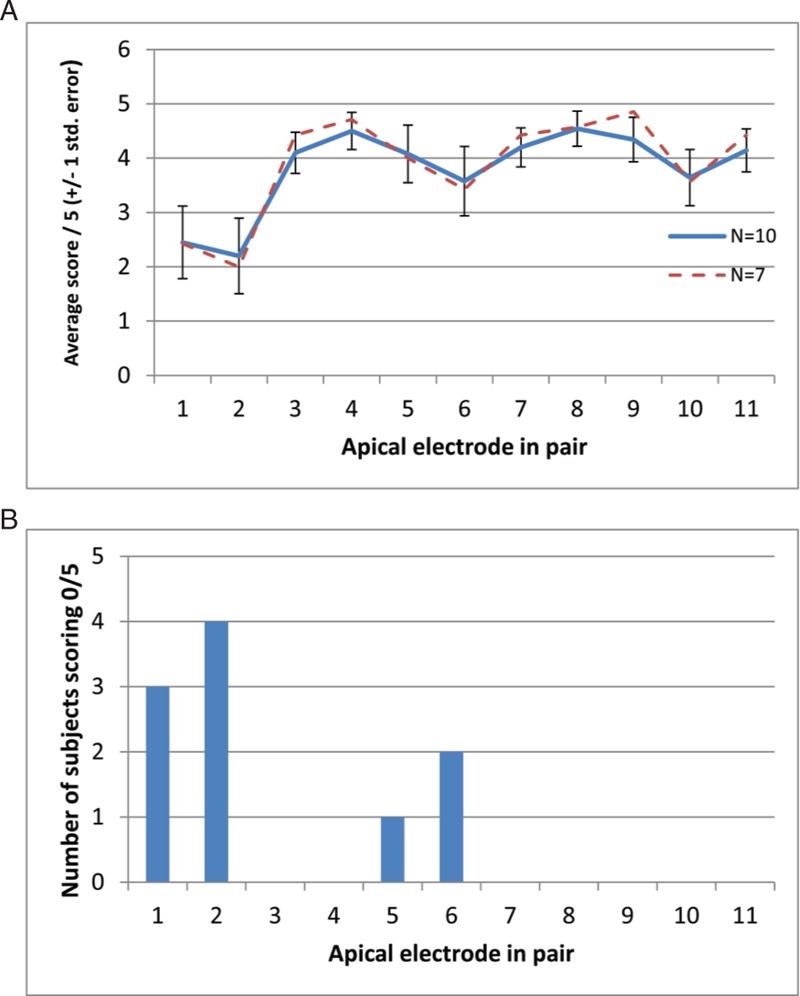
Ability to discriminate pitch across the electrode array, measured by consistency in discrimination of adjacent pairs of electrodes, as well as an assessment of the pitch order across the array using the midpoint comparison task.
Within the poor performing group there was wide variability in ability to pitch rank, from no errors, to a complete inability to reliably and consistently differentiate pitch change across the electrode array. Good performers were overall significantly more accurate at pitch ranking (p = 0.026). Consistent pitch ranking was found to be a significant independent predictor of BKB score, even after adjusting for age. Users of the MED-EL implant experienced significantly more pitch confusions at the apex than at more basal parts of the electrode array.
Many cochlear implant users struggle to discriminate pitch effectively. Accurate pitch ranking appears to be an independent predictor of overall outcome. Future work will concentrate on manipulating maps based upon pitch discrimination findings in an attempt to improve speech understanding.
评估在一系列言语理解表现水平上以及作为电极位置函数的音高排序能力差异。
对一组人工耳蜗植入者的观察性研究。
人工耳蜗植入的三级转诊中心。
共招募了22名患者。纳入了所有三家制造商的设备(奥地利因斯布鲁克的美迪乐公司,n = 10;美国加利福尼亚的先进生物电子公司,n = 8;以及澳大利亚悉尼的科利耳公司,n = 4),所有患者均为长期使用者(超过18个月)。其中12名患者表现较差(BKB句子列表得分<60%),10名患者表现出色(BKB>90%)。
在测量阈值和舒适水平以及整个电极阵列的响度平衡后,所有患者在舒适水平的80%下接受全面的音高排序评估。
通过相邻电极对辨别一致性测量的跨电极阵列辨别音高的能力,以及使用中点比较任务评估的整个阵列的音高顺序。
在表现较差的组中,音高排序能力差异很大,从无错误到完全无法可靠且一致地辨别电极阵列上的音高变化。表现出色的患者在音高排序方面总体上明显更准确(p = 0.026)。即使在调整年龄后,一致的音高排序被发现是BKB得分的显著独立预测因素。美迪乐植入物的使用者在电极阵列顶端比在更靠近基部的部分经历了明显更多的音高混淆。
许多人工耳蜗使用者难以有效辨别音高。准确的音高排序似乎是总体结果的独立预测因素。未来的工作将集中在根据音高辨别结果调整图谱,以试图改善言语理解。