Gallego-Delgado Julio, Baravian Charlotte, Edagha Innocent, Ty Maureen C, Ruiz-Ortega Marta, Xu Wenyue, Rodriguez Ana
New York University School of Medicine, Dept. of Microbiology, Division of Parasitology, New York, New York, United States of America.
Cellular Biology in Renal Diseases Laboratory, IIS-Fundación Jiménez Díaz/Universidad Autónoma Madrid, Madrid, Spain.
PLoS One. 2015 Sep 16;10(9):e0138191. doi: 10.1371/journal.pone.0138191. eCollection 2015.
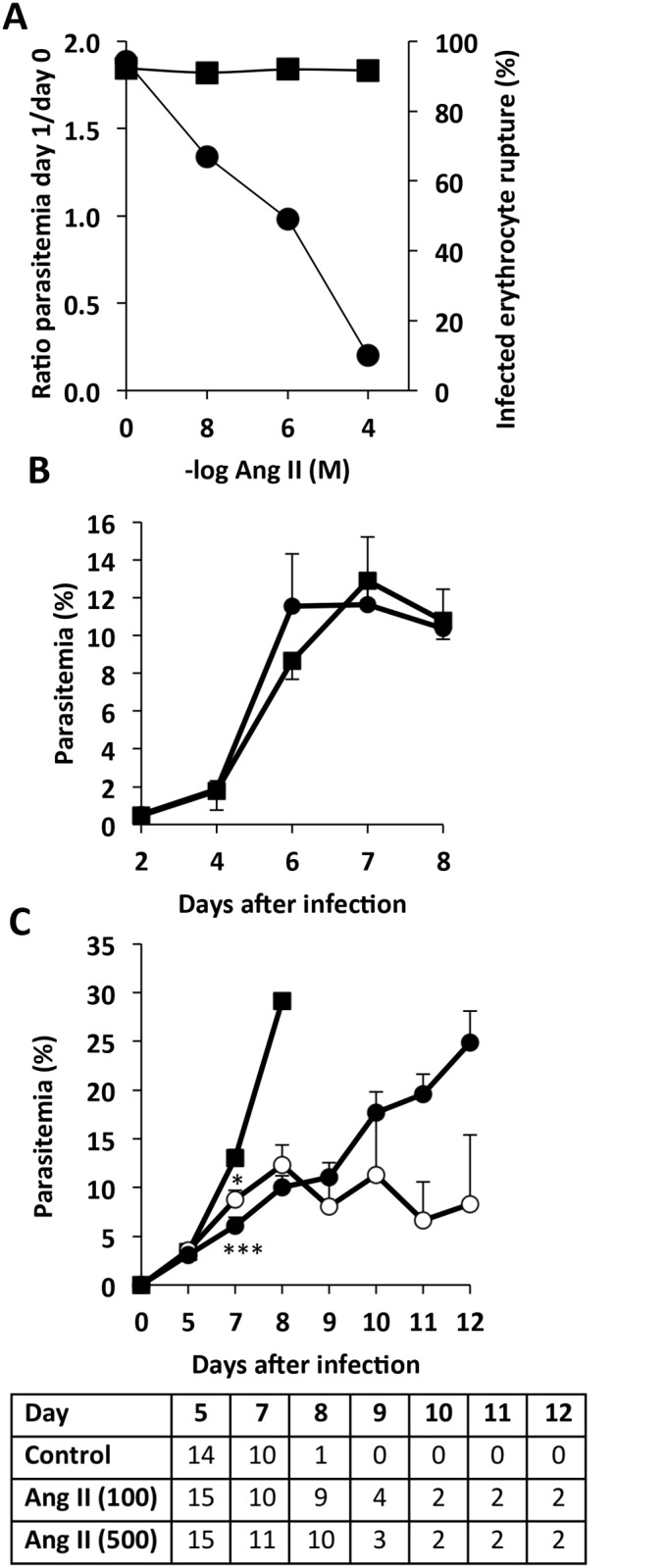
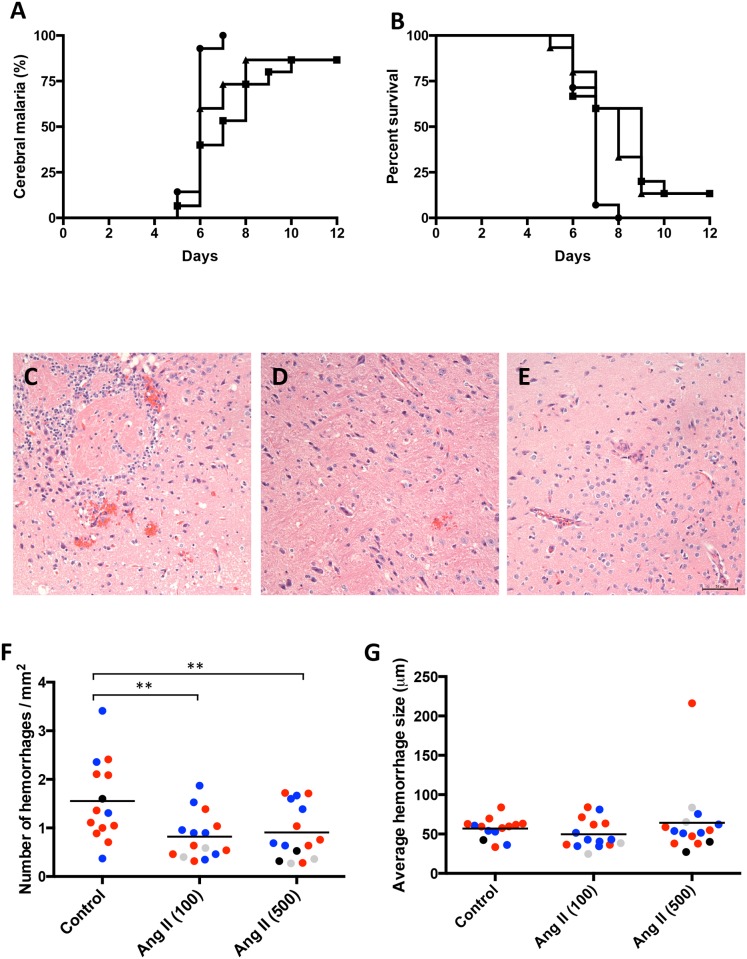
Angiotensin II, a peptide hormone that regulates blood pressure, has been proposed as a protective factor against cerebral malaria based on a genetic analysis. In vitro studies have documented an inhibitory effect of angiotensin II on Plasmodium growth, while studies using chemical inhibitors of angiotensin II in mice showed protection against experimental cerebral malaria but not major effects on parasite growth. To determine whether the level of angiotensin II affects Plasmodium growth and/or disease outcome in malaria, elevated levels of angiotensin II were induced in mice by intradermal implantation of osmotic mini-pumps providing constant release of this hormone. Mice were then infected with P. berghei and monitored for parasitemia and incidence of cerebral malaria. Mice infused with angiotensin II showed decreased parasitemia seven days after infection. The development of experimental cerebral malaria was delayed and a moderate increase in survival was observed in mice with elevated angiotensin II, as confirmed by decreased number of cerebral hemorrhages compared to controls. The results presented here show for the first time the effect of elevated levels of angiotensin II in an in vivo model of malaria. The decreased pathogenesis observed in mice complements a previous human genetic study, reinforcing the hypothesis of a beneficial effect of angiotensin II in malaria.
血管紧张素II是一种调节血压的肽类激素,基于一项基因分析,它被认为是预防脑型疟疾的保护因子。体外研究记录了血管紧张素II对疟原虫生长的抑制作用,而在小鼠中使用血管紧张素II化学抑制剂的研究显示对实验性脑型疟疾有保护作用,但对寄生虫生长没有显著影响。为了确定血管紧张素II水平是否影响疟疾中疟原虫的生长和/或疾病结局,通过皮内植入提供该激素持续释放的渗透微型泵,在小鼠中诱导血管紧张素II水平升高。然后用伯氏疟原虫感染小鼠,并监测其寄生虫血症和脑型疟疾的发病率。感染后七天,注入血管紧张素II的小鼠寄生虫血症减少。实验性脑型疟疾的发展延迟,血管紧张素II水平升高的小鼠存活率适度增加,与对照组相比,脑出血数量减少证实了这一点。此处呈现的结果首次显示了血管紧张素II水平升高在疟疾体内模型中的作用。在小鼠中观察到的发病机制降低补充了先前的一项人类基因研究,强化了血管紧张素II在疟疾中具有有益作用的假设。