Swiss Tropical and Public Health Institute.
University of Basel, Basel, Switzerland.
J Hypertens. 2019 Jul;37(7):1384-1392. doi: 10.1097/HJH.0000000000002071.
Although potential links between malaria parasitaemia and hypertension have been hypothesized, there is paucity of epidemiologic evidence on this link. We investigated in a population-based survey, the association between malaria parasitaemia and hypertension in Ivorian adults.
We estimated the adjusted odds ratios (OR) and 95% confidence intervals (CI) of hypertension in relation to malaria parasitaemia using multinomial regression, in 997 randomly selected adults in the 'Côte d'Ivoire Dual Burden of Disease Study' (CoDuBu), in south-central Côte d'Ivoire. We defined malaria parasitaemia as a positive rapid diagnostic test or identification of Plasmodium spp. on microscopy. Using the mean of the last two of three blood pressure (BP) measurements and questionnaire data, we defined hypertension as SBP at least 140 mmHg or DBP at least 90 mmHg or clinician-diagnosed hypertension.
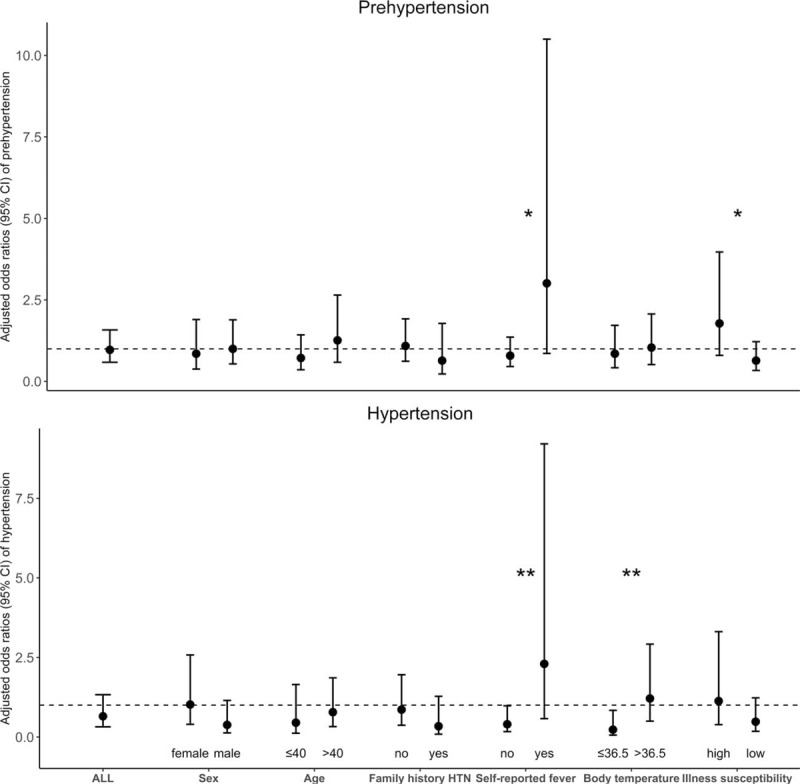
Prevalence of malaria parasitaemia and hypertension were 10 and 22%, respectively. Malaria parasitaemia was negatively associated with hypertension in participants with body temperature 36.5 °C or less [OR 0.23 (95% CI 0.06-0.84)]. Contrastingly, microscopic malaria parasitaemia showed positive associations with hypertension in participants with elevated body temperature [>36.5 °C; OR: 2.93 (95% CI 0.94-9.14)]. Participants having microscopic malaria parasitaemia with elevated body temperature had three-fold higher odds of hypertension [OR: 3.37 (95% CI 1.12-10.0)] than malaria parasitaemia-negatives with lower body temperature.
Malaria parasitaemia and hypertension are prevalent and seemingly linked comorbidities in African settings. This link may depend on malaria parasitaemia symptomaticity/latency where individuals with more latent/asymptomatic malaria parasitaemia have lower risk of hypertension and those with more acute/symptomatic malaria parasitaemia have a tendency toward higher BP. The cross-sectional nature of the study limited the distinction of short-term BP elevation (interim pathophysiological stress) from hypertension development. Future longitudinal studies considering malaria/hypertension phenotypes and host molecular variations are needed to clarify involved biological mechanisms, toward comorbidity management.
尽管人们假设疟疾寄生虫血症与高血压之间存在潜在联系,但在这方面的流行病学证据很少。我们在一项基于人群的调查中研究了科特迪瓦成年人中疟疾寄生虫血症与高血压之间的关系。
我们使用多项回归估计了与疟疾寄生虫血症相关的高血压的调整比值比(OR)和 95%置信区间(CI),该回归涉及在科特迪瓦南部中心的“科特迪瓦双重疾病负担研究”(CoDuBu)中随机选择的 997 名成年人。我们将疟疾寄生虫血症定义为快速诊断测试阳性或显微镜下发现疟原虫属。使用最后两次血压(BP)测量中的平均值和问卷调查数据,我们将高血压定义为收缩压至少 140mmHg 或舒张压至少 90mmHg 或临床医生诊断的高血压。
疟疾寄生虫血症和高血压的患病率分别为 10%和 22%。在体温为 36.5°C 或以下的参与者中,疟疾寄生虫血症与高血压呈负相关[OR 0.23(95%CI 0.06-0.84)]。相比之下,在体温升高的参与者中,显微镜下疟疾寄生虫血症与高血压呈正相关[>36.5°C;OR:2.93(95%CI 0.94-9.14)]。体温升高且有显微镜下疟疾寄生虫血症的参与者发生高血压的可能性是体温较低且无疟疾寄生虫血症的参与者的三倍[OR:3.37(95%CI 1.12-10.0)]。
在非洲环境中,疟疾寄生虫血症和高血压是普遍存在且似乎相关的合并症。这种联系可能取决于疟疾寄生虫血症的症状性/潜伏性,其中潜伏性/无症状性疟疾寄生虫血症较多的个体患高血压的风险较低,而急性/有症状性疟疾寄生虫血症较多的个体血压升高的趋势较大。该研究的横断面性质限制了短期血压升高(临时病理生理应激)与高血压发展之间的区别。需要未来的纵向研究考虑疟疾/高血压表型和宿主分子变异,以阐明涉及的生物学机制,实现合并症管理。