• 文献检索
  • 文档翻译
  • 深度研究
  • 学术资讯
  • Suppr Zotero 插件Zotero 插件
  • 邀请有礼
  • 套餐&价格
  • 历史记录
应用&插件
Suppr Zotero 插件Zotero 插件浏览器插件Mac 客户端Windows 客户端微信小程序
定价
高级版会员购买积分包购买API积分包
服务
文献检索文档翻译深度研究API 文档MCP 服务
关于我们
关于 Suppr公司介绍联系我们用户协议隐私条款
关注我们

Suppr 超能文献

核心技术专利:CN118964589B侵权必究
粤ICP备2023148730 号-1Suppr @ 2026

文献检索

告别复杂PubMed语法,用中文像聊天一样搜索,搜遍4000万医学文献。AI智能推荐,让科研检索更轻松。

立即免费搜索

文件翻译

保留排版,准确专业,支持PDF/Word/PPT等文件格式,支持 12+语言互译。

免费翻译文档

深度研究

AI帮你快速写综述,25分钟生成高质量综述,智能提取关键信息,辅助科研写作。

立即免费体验

基于供体和受体特征的不同评分系统对活体肝移植术后结局预测的比较

Comparison of Different Scoring Systems Based on Both Donor and Recipient Characteristics for Predicting Outcome after Living Donor Liver Transplantation.

作者信息

Ma Yucheng, Wang Qing, Yang Jiayin, Yan Lunan

机构信息

Department of Liver Transplantation, West China Hospital of Sichuan University, Chengdu, China.

出版信息

PLoS One. 2015 Sep 17;10(9):e0136604. doi: 10.1371/journal.pone.0136604. eCollection 2015.

DOI:10.1371/journal.pone.0136604
PMID:26378786
原文链接:https://pmc.ncbi.nlm.nih.gov/articles/PMC4574737/
Abstract

BACKGROUND AND OBJECTIVES

In order to provide a good match between donor and recipient in liver transplantation, four scoring systems [the product of donor age and Model for End-stage Liver Disease score (D-MELD), the score to predict survival outcomes following liver transplantation (SOFT), the balance of risk score (BAR), and the transplant risk index (TRI)] based on both donor and recipient parameters were designed. This study was conducted to evaluate the performance of the four scores in living donor liver transplantation (LDLT) and compare them with the MELD score.

PATIENTS AND METHODS

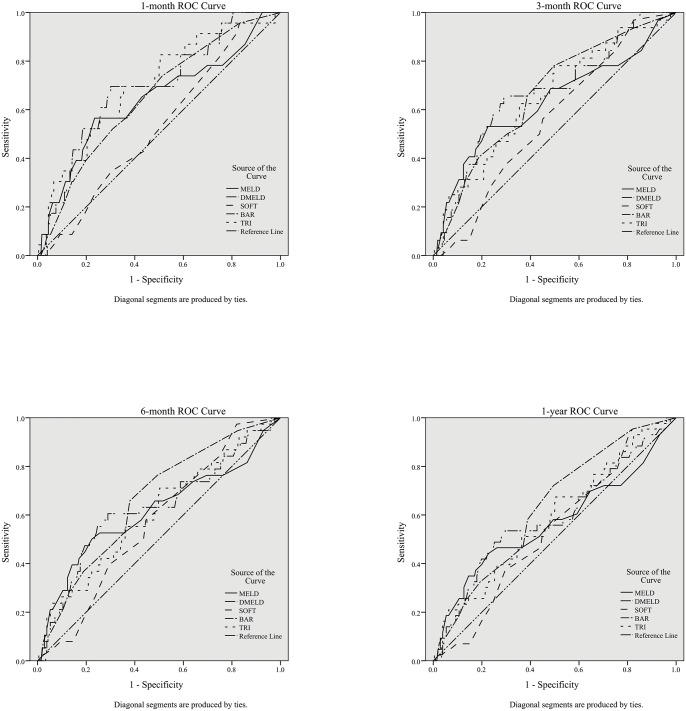
The clinical data of 249 adult patients undergoing LDLT in our center were retrospectively evaluated. The area under the receiver operating characteristic curves (AUCs) of each score were calculated and compared at 1-, 3-, 6-month and 1-year after LDLT.

RESULTS

The BAR at 1-, 3-, 6-month and 1-year after LDLT and the D-MELD and TRI at 1-, 3- and 6-month after LDLT showed acceptable performances in the prediction of survival (AUC>0.6), while the SOFT showed poor discrimination at 6-month after LDLT (AUC = 0.569). In addition, the D-MELD and BAR displayed positive correlations with the length of ICU stay (D-MELD, p = 0.025; BAR, p = 0.022). The SOFT was correlated with the time of mechanical ventilation (p = 0.022).

CONCLUSION

The D-MELD, BAR and TRI provided acceptable performance in predicting survival after LDLT. However, even though these scoring systems were based on both donor and recipient parameters, only the BAR provided better performance than the MELD in predicting 1-year survival after LDLT.

摘要

背景与目的

为了在肝移植中实现供体与受体的良好匹配,设计了四种基于供体和受体参数的评分系统[供体年龄与终末期肝病模型评分的乘积(D-MELD)、预测肝移植后生存结局的评分(SOFT)、风险平衡评分(BAR)和移植风险指数(TRI)]。本研究旨在评估这四种评分在活体肝移植(LDLT)中的性能,并将它们与MELD评分进行比较。

患者与方法

回顾性评估了在本中心接受LDLT的249例成年患者的临床资料。计算并比较了LDLT后1个月、3个月、6个月和1年时各评分的受试者工作特征曲线下面积(AUC)。

结果

LDLT后1个月、3个月、6个月和1年时的BAR以及LDLT后1个月、3个月和6个月时的D-MELD和TRI在生存预测方面表现可接受(AUC>0.6),而SOFT在LDLT后6个月时鉴别能力较差(AUC = 0.569)。此外,D-MELD和BAR与ICU住院时间呈正相关(D-MELD,p = 0.025;BAR,p = 0.022)。SOFT与机械通气时间相关(p = 0.022)。

结论

D-MELD、BAR和TRI在预测LDLT后的生存方面表现可接受。然而,尽管这些评分系统基于供体和受体参数,但只有BAR在预测LDLT后1年生存方面比MELD表现更好。
https://cdn.ncbi.nlm.nih.gov/pmc/blobs/c3be/4574737/f1f1cc240be1/pone.0136604.g001.jpg

相似文献

1
Comparison of Different Scoring Systems Based on Both Donor and Recipient Characteristics for Predicting Outcome after Living Donor Liver Transplantation.基于供体和受体特征的不同评分系统对活体肝移植术后结局预测的比较
PLoS One. 2015 Sep 17;10(9):e0136604. doi: 10.1371/journal.pone.0136604. eCollection 2015.
2
Is Muscle MELD a More Promising Predictor for Mortality After Living Donor Liver Transplantation?肌肉MELD评分是否是活体肝移植术后死亡率更有前景的预测指标?
Prog Transplant. 2018 Sep;28(3):213-219. doi: 10.1177/1526924818781571. Epub 2018 Jun 14.
3
Which score system can best predict recipient outcomes after living donor liver transplantation?哪种评分系统能够最好地预测活体肝移植受者的预后?
Transplant Proc. 2012 Mar;44(2):393-5. doi: 10.1016/j.transproceed.2012.01.064.
4
Artificial intelligence for predicting survival following deceased donor liver transplantation: Retrospective multi-center study.人工智能预测脑死亡供肝移植术后患者的生存情况:回顾性多中心研究。
Int J Surg. 2022 Sep;105:106838. doi: 10.1016/j.ijsu.2022.106838. Epub 2022 Aug 24.
5
Model for End-Stage Liver Disease score does not predict patient or graft survival in living donor liver transplant recipients.终末期肝病模型评分不能预测活体肝移植受者的患者或移植物存活率。
Liver Transpl. 2003 Jul;9(7):737-40. doi: 10.1053/jlts.2003.50122.
6
D-MELD as a predictor of early graft mortality in adult-to-adult living-donor liver transplantation.D-MELD 作为成人对成人活体肝移植中早期移植物死亡率的预测因子。
Transplantation. 2014 Feb 27;97(4):457-62. doi: 10.1097/01.TP.0000435696.23525.d0.
7
Different Score Systems to Predict Mortality in Living Donor Liver Transplantation: Which Is the Winner? The Experience of an Egyptian Center for Living Donor Liver Transplantation.预测活体肝移植死亡率的不同评分系统:哪一个是最佳的?埃及一家活体肝移植中心的经验。
Transplant Proc. 2015 Dec;47(10):2897-901. doi: 10.1016/j.transproceed.2015.10.022.
8
(D+10) MELD as a novel predictor of patient and graft survival after adult to adult living donor liver transplantation.(D+10)MELD作为成人至成人活体肝移植后患者和移植物存活的新型预测指标。
Clin Transplant. 2017 May;31(5). doi: 10.1111/ctr.12939. Epub 2017 Apr 4.
9
Risk Assessment in High- and Low-MELD Liver Transplantation.高、低终末期肝病模型(MELD)评分肝移植中的风险评估
Am J Transplant. 2017 Apr;17(4):1050-1063. doi: 10.1111/ajt.14065. Epub 2016 Nov 14.
10
Improving Matching Between Recipient and Donor in Liver Transplantation: Are Scores Able to Predict Long-term Survival?提高肝移植中受者与供者的匹配度:评分能否预测长期生存?
Transplant Proc. 2022 Jan-Feb;54(1):41-44. doi: 10.1016/j.transproceed.2021.11.007. Epub 2021 Dec 28.

引用本文的文献

1
Use of machine learning models for the prognostication of liver transplantation: A systematic review.机器学习模型在肝移植预后评估中的应用:一项系统综述。
World J Transplant. 2024 Mar 18;14(1):88891. doi: 10.5500/wjt.v14.i1.88891.
2
Maximizing utility of nondirected living liver donor grafts using machine learning.利用机器学习最大限度地提高非定向活体肝供体移植物的效用。
Front Immunol. 2023 Jun 29;14:1194338. doi: 10.3389/fimmu.2023.1194338. eCollection 2023.
3
BAR Score Performance in Predicting Survival after Living Donor Liver Transplantation: A Single-Center Retrospective Study.

本文引用的文献

1
Model for End-stage Liver Disease.终末期肝病模型
J Clin Exp Hepatol. 2013 Mar;3(1):50-60. doi: 10.1016/j.jceh.2012.11.002. Epub 2012 Dec 1.
2
D-MELD as a predictor of early graft mortality in adult-to-adult living-donor liver transplantation.D-MELD 作为成人对成人活体肝移植中早期移植物死亡率的预测因子。
Transplantation. 2014 Feb 27;97(4):457-62. doi: 10.1097/01.TP.0000435696.23525.d0.
3
Outcome of patients undergoing right lobe living donor liver transplantation with small-for-size grafts.小体积供肝右半肝活体肝移植患者的结局。
BAR 评分在预测活体肝移植术后生存中的表现:一项单中心回顾性研究。
Can J Gastroenterol Hepatol. 2022 Feb 18;2022:2877859. doi: 10.1155/2022/2877859. eCollection 2022.
4
Statistical methods versus machine learning techniques for donor-recipient matching in liver transplantation.统计方法与机器学习技术在肝移植中供受者匹配的比较。
PLoS One. 2021 May 21;16(5):e0252068. doi: 10.1371/journal.pone.0252068. eCollection 2021.
5
The role of the comprehensive complication index for the prediction of survival after liver transplantation.综合并发症指数在肝移植后生存预测中的作用。
Updates Surg. 2021 Feb;73(1):209-221. doi: 10.1007/s13304-020-00878-4. Epub 2020 Sep 6.
6
Predictive Capacity of Risk Models in Liver Transplantation.肝移植中风险模型的预测能力
Transplant Direct. 2019 May 22;5(6):e457. doi: 10.1097/TXD.0000000000000896. eCollection 2019 Jun.
7
Potential value and limitations of different clinical scoring systems in the assessment of short- and long-term outcome following orthotopic liver transplantation.不同临床评分系统在评估原位肝移植术后短期和长期预后中的潜在价值和局限性。
PLoS One. 2019 Mar 21;14(3):e0214221. doi: 10.1371/journal.pone.0214221. eCollection 2019.
World J Gastroenterol. 2014 Jan 7;20(1):282-9. doi: 10.3748/wjg.v20.i1.282.
4
Donor and recipient factors predicting time to graft failure following orthotopic liver transplantation: a transplant risk index.预测原位肝移植后移植物失功时间的供体和受体因素:一种移植风险指数。
Transplant Proc. 2013 Jul-Aug;45(6):2077-82. doi: 10.1016/j.transproceed.2013.06.001.
5
The balance of risk score for allocation in liver transplantation.肝移植分配中风险评分的平衡
Ann Surg. 2014 Feb;259(2):e34. doi: 10.1097/SLA.0b013e3182a18086.
6
The survival outcomes following liver transplantation (SOFT) score: validation with contemporaneous data and stratification of high-risk cohorts.肝移植后生存结局(SOFT)评分:同期数据验证和高危队列分层。
Clin Transplant. 2013 Jul-Aug;27(4):627-32. doi: 10.1111/ctr.12181. Epub 2013 Jul 1.
7
The use of fatty liver grafts in modern allocation systems: risk assessment by the balance of risk (BAR) score.现代分配系统中使用脂肪肝供肝:风险评估的平衡风险(BAR)评分。
Ann Surg. 2012 Nov;256(5):861-8; discussion 868-9. doi: 10.1097/SLA.0b013e318272dea2.
8
The Donor-Risk-Index, ECD-Score and D-MELD-Score all fail to predict short-term outcome after liver transplantation with acceptable sensitivity and specificity.供体风险指数、ECD评分和D-MELD评分均无法以可接受的敏感性和特异性预测肝移植后的短期预后。
Ann Transplant. 2012 Jul-Sep;17(3):5-13. doi: 10.12659/aot.883452.
9
Value of the preoperative SOFT-score, P-SOFT-score, SALT-score and labMELD-score for the prediction of short-term patient and graft survival of high-risk liver transplant recipients with a pre-transplant labMELD-score ≥30.术前SOFT评分、P-SOFT评分、SALT评分及实验室MELD评分对移植前实验室MELD评分≥30的高危肝移植受者短期患者及移植物存活预测的价值
Ann Transplant. 2012 Apr-Jun;17(2):11-7. doi: 10.12659/aot.883218.
10
Are there better guidelines for allocation in liver transplantation? A novel score targeting justice and utility in the model for end-stage liver disease era.在肝移植中是否有更好的分配指南?一种针对终末期肝病模型时代的正义和效用的新评分。
Ann Surg. 2011 Nov;254(5):745-53; discussion 753. doi: 10.1097/SLA.0b013e3182365081.