Piccinni Barbara, Massari Serafina, Caputi Jambrenghi Anna, Giannico Francesco, Lefranc Marie-Paule, Ciccarese Salvatrice, Antonacci Rachele
Dipartimento di Scienze e Tecnologie Biologiche ed Ambientali, Universita' del Salento, Lecce, Italy.
Dipartimento di Biologia, Universita' degli Studi di Bari Aldo Moro, Bari, Italy.
BMC Genomics. 2015 Sep 18;16:709. doi: 10.1186/s12864-015-1790-z.
In mammals, T cells develop along two discrete pathways characterized by expression of either the αβ or the γδ T cell receptors. Human and mouse display a low peripheral blood γδ T cell percentage ("γδ low species") while sheep, bovine and pig accounts for a high proportion of γδ T lymphocytes ("γδ high species"). While the T cell receptor alpha (TRA) and delta (TRD) genes and the genomic organization of the TRA/TRD locus has been determined in human and mouse, this information is still poorly known in artiodactyl species, such as sheep.
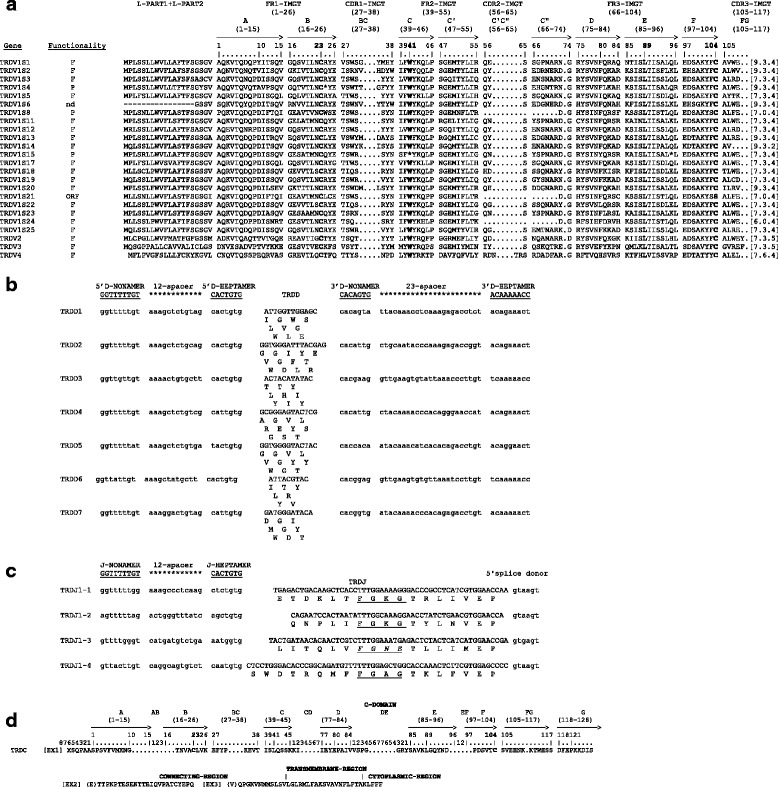
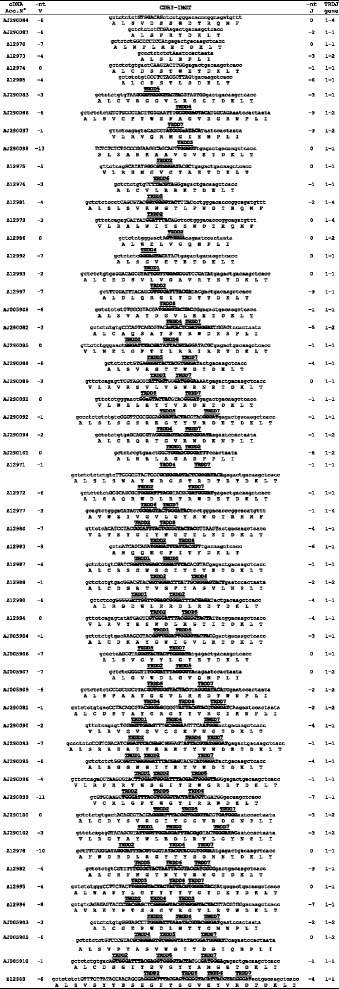
The analysis of the current Ovis aries whole genome assembly, Oar_v3.1, revealed that, as in the other mammalian species, the sheep TRD locus is nested within the TRA locus. In the most 5' part the TRA/TRD locus contains TRAV genes which are intermingled with TRDV genes, then TRD genes which include seven TRDD, four TRDJ genes, one TRDC and a single TRDV gene with an inverted transcriptional orientation, and finally in the most 3' part, the TRA locus is completed by 61 TRAJ genes and one TRAC gene. Comparative sequence and analysis and annotation led to the identification of 66 TRAV genes assigned to 34 TRAV subgroups and 25 TRDV genes belonging to the TRDV1 subgroup, while one gene was found for each TRDV2, TRDV3 and TRDV4 subgroups. Multiple duplication events within several TRAV subgroups have generated the sheep TRAV germline repertoire, which is substantially larger than the human one. A significant proportion of these TRAV gene duplications seems to have occurred simultaneously with the amplification of the TRDV1 subgroup genes. This dynamic of expansion has also generated novel multigene subgroups, which are species-specific. Ovis aries TRA and TRD genes identified in this study were assigned IMGT definitive or temporary names and were approved by the IMGT/WHO-IUIS nomenclature committee. The completeness of the genome assembly in the 3' part of the locus has allowed us to interpret rearranged CDR3 of cDNA from both TRA and TRD chain repertoires. The involvement of one up to four TRDD genes into a single transcript makes the potential sheep TRD chain much larger than any known TR chain repertoire.
The sheep genome, as the bovine genome, contains a large and diverse repertoire of TRA and TRD genes when compared to the "γδ T cell low" species genomes. The composition and length of the rearranged CDR3 in TRD V-delta domains influence the three-dimensional configuration of the antigen-combining site thus suggesting that in ruminants, γδ T cells play a more important and specific role in immune recognition.
在哺乳动物中,T细胞沿着两条不同的途径发育,其特征在于表达αβ或γδT细胞受体。人类和小鼠的外周血γδT细胞百分比很低(“γδ低物种”),而绵羊、牛和猪的γδT淋巴细胞比例很高(“γδ高物种”)。虽然人类和小鼠中已经确定了T细胞受体α(TRA)和δ(TRD)基因以及TRA/TRD基因座的基因组组织,但在偶蹄目物种(如绵羊)中,这些信息仍然知之甚少。
对当前的绵羊全基因组组装Oar_v3.1进行分析发现,与其他哺乳动物物种一样,绵羊的TRD基因座嵌套在TRA基因座内。在最5'端,TRA/TRD基因座包含与TRDV基因相互交织的TRAV基因,然后是TRD基因,其中包括7个TRDD、4个TRDJ基因、1个TRDC和1个转录方向倒置的TRDV基因,最后在最3'端,TRA基因座由61个TRAJ基因和1个TRAC基因完成。通过比较序列分析和注释,鉴定出66个TRAV基因,分为34个TRAV亚组,25个TRDV基因属于TRDV1亚组,而TRDV2、TRDV3和TRDV4亚组各发现1个基因。几个TRAV亚组内的多次重复事件产生了绵羊TRAV种系库,其比人类的要大得多。这些TRAV基因重复中有很大一部分似乎与TRDV1亚组基因的扩增同时发生。这种扩张动态也产生了新的多基因亚组,它们是物种特异性的。本研究中鉴定的绵羊TRA和TRD基因被赋予IMGT确定或临时名称,并得到了IMGT/WHO-IUIS命名委员会的批准。基因座3'端基因组组装的完整性使我们能够解读来自TRA和TRD链库的cDNA重排CDR3。一个转录本中涉及多达四个TRDD基因,这使得潜在的绵羊TRD链比任何已知的TR链库都要大得多。
与“γδT细胞低”物种的基因组相比,绵羊基因组与牛基因组一样,包含大量多样的TRA和TRD基因。TRD V-δ结构域中重排CDR3的组成和长度影响抗原结合位点的三维构型,因此表明在反刍动物中,γδT细胞在免疫识别中发挥着更重要和特定的作用。