
儿童慢性血源性骨髓炎的贝伊特CURE分类——治疗指南
The Beit CURE Classification of Childhood Chronic Haematogenous Osteomyelitis--a guide to treatment.
作者信息
Stevenson Andrew J, Jones Henry Wynn, Chokotho Linda C, Beckles Verona L L, Harrison William J
机构信息
FRCS (T&O), North Bristol NHS Trust, 8 Mervyn Road, Bristol, BS7 9EL, UK.
FRCS (T&O), Wrightington, Wigan & Leigh NHS Foundation Trust, Wigan, UK.
出版信息
J Orthop Surg Res. 2015 Sep 17;10:144. doi: 10.1186/s13018-015-0282-9.
BACKGROUND
The Beit CURE (BC) classification is a radiographic classification used in childhood chronic haematogenous osteomyelitis. The aim of this study is to assess correlation between this classification and the type and extent of treatment required.
METHODS
We present a retrospective series of 145 cases of childhood chronic haematogenous osteomyelitis classified using the BC classification. Variables measured include age, sex, bone involved, number of admissions, length of stay, type/number of operations and microbiology.
RESULTS
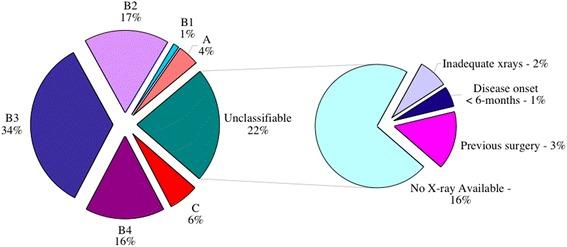
The most commonly affected bone was the tibia (46%), followed by femur (26%) and humerus (10%). Bone defects were most common in the tibia. Staphylococcus aureus was the most commonly isolated organism. Type B, sequestrum type, was the most common (88%), followed by type C, sclerotic type, (7%) and type A, Brodie's abscess (5%). Types A and B1 had the shortest length of hospitalisation (11 days), type B4 had the longest (87 days). Types A and B1 had the fewest infection control operations. Type B4 had the greatest total number of operations.
CONCLUSIONS
This study shows that the BC classification can guide surgical strategy and help predict length of inpatient treatment and number and type of procedures required.
背景
贝伊特·库里(BC)分类是一种用于儿童慢性血源性骨髓炎的影像学分类。本研究的目的是评估该分类与所需治疗的类型和程度之间的相关性。
方法
我们回顾性分析了145例采用BC分类的儿童慢性血源性骨髓炎病例。测量的变量包括年龄、性别、受累骨骼、入院次数、住院时间、手术类型/数量以及微生物学。
结果
最常受累的骨骼是胫骨(46%),其次是股骨(26%)和肱骨(10%)。骨缺损在胫骨中最为常见。金黄色葡萄球菌是最常分离出的病原体。B型,死骨型,最为常见(88%),其次是C型,硬化型,(7%)和A型,布罗迪脓肿(5%)。A型和B1型住院时间最短(11天),B4型最长(87天)。A型和B1型感染控制手术最少。B4型手术总数最多。
结论
本研究表明,BC分类可指导手术策略,并有助于预测住院治疗时间以及所需手术的数量和类型。




 Zotero 插件