Verkhratsky Alexei, Steardo Luca, Parpura Vladimir, Montana Vedrana
Faculty of Life Science, The University of Manchester, Manchester, UK; Achucarro Center for Neuroscience, IKERBASQUE, Basque Foundation for Science, Bilbao, Spain; University of Nizhny Novgorod, Nizhny Novgorod, Russia.
Department of Psychiatry, University of Naples SUN, Largo Madonna delle Grazie, Naples, Italy.
Prog Neurobiol. 2016 Sep;144:188-205. doi: 10.1016/j.pneurobio.2015.09.003. Epub 2015 Sep 16.
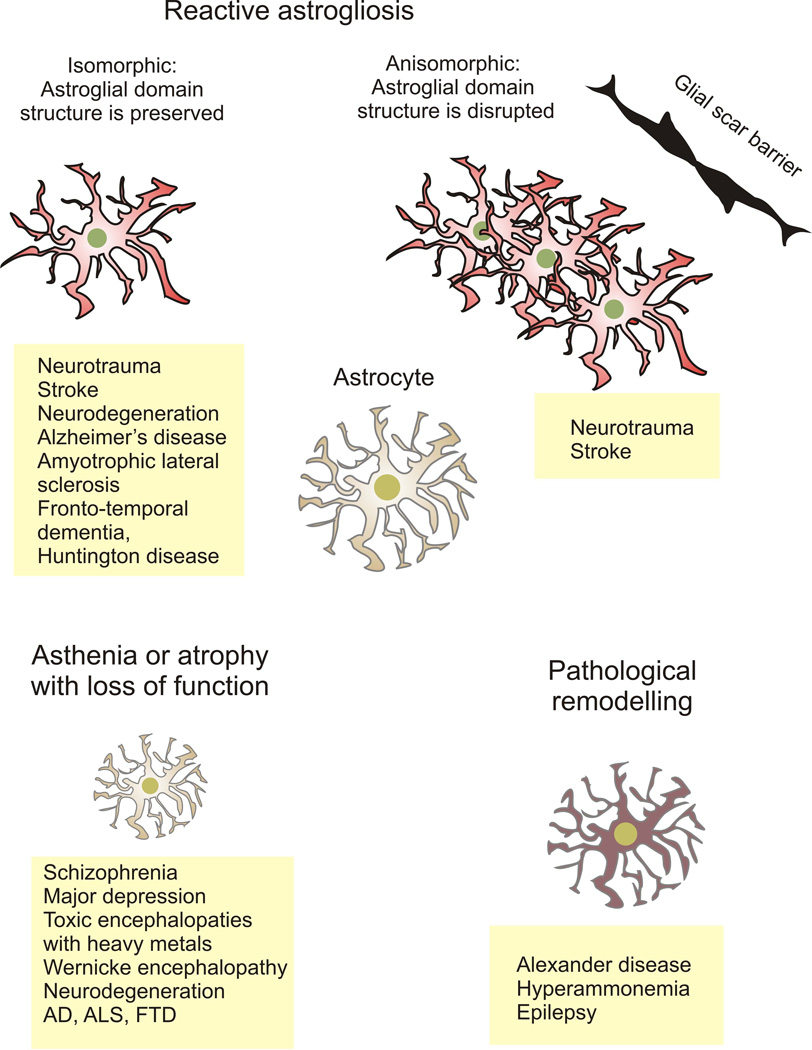
Fundamentally, all brain disorders can be broadly defined as the homeostatic failure of this organ. As the brain is composed of many different cells types, including but not limited to neurons and glia, it is only logical that all the cell types/constituents could play a role in health and disease. Yet, for a long time the sole conceptualization of brain pathology was focused on the well-being of neurons. Here, we challenge this neuron-centric view and present neuroglia as a key element in neuropathology, a process that has a toll on astrocytes, which undergo complex morpho-functional changes that can in turn affect the course of the disorder. Such changes can be grossly identified as reactivity, atrophy with loss of function and pathological remodeling. We outline the pathogenic potential of astrocytes in variety of disorders, ranging from neurotrauma, infection, toxic damage, stroke, epilepsy, neurodevelopmental, neurodegenerative and psychiatric disorders, Alexander disease to neoplastic changes seen in gliomas. We hope that in near future we would witness glial-based translational medicine with generation of deliverables for the containment and cure of disorders. We point out that such as a task will require a holistic and multi-disciplinary approach that will take in consideration the concerted operation of all the cell types in the brain.
从根本上说,所有脑部疾病都可大致定义为该器官的稳态失衡。由于大脑由多种不同类型的细胞组成,包括但不限于神经元和神经胶质细胞,所以所有细胞类型/成分在健康和疾病中都可能发挥作用,这是合乎逻辑的。然而,长期以来,脑部病理学的唯一概念化都集中在神经元的健康状况上。在此,我们挑战这种以神经元为中心的观点,并提出神经胶质细胞是神经病理学中的关键要素,这一过程对星形胶质细胞造成损害,星形胶质细胞会经历复杂的形态功能变化,进而可能影响疾病的进程。这种变化可大致识别为反应性、功能丧失性萎缩和病理性重塑。我们概述了星形胶质细胞在多种疾病中的致病潜力,这些疾病包括神经创伤、感染、毒性损伤、中风、癫痫、神经发育性疾病、神经退行性疾病、精神疾病、亚历山大病以及胶质瘤中出现的肿瘤性变化。我们希望在不久的将来,我们能见证基于神经胶质细胞的转化医学,产生用于控制和治愈疾病的成果。我们指出,这样一项任务将需要一种全面的多学科方法,该方法要考虑到大脑中所有细胞类型的协同运作。