Kesselheim Aaron S, Wang Bo, Franklin Jessica M, Darrow Jonathan J
Program On Regulation, Therapeutics, And Law (PORTAL), Division of Pharmacoepidemiology and Pharmacoeconomics, Department of Medicine, Brigham and Women's Hospital and Harvard Medical School, Boston 02120, MA, USA
Program On Regulation, Therapeutics, And Law (PORTAL), Division of Pharmacoepidemiology and Pharmacoeconomics, Department of Medicine, Brigham and Women's Hospital and Harvard Medical School, Boston 02120, MA, USA.
BMJ. 2015 Sep 23;351:h4633. doi: 10.1136/bmj.h4633.
To evaluate the use of special expedited development and review pathways at the US Food and Drug Administration over the past two decades.
Cohort study.
FDA approved novel therapeutics between 1987 and 2014.
Publicly available sources provided each drug's year of approval, their innovativeness (first in class versus not first in class), World Health Organization Anatomic Therapeutic Classification, and which (if any) of the FDA's four primary expedited development and review programs or designations were associated with each drug: orphan drug, fast track, accelerated approval, and priority review.
Logistic regression models evaluated trends in the proportion of drugs associated with each of the four expedited development and review programs. To evaluate the number of programs associated with each approved drug over time, Poisson models were employed, with the number of programs as the dependent variable and a linear term for year of approval. The difference in trends was compared between drugs that were first in class and those that were not.
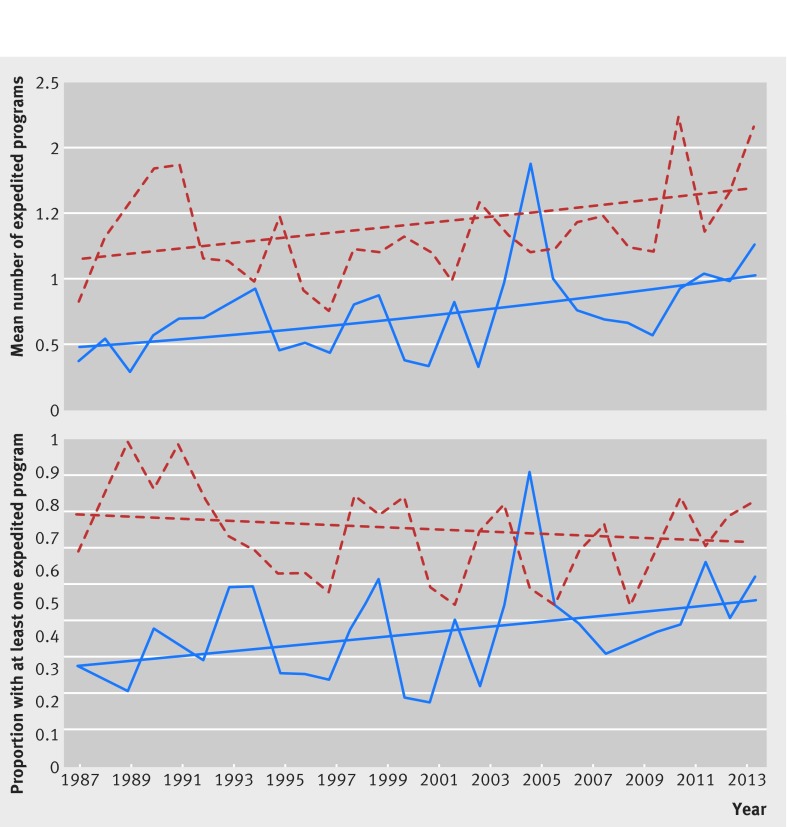
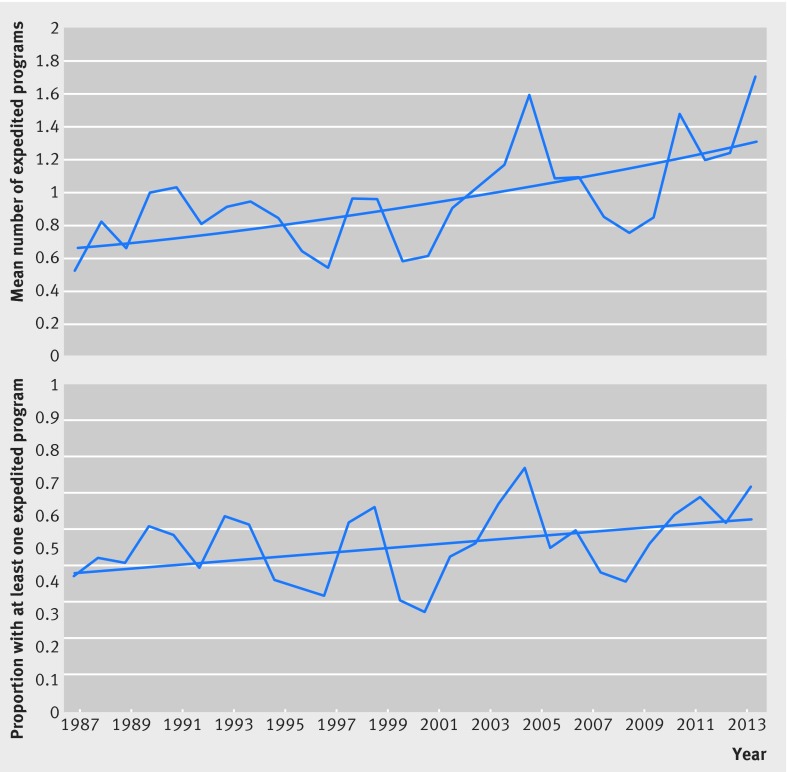
The FDA approved 774 drugs during the study period, with one third representing first in class agents. Priority review (43%) was the most prevalent of the four programs, with accelerated approval (9%) the least common. There was a significant increase of 2.6% per year in the number of expedited review and approval programs granted to each newly approved agent (incidence rate ratio 1.026, 95% confidence interval 1.017 to 1.035, P<0.001), and a 2.4% increase in the proportion of drugs associated with at least one such program (odds ratio 1.024, 95% confidence interval 1.006 to 1.043, P=0.009). Driving this trend was an increase in the proportion of approved, non-first in class drugs associated with at least one program for drugs (P=0.03 for interaction).
In the past two decades, drugs newly approved by the FDA have been associated with an increasing number of expedited development or review programs. Though expedited programs should be strictly limited to drugs providing noticeable clinical advances, this trend is being driven by drugs that are not first in class and thus potentially less innovative.
评估过去二十年间美国食品药品监督管理局(FDA)特殊快速开发和审查途径的使用情况。
队列研究。
FDA在1987年至2014年间批准的新型疗法。
公开资料提供了每种药物的批准年份、创新性(同类首创与非同类首创)、世界卫生组织解剖治疗学分类,以及FDA的四个主要快速开发和审查计划或指定中哪些(如果有的话)与每种药物相关:孤儿药、快速通道、加速批准和优先审查。
逻辑回归模型评估了与四个快速开发和审查计划中每个计划相关的药物比例趋势。为了评估随时间推移与每种批准药物相关的计划数量,采用了泊松模型,将计划数量作为因变量,并将批准年份作为线性项。比较了同类首创药物和非同类首创药物的趋势差异。
在研究期间,FDA批准了774种药物,其中三分之一为同类首创药物。优先审查(43%)是四个计划中最普遍的,加速批准(9%)最不常见。每个新批准药物获得的快速审查和批准计划数量每年显著增加2.6%(发病率比1.026,95%置信区间1.017至1.035,P<0.001),与至少一个此类计划相关的药物比例增加2.4%(优势比1.024,95%置信区间1.006至1.043,P=0.009)。推动这一趋势的是与至少一个药物计划相关的已批准非同类首创药物比例的增加(交互作用P=0.03)。
在过去二十年中,FDA新批准的药物与越来越多的快速开发或审查计划相关。尽管快速计划应严格限于提供显著临床进展的药物,但这一趋势是由非同类首创药物推动的,因此潜在创新性较低。