König Katrin, Klemens Christine, Eder Katharina, San Nicoló Marion, Becker Sven, Kramer Matthias F, Gröger Moritz
Department of Otorhinolaryngology, Head and Neck Surgery, University Medical Center Großhadern of the Ludwig-Maximilians-University Munich, Marchioninistr. 15, 81377 Munich, Germany.
Department of Otorhinolaryngology, Head and Neck Surgery, University Medical Center Großhadern of the Ludwig-Maximilians-University Munich, Marchioninistr. 15, 81377 Munich, Germany ; Department of Otorhinolaryngology, Head and Neck Surgery, University Medical Center of the Johannes Gutenberg University Mainz, Langenbeckstr. 1, 55101 Mainz, Germany.
Allergy Asthma Clin Immunol. 2015 Sep 22;11(1):26. doi: 10.1186/s13223-015-0093-x. eCollection 2015.
New therapeutic approaches with biologic agents such as anti-cytokine antibodies are currently on trial for the treatment of asthma, rhinosinusitis or allergic diseases necessitating patient selection by biomarkers. Allergic rhinitis (AR), affecting about 20 % of the Canadian population, is an inflammatory disease characterised by a disequilibrium of T-lymphocytes and tissue eosinophilia. Aim of the present study was to describe distinct cytokine patterns in nasal secretion between seasonal and perennial AR (SAR/PAR), and healthy controls by comparing cytokines regulating T-cells or stimulating inflammatory cells, and chemokines.
Nasal secretions of 44 participants suffering from SAR, 45 participants with PAR and 48 healthy controls were gained using the cotton wool method, and analysed for IL-1β, IL-4, IL-5, IL-6, IL-10, IL-12, IL-13, IL-17, GM-CSF, G-CSF, IFN-γ, MCP-1, MIP-1α, MIP-1β, eotaxin, and RANTES by Bio-Plex Cytokine Assay as well as for ECP and tryptase by UniCAP-FEIA.
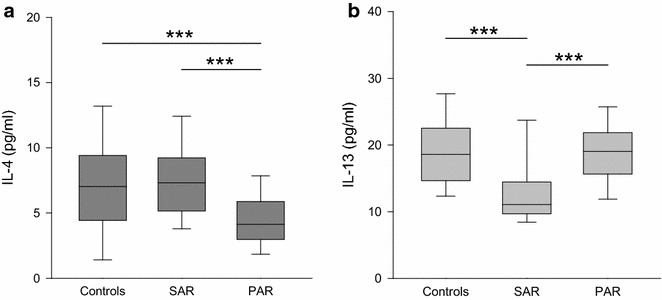
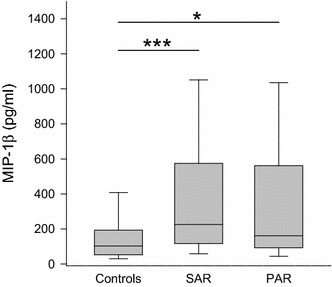
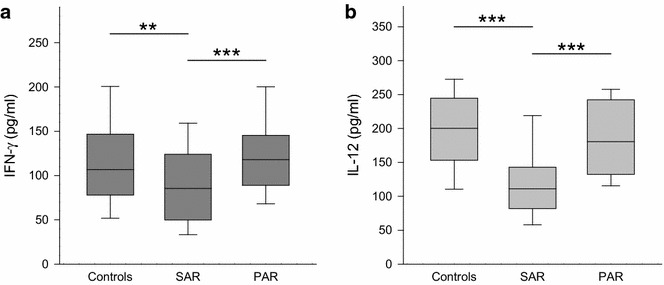
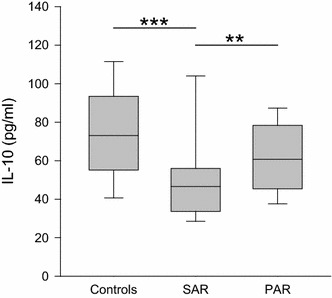
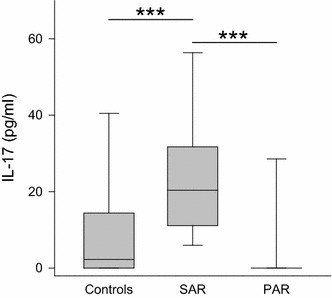
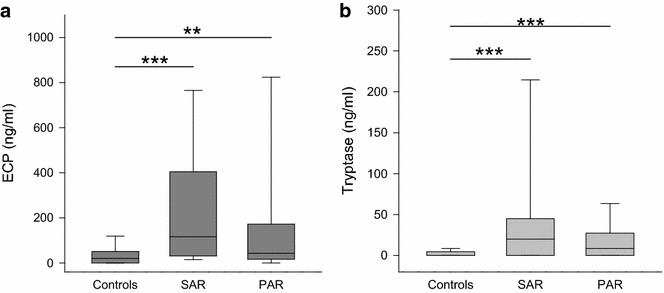
Participants with SAR or PAR presented elevated levels of tryptase, ECP, MCP-1, and MIP-1β, while values of GM-CSF, G-CSF, IL-1β, and IL-6 did not differ from the controls. Increased levels of IL-5, eotaxin, MIP-1α, and IL-17 and decreased levels of IFN-γ, IL-12 and IL-10 were found in SAR only. RANTES was elevated in SAR in comparison to PAR. Interestingly, we found reduced levels of IL-4 in PAR and of IL-13 in SAR.
Elevated levels of proinflammatory cytokines were seen in both disease entities. They were, however, more pronounced in SAR, indicating a higher degree of inflammation. This study suggests a downregulation of TH1 and Treg-lymphocytes and an upregulation of TH17 in SAR. Moreover, the results display a prominent role of eosinophils and mast cells in AR. The observed distinct cytokine profiles in nasal secretion may prove useful as a diagnostic tool helping to match patients to antibody therapies.
目前正在试验使用抗细胞因子抗体等生物制剂的新型治疗方法来治疗哮喘、鼻窦炎或过敏性疾病,这需要通过生物标志物来选择患者。变应性鼻炎(AR)影响约20%的加拿大人口,是一种以T淋巴细胞失衡和组织嗜酸性粒细胞增多为特征的炎症性疾病。本研究的目的是通过比较调节T细胞或刺激炎症细胞的细胞因子以及趋化因子,来描述季节性和常年性AR(SAR/PAR)患者与健康对照者鼻分泌物中不同的细胞因子模式。
采用棉拭子法收集44例季节性AR患者、45例常年性AR患者和48例健康对照者的鼻分泌物,通过生物芯片细胞因子检测法分析其中白细胞介素-1β(IL-1β)、IL-4、IL-5、IL-6、IL-10、IL-12、IL-13、IL-17、粒细胞-巨噬细胞集落刺激因子(GM-CSF)、粒细胞集落刺激因子(G-CSF)、干扰素-γ(IFN-γ)、单核细胞趋化蛋白-1(MCP-1)、巨噬细胞炎性蛋白-1α(MIP-1α)、MIP-1β、嗜酸性粒细胞趋化因子和调节激活正常T细胞表达和分泌因子(RANTES)的水平,并通过UniCAP荧光酶免疫测定法检测嗜酸性粒细胞阳离子蛋白(ECP)和类胰蛋白酶的水平。
季节性AR或常年性AR患者的类胰蛋白酶、ECP、MCP-1和MIP-1β水平升高,而GM-CSF、G-CSF、IL-1β和IL-6的值与对照组无差异。仅在季节性AR患者中发现IL-5、嗜酸性粒细胞趋化因子、MIP-1α和IL-17水平升高,IFN-γ、IL-12和IL-10水平降低。与常年性AR相比,季节性AR患者的RANTES水平升高。有趣的是,我们发现常年性AR患者的IL-4水平降低,季节性AR患者的IL-13水平降低。
在这两种疾病中均观察到促炎细胞因子水平升高。然而,季节性AR中的升高更为明显,表明炎症程度更高。本研究提示季节性AR中TH1和调节性T淋巴细胞下调,TH17上调。此外,结果显示嗜酸性粒细胞和肥大细胞在变应性鼻炎中起重要作用。在鼻分泌物中观察到的不同细胞因子谱可能作为一种诊断工具,有助于将患者与抗体治疗相匹配。