Tounekti Taieb, Khemira Habib
Laboratory of plant Ecophysiology, Centre for Environmental Research & Studies, Jazan University, Jazan, Kingdom of Saudi Arabia.
J Intercult Ethnopharmacol. 2015 Jul-Sep;4(3):208-16. doi: 10.5455/jice.20150405064135. Epub 2015 Apr 10.
The purpose of this study was to evaluate how increasing NaCl salinity in the medium can affects the essential oils (EOs) composition and phenolic diterpene content and yield in leaves of Salvia officinalis L. The protective role of such compounds against NaCl stress was also argued with regard to some physiological characteristics of the plant (water and ionic relations as well as the leaf gas exchanges).
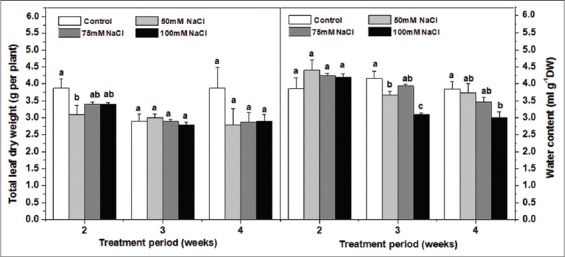
Potted plants were exposed to increasing NaCl concentrations (0, 50, 75, and 100 mM) for 4 weeks during July 2012. Replicates from each treatment were harvested after 0, 2, 3, and 4 weeks of adding salt to perform physiological measurements and biochemical analysis.
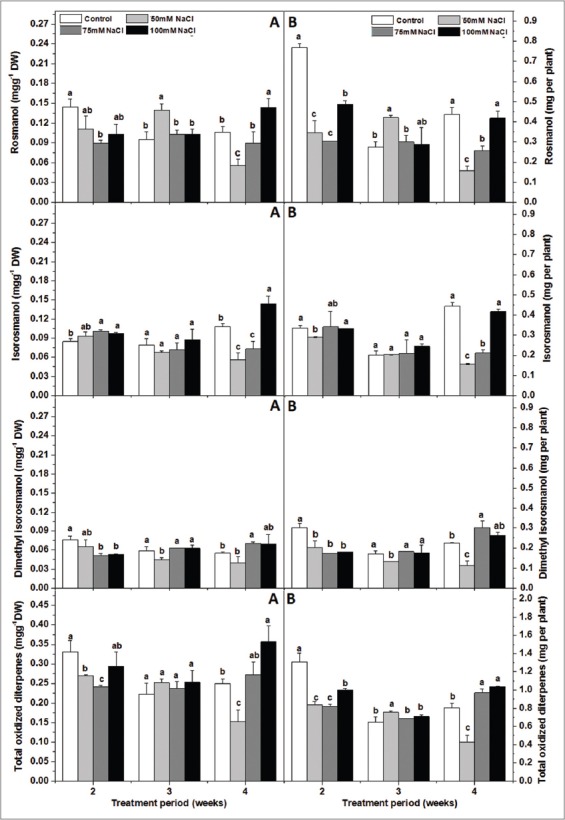
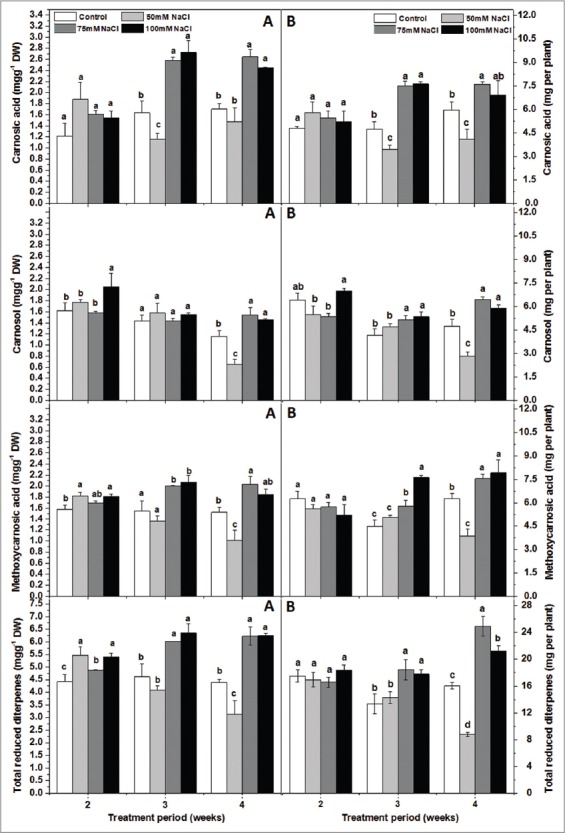
Sage EOs were rich in manool, viridiflorol, camphor, and borneol. Irrigation with a solution containing 100 mM NaCl for 4 weeks increased considerably 1.8-cineole, camphor and β-thujone concentrations, whereas lower concentrations (50 and 75 mM) had no effects. On the contrary, borneol and viridiflorol concentrations decreased significantly under the former treatment while manool and total fatty acid concentrations were not affected. Leaf extracts also contained several diterpenes such as carnosic acid (CA), carnosol, and 12-O-methoxy carnosic acid (MCA). The concentrations and total contents of CA and MCA increased after 3 weeks of irrigation with 75 or 100 mM NaCl. The 50 mM NaCl had no effect on these diterpenes. Our results suggest a protective role for CA against salinity stress.
This study may provide ways to manipulate the concentration and yield of some phenolic diterpenes and EOs in sage. In fact, soil salinity may favor a directional production of particular components of interest.
本研究旨在评估培养基中氯化钠盐度增加如何影响鼠尾草叶片中挥发油(EOs)的成分、酚类二萜含量及产量。还就这些化合物对氯化钠胁迫的保护作用与植物的一些生理特性(水分和离子关系以及叶片气体交换)进行了探讨。
2012年7月,将盆栽植物暴露于不断增加的氯化钠浓度(0、50、75和100 mM)下4周。在添加盐分后的0、2、3和4周后,对每个处理的重复样本进行收获,以进行生理测量和生化分析。
鼠尾草挥发油富含马尼醇、绿花白千层醇、樟脑和冰片。用含100 mM氯化钠的溶液灌溉4周后,1,8-桉叶素、樟脑和β-侧柏酮的浓度显著增加,而较低浓度(50和75 mM)则无影响。相反,在前一种处理下,冰片和绿花白千层醇的浓度显著降低,而马尼醇和总脂肪酸浓度不受影响。叶片提取物还含有几种二萜类化合物,如鼠尾草酸(CA)、鼠尾草酚和12-O-甲氧基鼠尾草酸(MCA)。用75或100 mM氯化钠灌溉3周后,CA和MCA的浓度及总含量增加。50 mM氯化钠对这些二萜类化合物没有影响。我们的结果表明CA对盐胁迫具有保护作用。
本研究可能提供了控制鼠尾草中某些酚类二萜和挥发油浓度及产量的方法。事实上,土壤盐度可能有利于特定目标成分的定向生产。