Yin Zhenyu, Wu Wenbo, Liu Renyuan, Liang Xue, Yu Tingting, Chen Xiaoling, Feng Jie, Guo Aibin, Xie Yu, Yang Haiyan, Huang Mingmin, Tian Chuanshuai, Zhang Bing, Xu Yun
Department of Geriatrics, Affiliated Drum Tower Hospital of Nanjing University Medical School, Nanjing, Jiangsu, China.
Department of Neurology, Affiliated Drum Tower Hospital of Nanjing Medical University, Nanjing, Jiangsu, China.
PeerJ. 2015 Sep 17;3:e1202. doi: 10.7717/peerj.1202. eCollection 2015.
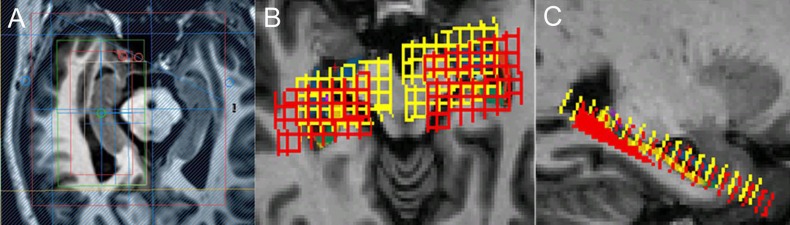
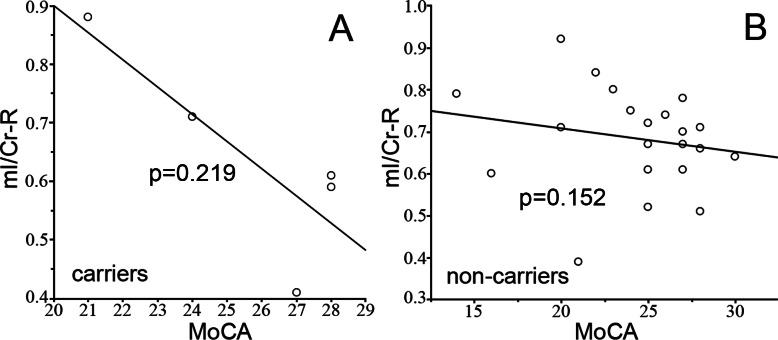
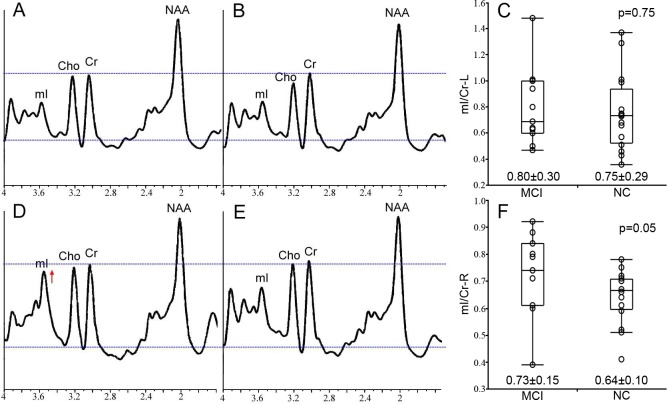
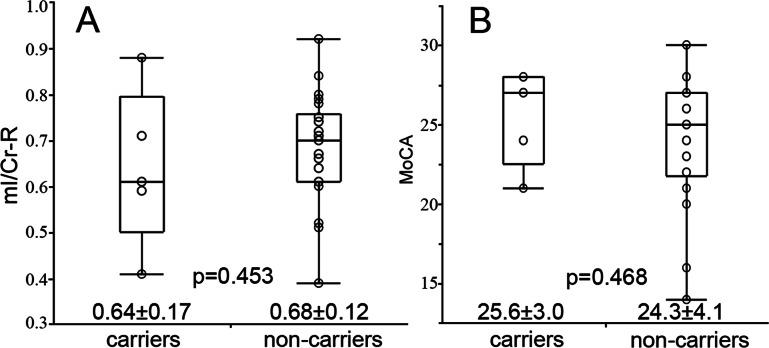
Purpose. To examine the associations among age, Apolipoprotein E (APOE) genotype, metabolic changes in the hippocampus detected by 2D (1)H magnetic resonance spectroscopy (MRS), and neuropsychological measures of cognition in non-demented elders. Materials and Methods. We studied a cohort of 16 cognitively normal controls (CN) and 11 amnestic mild cognitive impairment (aMCI) patients between 66 and 88 years old who were genotyped for APOE genetic polymorphism. Measurements of 2D(1)H-MRS metabolites were obtained in the hippocampus region. Adjusting by age among all subjects, the association between metabolic changes and cognitive function was measured by Spearman partial rank-order correlation. The effect of APOE status was measured by separating the subjects into APOE genotype subgroups, including the APOEε4 carriers and APOEε4 non-carriers. Results. In contrast to the CN group matched with age, gender, and education, aMCI patients showed increased myo-inositol (mI)/Creatine (Cr) ratio only in the right hippocampus. No differences were noted on N-acetylaspartate (NAA)/Cr and mI/NAA from bilateral hippocampus, and so was mI/Cr ratio in left hippocampus between aMCI and CN. The mI/Cr ratio from the right hippocampus in non-demented elders was negatively correlated with Montreal Cognitive Assessment (MoCA) scores. Whether ε4 genotype or age was added as a covariate, none of the correlation effects remained significant. Additionally, adjusting for age and APOE genotype together, there was no significant correlation between them. Conclusion. Since the higher mI/Cr from the right hippocampus of the patients with aMCI than those from CN, the mI/Cr could be a more specific predictor of general cognitive function in aMCI patients. There is an association between higher mI/Cr in right hippocampus and worse cognitive function for the non-demented older adults, and the correlation could be modified by APOE status and age. That provided a window on objectively understanding the mechanism between the brain metabolites and the influence factors in non-demented elders.
目的。研究非痴呆老年人的年龄、载脂蛋白E(APOE)基因型、二维氢磁共振波谱(MRS)检测到的海马代谢变化以及认知的神经心理学测量指标之间的关联。材料与方法。我们研究了一组年龄在66至88岁之间的16名认知正常对照者(CN)和11名遗忘型轻度认知障碍(aMCI)患者,对其进行APOE基因多态性基因分型。在海马区获取二维氢磁共振波谱代谢物测量值。在所有受试者中按年龄进行校正后,通过Spearman偏等级相关测量代谢变化与认知功能之间的关联。通过将受试者分为APOE基因型亚组来测量APOE状态的影响,包括APOEε4携带者和APOEε4非携带者。结果。与年龄、性别和教育程度相匹配的CN组相比,aMCI患者仅在右侧海马中肌醇(mI)/肌酸(Cr)比值升高。aMCI组和CN组双侧海马的N - 乙酰天门冬氨酸(NAA)/Cr和mI/NAA无差异,左侧海马的mI/Cr比值也无差异。非痴呆老年人右侧海马的mI/Cr比值与蒙特利尔认知评估(MoCA)评分呈负相关。无论将ε4基因型还是年龄作为协变量加入,均无相关效应仍具有显著性。此外,同时校正年龄和APOE基因型后,它们之间无显著相关性。结论。由于aMCI患者右侧海马的mI/Cr高于CN患者,mI/Cr可能是aMCI患者一般认知功能更特异的预测指标。非痴呆老年人右侧海马中较高的mI/Cr与较差的认知功能之间存在关联,且这种相关性可能会因APOE状态和年龄而改变。这为客观理解非痴呆老年人脑代谢物与影响因素之间的机制提供了一个窗口。