Gielen Evelien, O'Neill Terence W, Pye Stephen R, Adams Judith E, Wu Frederick C, Laurent Michaël R, Claessens Frank, Ward Kate A, Boonen Steven, Bouillon Roger, Vanderschueren Dirk, Verschueren Sabine
Gerontology and Geriatrics, Department of Clinical and Experimental Medicine, KU Leuven Leuven, Belgium ; Centre for Metabolic Bone Diseases, UZ Leuven Leuven, Belgium.
Arthritis Research UK Centre for Epidemiology & NIHR Manchester Musculoskeletal Biomedical Research Unit Manchester, UK.
J Cachexia Sarcopenia Muscle. 2015 Sep;6(3):242-52. doi: 10.1002/jcsm.12030. Epub 2015 Apr 27.
In men, the long-term consequences of low serum levels of sex steroids, vitamin D metabolites, and insulin-like growth factor 1 (IGF-1) on the evolution of muscle mass, muscle strength, or physical performance are unclear. Moreover, there are no data about the relationship between these hormones and incident sarcopenia defined as low muscle mass and function. The aim of this study was to determine whether the baseline levels of sex hormones, vitamin D metabolites, and IGF-1 predict changes in muscle mass, muscle strength, physical performance, and incident sarcopenia.
In 518 men aged 40-79 years, recruited for participation in the European Male Ageing Study, total, free, and bioavailable testosterone (T), oestradiol (E), sex hormone-binding globulin, IGF-1, 25-hydroxyvitamin D (25OHD), 1,25-dihydroxyvitamin D (1,25(OH)2D), and parathyroid hormone were assessed at baseline. Appendicular lean mass (aLM), gait speed, and grip strength were measured at baseline and after a mean follow-up of 4.3 years. Sarcopenia was defined by the definition of Baumgartner (relative aLM ≤7.26 kg/m(2)), the International Working Group on Sarcopenia (IWGS), and the European Working Group on Sarcopenia in Older People (EWGSOP).
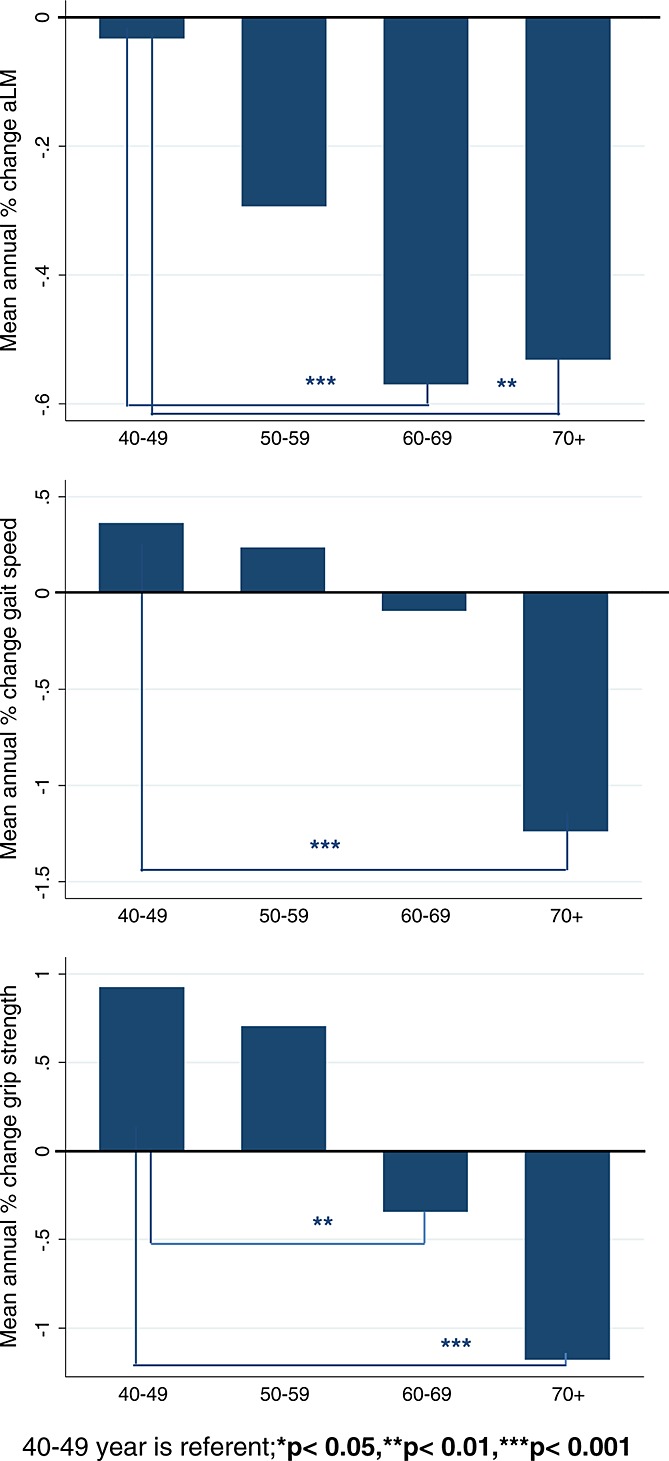
aLM significantly decreased from age 50 years, while gait speed and grip strength significantly decreased from age 70 years. The incidence of sarcopenia by the definitions of Baumgartner, IWGS, and EWGSOP was 8.1%, 3.0%, and 1.6%, respectively. After adjustment for age, centre, body mass index, smoking, and number of comorbidities at baseline, baseline levels of T and vitamin D metabolites were not associated with change in aLM, gait speed, and/or grip strength, while a high baseline level of total E2 was associated with a greater decrease in aLM. In men aged ≥70 years, low IGF-1 was associated with a greater decrease in gait speed. Baseline endocrine variables were not independently associated with an increased risk of incident sarcopenia by any definition.
Low levels of T and 25OHD do not predict loss of muscle mass, gait speed, or grip strength in middle-aged and elderly community-dwelling European men. Low IGF-1 predicts change in gait speed in men aged ≥70 years.
在男性中,血清性激素、维生素D代谢物和胰岛素样生长因子1(IGF-1)水平较低对肌肉量、肌肉力量或身体机能演变的长期影响尚不清楚。此外,关于这些激素与定义为低肌肉量和功能的肌肉减少症的发生之间的关系,尚无相关数据。本研究的目的是确定性激素、维生素D代谢物和IGF-1的基线水平是否能预测肌肉量、肌肉力量、身体机能的变化以及肌肉减少症的发生。
在518名年龄在40 - 79岁之间、参与欧洲男性衰老研究的男性中,在基线时评估了总睾酮、游离睾酮和生物可利用睾酮(T)、雌二醇(E)、性激素结合球蛋白、IGF-1、25-羟基维生素D(25OHD)、1,25-二羟基维生素D(1,25(OH)2D)和甲状旁腺激素。在基线时以及平均随访4.3年后测量了四肢瘦体重(aLM)、步速和握力。肌肉减少症根据鲍姆加特纳的定义(相对aLM≤7.26 kg/m²)、肌肉减少症国际工作组(IWGS)以及老年人肌肉减少症欧洲工作组(EWGSOP)的定义来定义。
aLM从50岁起显著下降,而步速和握力从70岁起显著下降。根据鲍姆加特纳、IWGS和EWGSOP的定义,肌肉减少症的发生率分别为8.1%、3.0%和1.6%。在对年龄、中心、体重指数、吸烟情况和基线时的合并症数量进行调整后,T和维生素D代谢物的基线水平与aLM、步速和/或握力的变化无关,而总E2的高基线水平与aLM的更大下降相关。在年龄≥70岁的男性中,低IGF-1与步速的更大下降相关。根据任何定义,基线内分泌变量均与肌肉减少症发生风险的增加无独立关联。
在欧洲社区居住的中老年男性中,低水平的T和25OHD不能预测肌肉量、步速或握力的丧失。低IGF-1可预测年龄≥70岁男性的步速变化。