Guercio Brendan J, Donovan Nancy J, Munro Catherine E, Aghjayan Sarah L, Wigman Sarah E, Locascio Joseph J, Amariglio Rebecca E, Rentz Dorene M, Johnson Keith A, Sperling Reisa A, Marshall Gad A
Harvard Medical School, Boston, MA, USA.
Center for Alzheimer Research and Treatment, Brigham and Women's Hospital, Boston, MA, USA.
J Alzheimers Dis. 2015;47(2):421-32. doi: 10.3233/JAD-150146.
Apathy is a common neuropsychiatric symptom in Alzheimer's disease (AD) dementia and mild cognitive impairment (MCI). Detecting apathy accurately may facilitate earlier diagnosis of AD. The Apathy Evaluation Scale (AES) is a promising tool for measurement of apathy in prodromal and possibly preclinical AD.
To compare the three AES sub-scales - subject-reported (AES-S), informant-reported (AES-I), and clinician-reported (AES-C) - over time in individuals at risk for AD due to MCI and advanced age (cognitively normal [CN] elderly).
Mixed effects longitudinal models were used to assess predictors of score for each AES sub-scale. Cox proportional hazards models were used to assess which AES sub-scales predict progression from MCI to AD dementia.
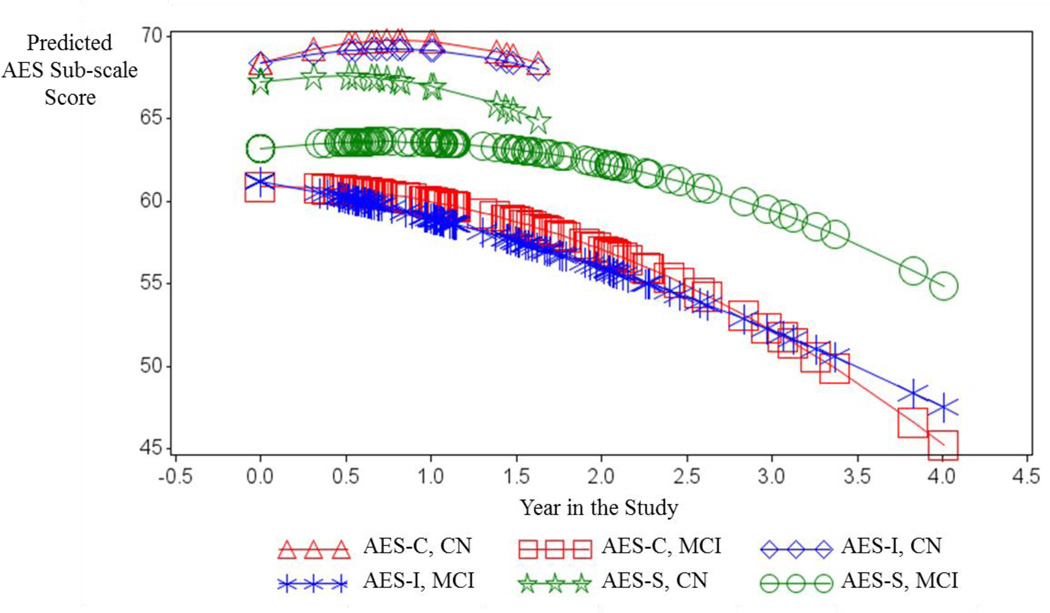
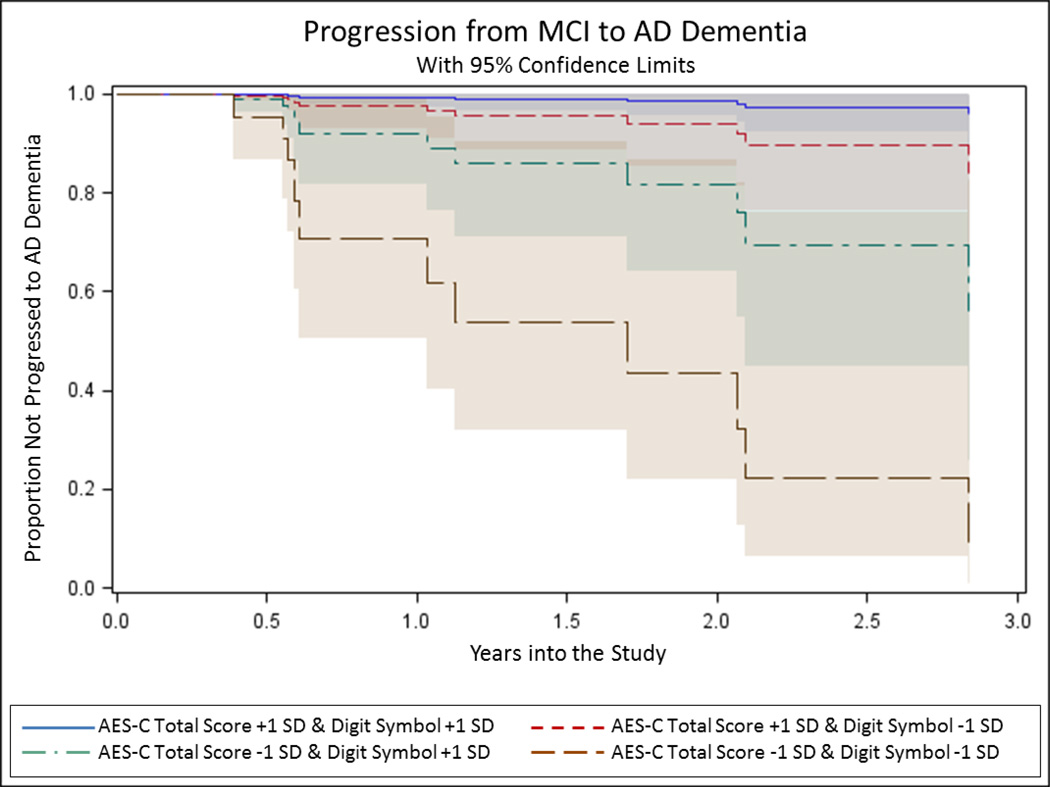
Fifty-seven MCI and 18 CN subjects (ages 53-86) were followed for 1.4 ± 1.2 years and 0.7 ± 0.7 years, respectively. Across the three mixed effects longitudinal models, the common findings were associations between greater apathy and greater years in study, a baseline diagnosis of MCI (compared to CN), and male gender. CN elderly self-reported greater apathy compared to that reported by informants and clinicians, while individuals with MCI under-reported their apathy compared to informants and clinicians. Of the three sub-scales, the AES-C best predicted transition from MCI to AD dementia.
In a sample of CN elderly and elderly with MCI, apathy increased over time, particularly in men and those with MCI. AES-S scores may be more sensitive than AES-I and AES-C scores in CN elderly, but less reliable if subjects have MCI. Moreover, the AES-C sub-scale predicted progression from MCI to AD dementia.
冷漠是阿尔茨海默病(AD)痴呆和轻度认知障碍(MCI)中常见的神经精神症状。准确检测冷漠可能有助于AD的早期诊断。冷漠评估量表(AES)是一种很有前景的工具,可用于测量前驱期甚至可能是临床前期AD中的冷漠。
比较AES的三个子量表——受试者报告(AES-S)、知情者报告(AES-I)和临床医生报告(AES-C)——在因MCI和高龄(认知正常[CN]老年人)而有AD风险的个体中随时间的变化情况。
使用混合效应纵向模型评估每个AES子量表得分的预测因素。使用Cox比例风险模型评估哪些AES子量表可预测从MCI进展为AD痴呆。
57名MCI患者和18名CN受试者(年龄53 - 86岁)分别随访了1.4±1.2年和0.7±0.7年。在三个混合效应纵向模型中,共同的发现是冷漠程度越高与研究年限越长、MCI的基线诊断(与CN相比)以及男性性别之间存在关联。CN老年人自我报告的冷漠程度高于知情者和临床医生报告的,而MCI患者与知情者和临床医生相比,对自己的冷漠程度报告不足。在这三个子量表中,AES-C最能预测从MCI到AD痴呆的转变。
在CN老年人和MCI老年人样本中,冷漠随时间增加,尤其是在男性和MCI患者中。AES-S得分在CN老年人中可能比AES-I和AES-C得分更敏感,但如果受试者患有MCI则可靠性较低。此外,AES-C子量表可预测从MCI到AD痴呆的进展。