Lee Charmaine Pei Ling, Choi Hyungwon, Soo Khee Chee, Tan Min-Han, Chay Wen Yee, Chia Kee Seng, Liu Jenny, Li Jingmei, Hartman Mikael
NUS Graduate School for Integrative Sciences and Engineering, National University of Singapore, Singapore, Singapore; Saw Swee Hock School of Public Health, National University of Singapore, Singapore, Singapore.
Saw Swee Hock School of Public Health, National University of Singapore, Singapore, Singapore.
PLoS One. 2015 Sep 24;10(9):e0136650. doi: 10.1371/journal.pone.0136650. eCollection 2015.
Known prediction models for breast cancer can potentially by improved by the addition of mammographic density and common genetic variants identified in genome-wide associations studies known to be associated with risk of the disease. We evaluated the benefit of including mammographic density and the cumulative effect of genetic variants in breast cancer risk prediction among women in a Singapore population.
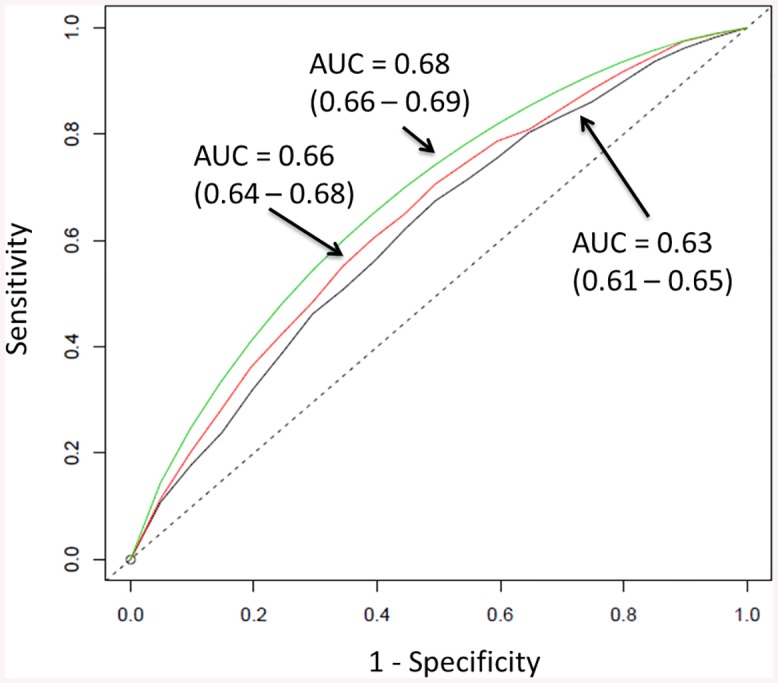
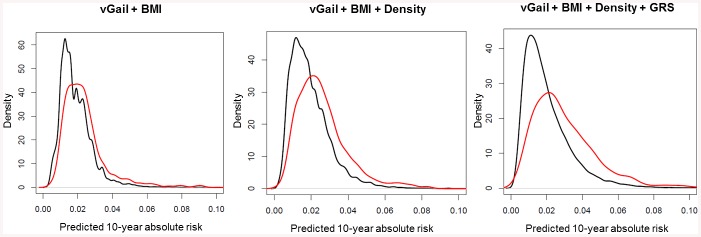
We estimated the risk of breast cancer using a prospective cohort of 24,161 women aged 50 to 64 from Singapore with available mammograms and known risk factors for breast cancer who were recruited between 1994 and 1997. We measured mammographic density using the medio-lateral oblique views of both breasts. Each woman's genotype for 75 SNPs was simulated based on the genotype frequency obtained from the Breast Cancer Association Consortium data and the cumulative effect was summarized by a genetic risk score (GRS). Any improvement in the performance of our proposed prediction model versus one containing only variables from the Gail model was assessed by changes in receiver-operating characteristic and predictive values.
During 17 years of follow-up, 680 breast cancer cases were diagnosed. The multivariate-adjusted hazard ratios (95% confidence intervals) were 1.60 (1.22-2.10), 2.20 (1.65-2.92), 2.33 (1.71-3.20), 2.12 (1.43-3.14), and 3.27 (2.24-4.76) for the corresponding mammographic density categories: 11-20cm2, 21-30cm2, 31-40cm2, 41-50cm2, 51-60cm2, and 1.10 (1.03-1.16) for GRS. At the predicted absolute 10-year risk thresholds of 2.5% and 3.0%, a model with mammographic density and GRS could correctly identify 0.9% and 0.5% more women who would develop the disease compared to a model using only the Gail variables, respectively.
Mammographic density and common genetic variants can improve the discriminatory power of an established breast cancer risk prediction model among females in Singapore.
通过纳入乳房X线密度以及全基因组关联研究中确定的与乳腺癌风险相关的常见基因变异,已知的乳腺癌预测模型可能会得到改进。我们评估了纳入乳房X线密度和基因变异的累积效应在新加坡女性人群乳腺癌风险预测中的益处。
我们使用一个前瞻性队列对24161名年龄在50至64岁之间的新加坡女性进行乳腺癌风险评估,这些女性有可用的乳房X线照片且已知乳腺癌风险因素,她们于1994年至1997年期间被招募。我们使用双侧乳房的内外斜位视图测量乳房X线密度。根据从乳腺癌协会联盟数据中获得的基因型频率模拟每位女性75个单核苷酸多态性(SNP)的基因型,并通过遗传风险评分(GRS)总结累积效应。通过受试者工作特征曲线和预测值的变化评估我们提出的预测模型相对于仅包含盖尔模型变量的模型在性能上的任何改进。
在17年的随访期间,确诊了680例乳腺癌病例。对于相应的乳房X线密度类别:11 - 20平方厘米、21 - 30平方厘米、31 - 40平方厘米、41 - 50平方厘米、51 - 60平方厘米,多变量调整后的风险比(95%置信区间)分别为1.60(1.22 - 2.10)、2.20(1.65 - 2.92)、2.33(1.71 - 3.20)、2.12(1.43 - 3.14)和3.27(2.24 - 4.76),GRS的风险比为1.10(1.03 - 1.16)。在预测的10年绝对风险阈值为2.5%和