Michaud Tzeyu L, Kane Robert L, McCarten J Riley, Gaugler Joseph E, Nyman John A, Kuntz Karen M
Division of Health Policy and Management, School of Public Health, University of Minnesota, Minneapolis, MN, USA.
Geriatric Research, Education and Clinical Center, Minneapolis Veterans Affairs Medical Center, Minneapolis, MN, USA.
J Alzheimers Dis. 2015;47(3):729-40. doi: 10.3233/JAD-150066.
Cerebrospinal fluid (CSF) biomarkers can distinguish Alzheimer's disease (AD) patients from normal controls; however, their interpretation and potential for use in patients with mild cognitive impairment (MCI) remains unclear.
To examine whether biomarker levels allow for risk stratification among MCI patients who are at increased risk to develop AD, thus allowing for improved targeting of early interventions for those whose risk are higher.
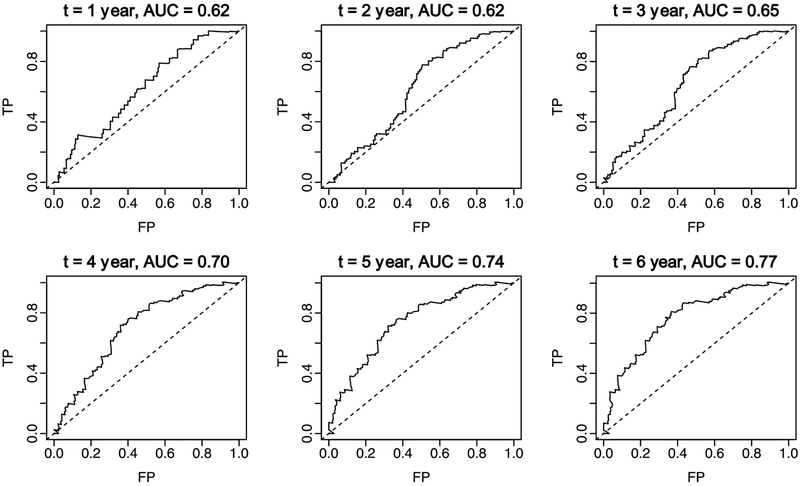
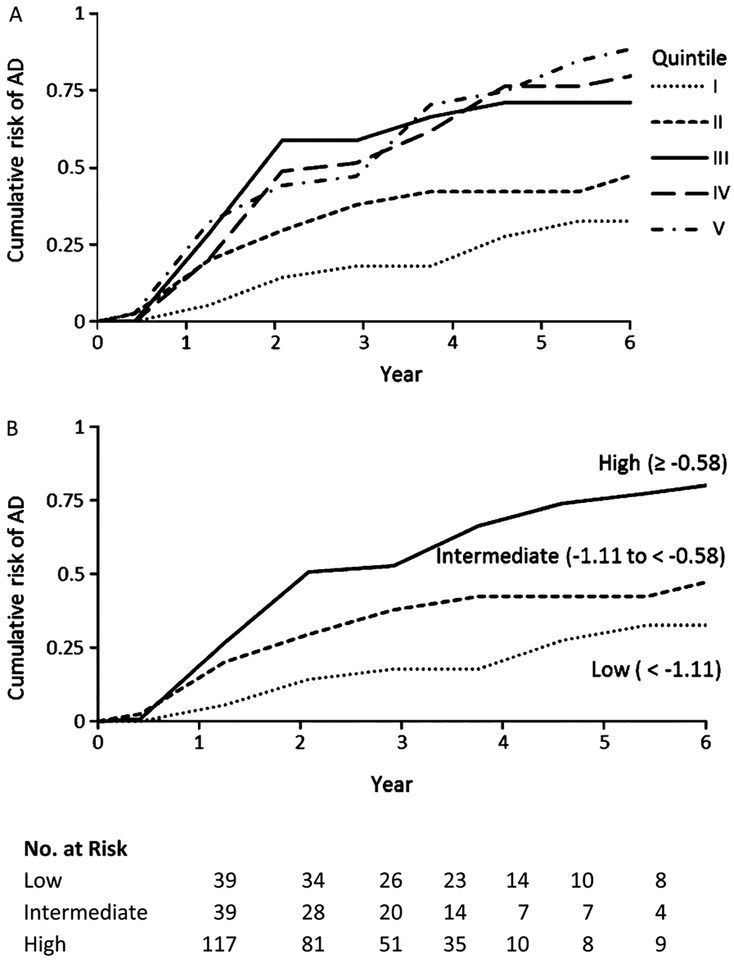
We analyzed data from the Alzheimer's Disease Neuroimaging Initiative on MCI patients (n = 195) to estimate their risk of developing AD for up to 6 years on the basis of baseline CSF biomarkers. We used time-dependent receiver operating characteristic analysis to identify the best combination of biomarkers to discriminate those who converted to AD from those who remained stable. We used these data to construct a multi-biomarker score and estimated the risk of progression to AD for each quintile of the multi-biomarker score.
We found that Aβ(1-42) and P-tau(181p) were the best combination among CSF biomarkers to predict the overall risk of developing AD among MCI patients (area under the curve = 0.77). The hazard ratio of developing AD among MCI patients with high-risk (3rd-5th quintiles) biomarker levels was about 4 times greater than MCI patients with low-risk (1st quintile) levels (95% confidence interval, 1.93-7.26).
Our study identifies MCI patients at increased risk of developing AD by applying a multi-biomarker score using CSF biomarker results. Our findings may be of value to MCI patients and their clinicians for planning purposes and early intervention as well as for future clinical trials.
脑脊液(CSF)生物标志物可区分阿尔茨海默病(AD)患者与正常对照;然而,其在轻度认知障碍(MCI)患者中的解读及应用潜力仍不明确。
研究生物标志物水平是否能对有发展为AD高风险的MCI患者进行风险分层,从而使针对高风险患者的早期干预目标更明确。
我们分析了阿尔茨海默病神经影像倡议中MCI患者(n = 195)的数据,根据基线脑脊液生物标志物评估他们未来6年内发展为AD的风险。我们采用时间依赖性受试者工作特征分析来确定能区分转化为AD的患者与病情稳定患者的最佳生物标志物组合。我们利用这些数据构建多生物标志物评分,并估计多生物标志物评分各五分位数发展为AD的进展风险。
我们发现,Aβ(1 - 42)和P - tau(181p)是脑脊液生物标志物中预测MCI患者发展为AD总体风险的最佳组合(曲线下面积 = 0.77)。生物标志物水平处于高风险(第3 - 5五分位数)的MCI患者发展为AD的风险比处于低风险(第1五分位数)的MCI患者高约4倍(95%置信区间,1.93 - 7.26)。
我们的研究通过应用基于脑脊液生物标志物结果的多生物标志物评分,识别出有发展为AD高风险的MCI患者。我们的发现可能对MCI患者及其临床医生在规划、早期干预以及未来临床试验方面具有价值。