Feng Wei, Yokoyama Jennifer S, Yu Shunying, Chen You, Cheng Yan, Bonham Luke W, Wang Dongxiang, Shen Yuan, Wu Wenyuan, Li Chunbo
Department of Psychiatry, Tongji Hospital, Tongji University, Shanghai, P.R. China.
Memory and Aging Center, Department of Neurology, University of California, San Francisco, California, USA.
J Alzheimers Dis. 2015;47(4):1035-46. doi: 10.3233/JAD-150039.
Cognitive training may contribute to the ability to maintain cognitive function in healthy elderly adults. Whether genotype modifies training effects remains unknown.
Assess influence of APOE on cognitive function over time in community-dwelling elderly adults participating in multi-domain cognitive training.
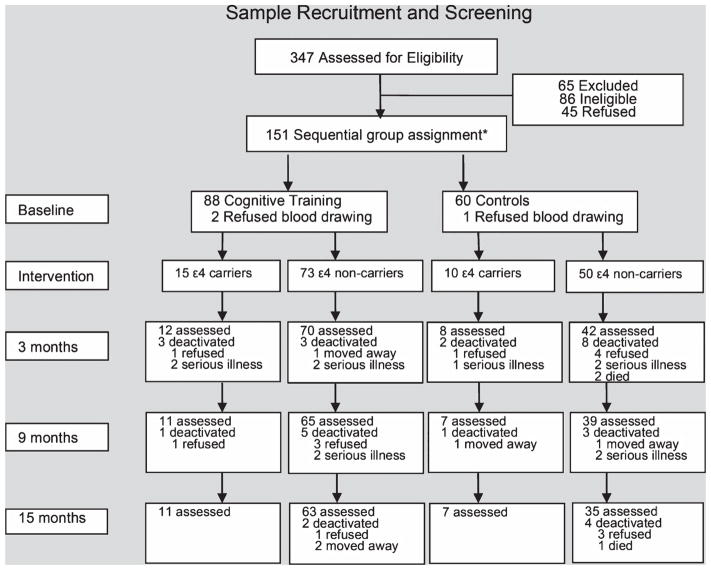
Healthy individuals ≥70 years of age were screened from one urban community in Shanghai. 145 healthy Chinese older adults met inclusion criteria and were assigned to intervention (n = 88) or control (n = 57) groups. Multi-domain cognitive training involved 24 sessions of different content taking place over 12 weeks. Neuropsychological testing was administered at baseline, immediately after training, six months and twelve months post-intervention; composite measures of cognitive function were identified via factor analysis.
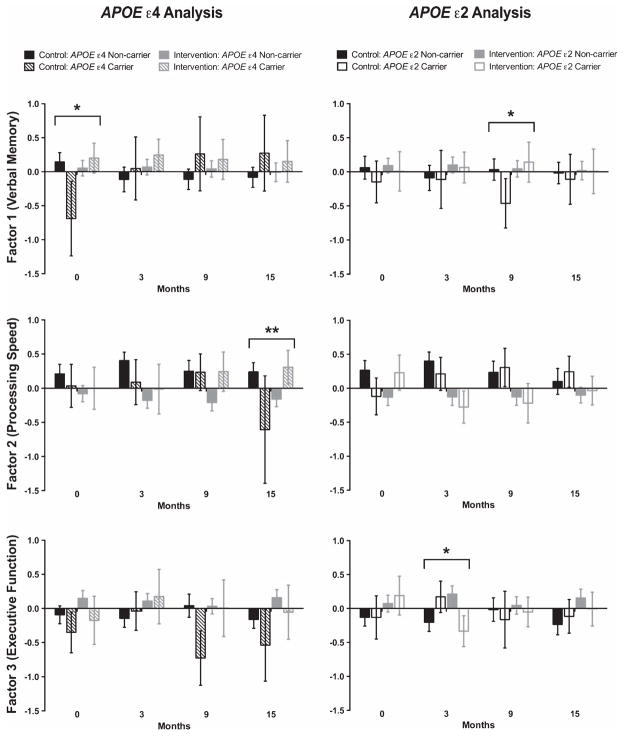
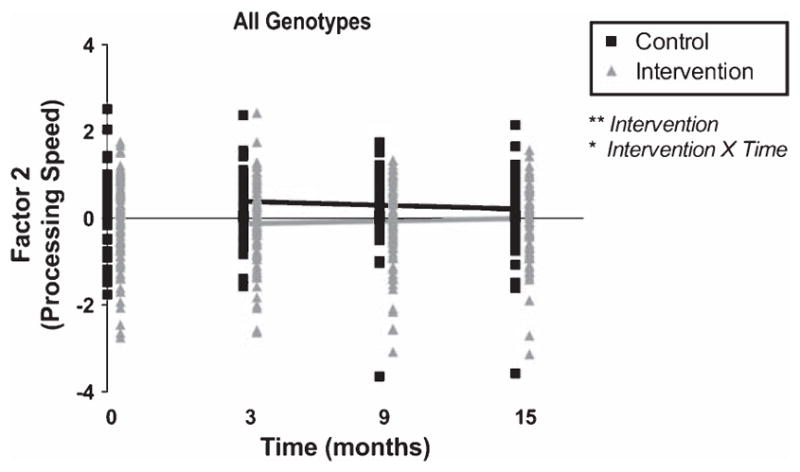
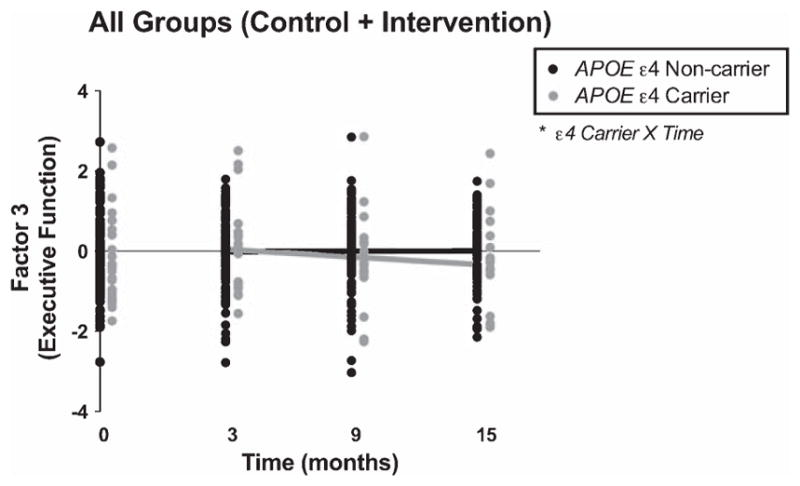
Three factors explained the majority of variance in function (verbal memory, processing speed, executive function). The intervention attenuated 12-month declines in processing speed, regardless of APOE genotype (p = 0.047). Executive function declined in APOEɛ4 carriers over 12 months, regardless of intervention (p = 0.056). There was a significant interaction after 12 months where intervention ɛ4 carriers had better processing speed than ɛ4 controls (p = 0.003). Intervention ɛ2 carriers had better executive function immediately after training (p = 0.02) and had better verbal memory 6-months post-intervention (p = 0.04). These effects remained significant after false-discovery rate correction.
Multi-domain cognitive training reduces declines in processing speed over time. APOEɛ4 is associated with reductions in executive function over time, and training may attenuate ɛ4-associated declines in processing speed. APOEɛ2 carriers may also benefit from training, particularly on measures of executive function and verbal memory.
认知训练可能有助于健康老年人维持认知功能。基因类型是否会改变训练效果尚不清楚。
评估载脂蛋白E(APOE)对参与多领域认知训练的社区居住老年人随时间变化的认知功能的影响。
从上海的一个城市社区筛选出年龄≥70岁的健康个体。145名健康的中国老年人符合纳入标准,被分为干预组(n = 88)或对照组(n = 57)。多领域认知训练包括在12周内进行24节不同内容的课程。在基线、训练结束后立即、干预后6个月和12个月进行神经心理学测试;通过因子分析确定认知功能的综合指标。
三个因素解释了功能变异的大部分(言语记忆、处理速度、执行功能)。无论APOE基因类型如何,干预均减轻了处理速度在12个月时的下降(p = 0.047)。无论是否干预,APOEɛ4携带者的执行功能在12个月内均下降(p = 0.056)。12个月后存在显著交互作用,干预组的ɛ4携带者比ɛ4对照组具有更好的处理速度(p = 0.003)。干预组的ɛ2携带者在训练后立即具有更好的执行功能(p = 0.02),在干预后6个月具有更好的言语记忆(p = 0.04)。在错误发现率校正后,这些效应仍然显著。
多领域认知训练可随时间减少处理速度的下降。APOEɛ4与执行功能随时间的下降有关,训练可能减轻与ɛ4相关的处理速度下降。APOEɛ2携带者也可能从训练中受益,特别是在执行功能和言语记忆方面。