Schmöle Anne-Caroline, Lundt Ramona, Gennequin Benjamin, Schrage Hanna, Beins Eva, Krämer Alexandra, Zimmer Till, Limmer Andreas, Zimmer Andreas, Otte David-Marian
Institute of Molecular Psychiatry, University of Bonn, Bonn, Germany.
Clinic for Orthopaedics and Trauma Surgery, University of Bonn, Bonn, Germany.
PLoS One. 2015 Sep 25;10(9):e0138986. doi: 10.1371/journal.pone.0138986. eCollection 2015.
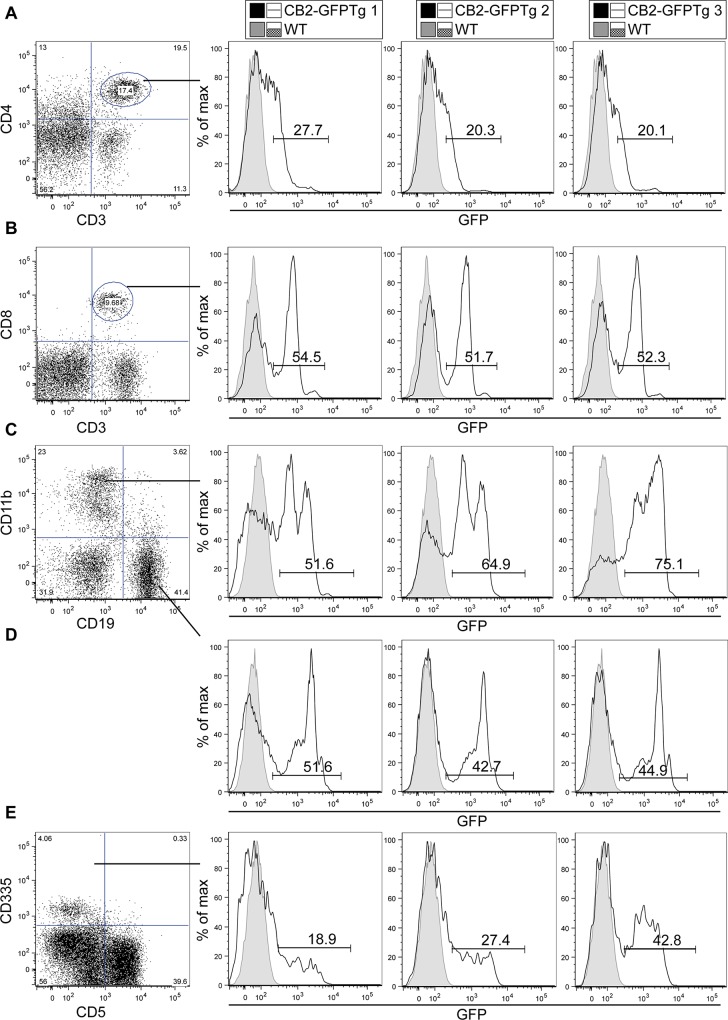
The endocannabinoid system (ECS) is a retrograde messenger system, consisting of lipid signaling molecules that bind to at least two G-protein-coupled receptors, Cannabinoid receptor 1 and 2 (CB1 and 2). As CB2 is primarily expressed on immune cells such as B cells, T cells, macrophages, dendritic cells, and microglia, it is of great interest how CB2 contributes to immune cell development and function in health and disease. Here, understanding the mechanisms of CB2 involvement in immune-cell function as well as the trafficking and regulation of CB2 expressing cells are crucial issues. Up to now, CB2 antibodies produce unclear results, especially those targeting the murine protein. Therefore, we have generated BAC transgenic GFP reporter mice (CB2-GFPTg) to trace CB2 expression in vitro and in situ. Those mice express GFP under the CB2 promoter and display GFP expression paralleling CB2 expression on the transcript level in spleen, thymus and brain tissue. Furthermore, by using fluorescence techniques we show that the major sources for GFP-CB2 expression are B cells in spleen and blood and microglia in the brain. This novel CB2-GFP transgenic reporter mouse line represents a powerful resource to study CB2 expression in different cell types. Furthermore, it could be used for analyzing CB2-mediated mobilization and trafficking of immune cells as well as studying the fate of recruited immune cells in models of acute and chronic inflammation.
内源性大麻素系统(ECS)是一种逆行信使系统,由脂质信号分子组成,这些分子可与至少两种G蛋白偶联受体,即大麻素受体1和2(CB1和CB2)结合。由于CB2主要在免疫细胞如B细胞、T细胞、巨噬细胞、树突状细胞和小胶质细胞上表达,因此CB2如何在健康和疾病状态下对免疫细胞的发育和功能产生影响备受关注。在此,了解CB2参与免疫细胞功能的机制以及CB2表达细胞的运输和调节是关键问题。到目前为止,CB2抗体产生的结果不明确,尤其是针对鼠蛋白的抗体。因此,我们构建了BAC转基因绿色荧光蛋白报告小鼠(CB2-GFPTg),用于在体外和原位追踪CB2的表达。这些小鼠在CB2启动子的控制下表达绿色荧光蛋白,并在脾脏、胸腺和脑组织的转录水平上显示出与CB2表达平行的绿色荧光蛋白表达。此外,通过荧光技术我们发现,绿色荧光蛋白-CB2表达的主要来源是脾脏和血液中的B细胞以及脑中的小胶质细胞。这种新型的CB2-绿色荧光蛋白转基因报告小鼠品系是研究不同细胞类型中CB2表达的有力资源。此外,它可用于分析CB2介导的免疫细胞动员和运输,以及研究急性和慢性炎症模型中募集的免疫细胞的命运。