Magnuszewski Piotr, Ostasiewicz Katarzyna, Chazdon Robin, Salk Carl, Pajak Michal, Sendzimir Jan, Andersson Krister
Risk, Policy and Vulnerability Program, International Institute for Applied Systems Analysis, Laxenburg, Austria; Centre for Systems Solutions, Wroclaw, Poland.
Risk, Policy and Vulnerability Program, International Institute for Applied Systems Analysis, Laxenburg, Austria; Department of statistics, Wroclaw University Of Economics, Wroclaw, Poland.
PLoS One. 2015 Sep 25;10(9):e0137497. doi: 10.1371/journal.pone.0137497. eCollection 2015.
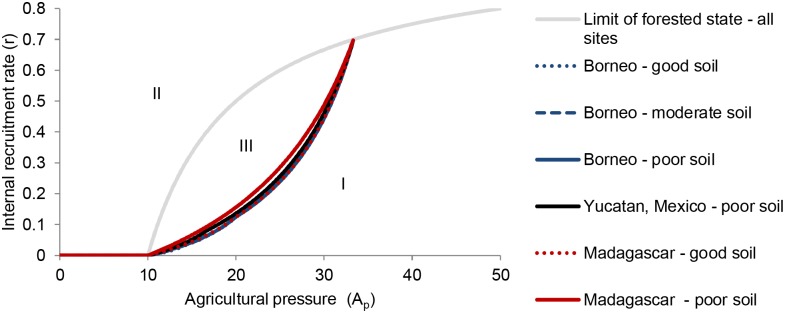
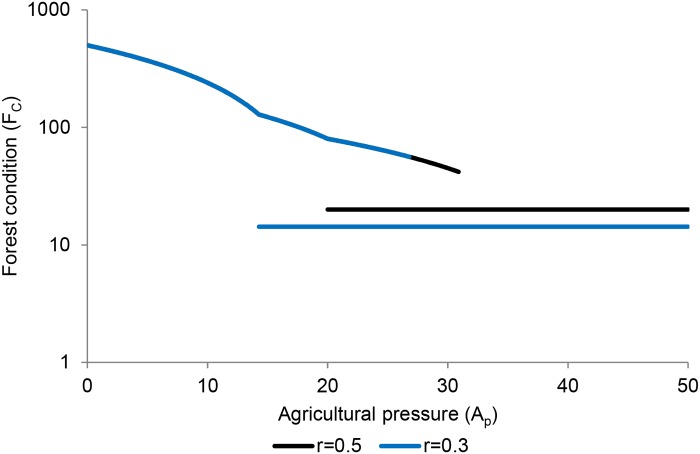
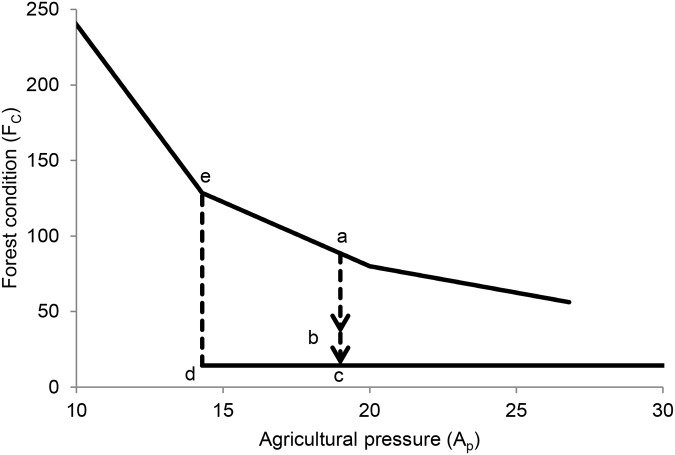
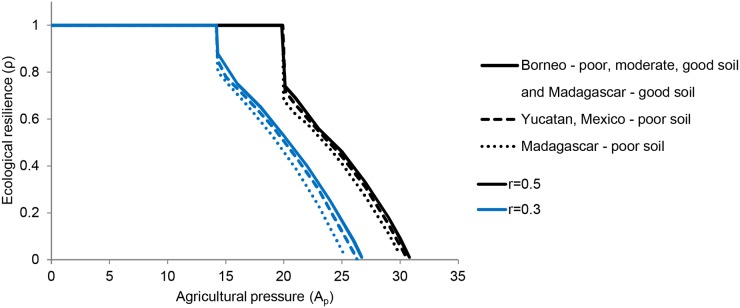
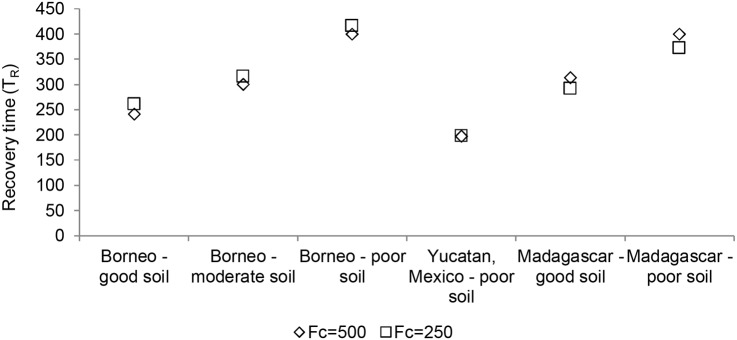
Shifting cultivation is a traditional agricultural practice in most tropical regions of the world and has the potential to provide for human livelihoods while hosting substantial biodiversity. Little is known about the resilience of shifting cultivation to increasing agricultural demands on the landscape or to unexpected disturbances. To investigate these issues, we develop a simple social-ecological model and implement it with literature-derived ecological parameters for six shifting cultivation landscapes from three continents. Analyzing the model with the tools of dynamical systems analysis, we show that such landscapes exhibit two stable states, one characterized by high forest cover and agricultural productivity, and another with much lower values of these traits. For some combinations of agricultural pressure and ecological parameters both of these states can potentially exist, and the actual state of the forest depends critically on its historic state. In many cases, the landscapes' 'ecological resilience', or amount of forest that could be destroyed without shifting out of the forested stability domain, declined substantially at lower levels of agricultural pressure than would lead to maximum productivity. A measure of 'engineering resilience', the recovery time from standardized disturbances, was independent of ecological resilience. These findings suggest that maximization of short-term agricultural output may have counterproductive impacts on the long-term productivity of shifting cultivation landscapes and the persistence of forested areas.
轮垦是世界上大多数热带地区的一种传统农业生产方式,它在维系丰富生物多样性的同时,还具备保障人类生计的潜力。人们对轮垦应对农业需求增加以及意外干扰的恢复力了解甚少。为了探究这些问题,我们构建了一个简单的社会生态模型,并运用来自文献的生态参数,对来自三大洲的六个轮垦景观进行了模拟。通过运用动力系统分析工具对模型进行分析,我们发现这些景观呈现出两种稳定状态,一种以高森林覆盖率和农业生产力为特征,另一种则在这些特征方面的值要低得多。对于农业压力和生态参数的某些组合,这两种状态都有可能存在,而森林的实际状态关键取决于其历史状态。在许多情况下,景观的“生态恢复力”,即不超出森林稳定区域的情况下能够被破坏的森林量,在农业压力水平低于实现最大生产力所需水平时就大幅下降。衡量“工程恢复力”的标准化干扰后的恢复时间,与生态恢复力无关。这些发现表明,短期农业产出最大化可能会对轮垦景观的长期生产力以及森林区域的持久性产生适得其反的影响。