Albrich Katharina, Rammer Werner, Turner Monica G, Ratajczak Zak, Braziunas Kristin H, Hansen Winslow D, Seidl Rupert
Institute of Silviculture University of Natural Resources and Life Sciences (BOKU) Vienna Wien Austria.
Ecosystem Dynamics and Forest Management Group Technical University of Munich Freising Germany.
Glob Ecol Biogeogr. 2020 Dec;29(12):2082-2096. doi: 10.1111/geb.13197. Epub 2020 Oct 8.
Simulation models are important tools for quantifying the resilience (i.e., persistence under changed environmental conditions) of forest ecosystems to global change. We synthesized the modelling literature on forest resilience, summarizing common models and applications in resilience research, and scrutinizing the implementation of important resilience mechanisms in these models. Models applied to assess resilience are highly diverse, and our goal was to assess how well they account for important resilience mechanisms identified in experimental and empirical research.
Global.
1994 to 2019.
Trees.
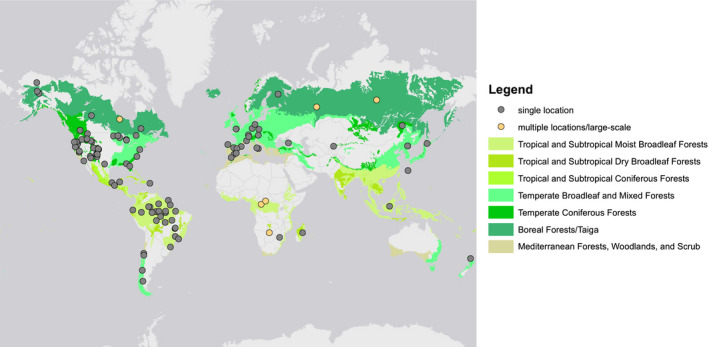
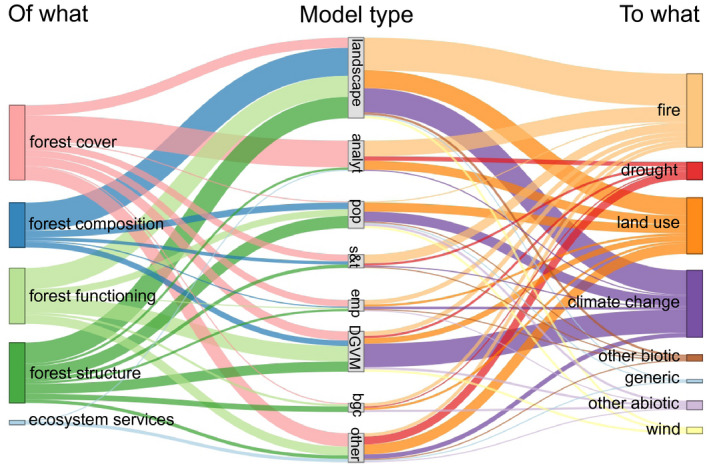
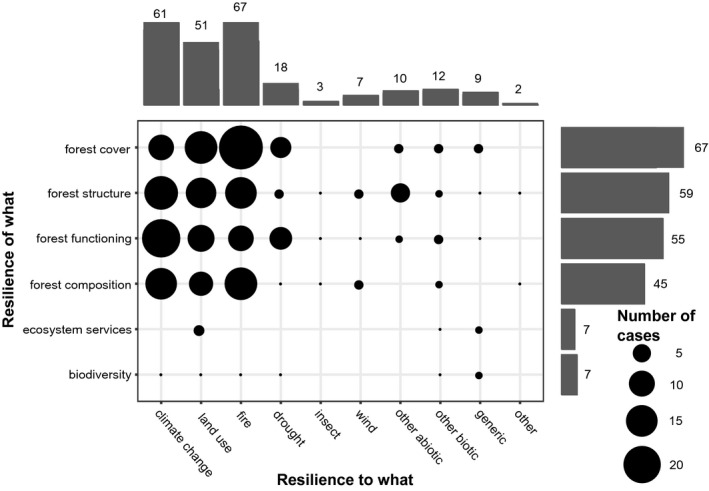
We reviewed the forest resilience literature using online databases, selecting 119 simulation modelling studies for further analysis. We identified a set of resilience mechanisms from the general resilience literature and analysed models for their representation of these mechanisms. Analyses were grouped by investigated drivers (resilience to what) and responses (resilience of what), as well as by the type of model being used.
Models used to study forest resilience varied widely, from analytical approaches to complex landscape simulators. The most commonly addressed questions were associated with resilience of forest cover to fire. Important resilience mechanisms pertaining to regeneration, soil processes, and disturbance legacies were explicitly simulated in only 34 to 46% of the model applications.
We found a large gap between processes identified as underpinning forest resilience in the theoretical and empirical literature, and those represented in models used to assess forest resilience. Contemporary forest models developed for other goals may be poorly suited for studying forest resilience during an era of accelerating change. Our results highlight the need for a new wave of model development to enhance understanding of and management for resilient forests.
模拟模型是量化森林生态系统对全球变化的恢复力(即在变化的环境条件下的持久性)的重要工具。我们综合了关于森林恢复力的建模文献,总结了恢复力研究中的常见模型和应用,并审视了这些模型中重要恢复力机制的实施情况。用于评估恢复力的模型种类繁多,我们的目标是评估它们对实验和实证研究中确定的重要恢复力机制的解释程度。
全球。
1994年至2019年。
树木。
我们使用在线数据库回顾了森林恢复力文献,选择了119项模拟建模研究进行进一步分析。我们从一般恢复力文献中确定了一组恢复力机制,并分析模型对这些机制的表述。分析按调查驱动因素(对什么的恢复力)和响应(什么的恢复力)以及所使用模型的类型进行分组。
用于研究森林恢复力的模型差异很大,从分析方法到复杂的景观模拟器。最常涉及的问题与森林覆盖对火灾的恢复力有关。在仅34%至46%的模型应用中明确模拟了与再生、土壤过程和干扰遗留物相关的重要恢复力机制。
我们发现,理论和实证文献中确定为支撑森林恢复力的过程与用于评估森林恢复力的模型中所体现的过程之间存在很大差距。为其他目标开发的当代森林模型可能不太适合研究加速变化时代的森林恢复力。我们的结果凸显了需要新一轮的模型开发,以加强对恢复力强的森林的理解和管理。