Wu Yao, Xie Guanghui, Xu Yanyong, Ma Li, Tong Chuanfeng, Fan Daping, Du Fen, Yu Hong
Department of Biochemistry and Molecular Biology, Hubei Provincial Key Laboratory of Developmentally Originated Disease, Wuhan University School of Basic Medical Sciences, 185 Donghu Road, Bldg. 2, 2-209, Wuhan, 430071, Hubei, China.
Cardiology Division of Wuhan University Zhongnan Hospital, Wuhan, China.
J Transl Med. 2015 Sep 26;13:316. doi: 10.1186/s12967-015-0677-8.
Methionine sulfoxide reductase A (MsrA) is a potent intracellular oxidoreductase and serves as an essential factor that protects cells against oxidative damage. However, therapeutic use of exogenous MsrA in oxidative stress-induced diseases is limited, because it cannot enter the cells. The aim of this study is to investigate whether MsrA with PEP-1, a cell penetrating peptide, fused to its N-terminus can protect against oxidative stress in macrophages and can attenuate atherosclerosis in apolipoprotein E deficient (apoE(-/-)) mice.
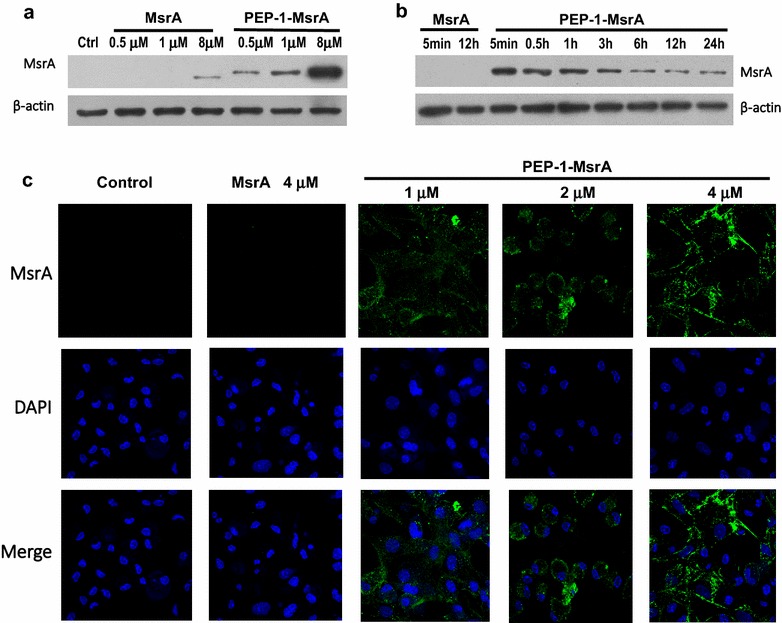
MsrA and the fusion protein PEP-1-MsrA were expressed and purified using a pET28a expression system. Transduction of the fusion protein into macrophages was confirmed by Western blot and immunofluorescence staining. Intracellular reactive oxygen species (ROS) and apoptosis levels were measured by flow cytometry. In in vivo study, MsrA or PEP-1-MsrA proteins were intraperitoneally injected into apoE(-/-) mice fed a Western diet for 12 weeks. Plasma lipids levels, inflammatory gene expression, and paraoxonase-1 (PON1) and superoxide dismutase (SOD) activities were assessed. Atherosclerotic lesions were analyzed by Oil Red O staining and immunohistochemistry.
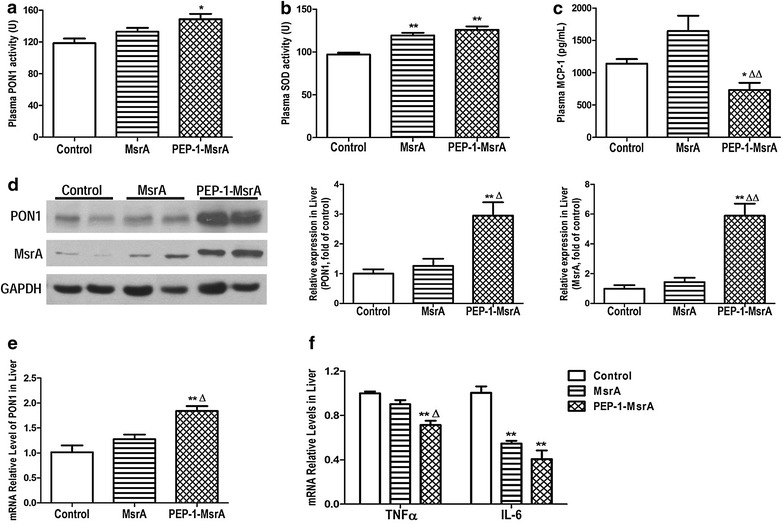
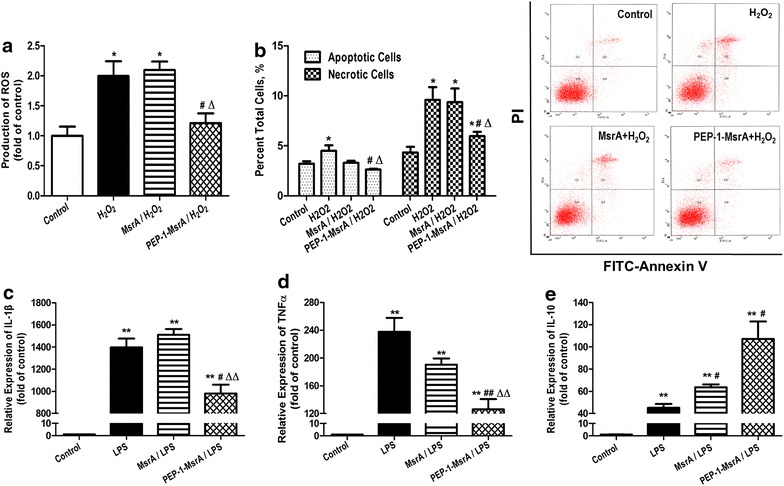
PEP-1-MsrA could penetrate the cells and significantly reduced intracellular ROS levels and apoptosis in H2O2-treated macrophages. It also decreased TNFα and IL-1β mRNA levels and increased the IL-10 mRNA level in lipopolysaccharide-treated macrophages. In in vivo study, PEP-1-MsrA injection significantly increased plasma PON1 and SOD activities and decreased plasma monocyte chemoattractant protein 1 (MCP-1) level compared to the injection of vehicle control or MsrA. In PEP-1-MsrA injected mice, hepatic PON1 levels were increased, while the expression of TNFα and IL-6 mRNA in the liver was suppressed. Although plasma total cholesterol and triglyceride levels did not change, the aortic atherosclerosis in PEP-1-MsrA treated mice was significantly reduced. This was accompanied by a reduction of total and apoptotic macrophages in the lesions.
Our study provides evidence that PEP-1-MsrA may be a potential therapeutic agent for atherosclerosis-related cardiovascular diseases.
甲硫氨酸亚砜还原酶A(MsrA)是一种强大的细胞内氧化还原酶,是保护细胞免受氧化损伤的重要因素。然而,外源性MsrA在氧化应激诱导的疾病中的治疗应用有限,因为它无法进入细胞。本研究的目的是探讨N端融合细胞穿透肽PEP-1的MsrA是否能保护巨噬细胞免受氧化应激,并减轻载脂蛋白E缺陷(apoE(-/-))小鼠的动脉粥样硬化。
使用pET28a表达系统表达并纯化MsrA和融合蛋白PEP-1-MsrA。通过蛋白质印迹法和免疫荧光染色确认融合蛋白转导至巨噬细胞。通过流式细胞术测量细胞内活性氧(ROS)水平和凋亡水平。在体内研究中,将MsrA或PEP-1-MsrA蛋白腹腔注射到喂食西式饮食12周的apoE(-/-)小鼠体内。评估血浆脂质水平、炎症基因表达以及对氧磷酶-1(PON1)和超氧化物歧化酶(SOD)活性。通过油红O染色和免疫组织化学分析动脉粥样硬化病变。
PEP-1-MsrA可穿透细胞,并显著降低H2O2处理的巨噬细胞内的ROS水平和凋亡。它还降低了脂多糖处理的巨噬细胞中TNFα和IL-1β的mRNA水平,并增加了IL-10的mRNA水平。在体内研究中,与注射载体对照或MsrA相比,注射PEP-1-MsrA显著提高了血浆PON1和SOD活性,并降低了血浆单核细胞趋化蛋白1(MCP-1)水平。在注射PEP-1-MsrA的小鼠中,肝脏PON1水平升高,而肝脏中TNFα和IL-6的mRNA表达受到抑制。虽然血浆总胆固醇和甘油三酯水平没有变化,但PEP-1-MsrA处理的小鼠的主动脉粥样硬化明显减轻。这伴随着病变中总巨噬细胞和凋亡巨噬细胞的减少。
我们的研究提供了证据,表明PEP-1-MsrA可能是动脉粥样硬化相关心血管疾病的潜在治疗剂。