Mills Melinda C, Tropf Felix C
Department of Sociology and Nuffield College, University of Oxford, 1 New Road, OX1 1NF Oxford, UK.
Department of Sociology, Interuniversity Center for Social Science Theory and Methodology (ICS), University of Groningen, Grote Rozenstraat 31, 9712 Groningen, TG The Netherlands.
Kolner Z Soz Sozpsychol. 2015;67(Suppl 1):397-424. doi: 10.1007/s11577-015-0319-4.
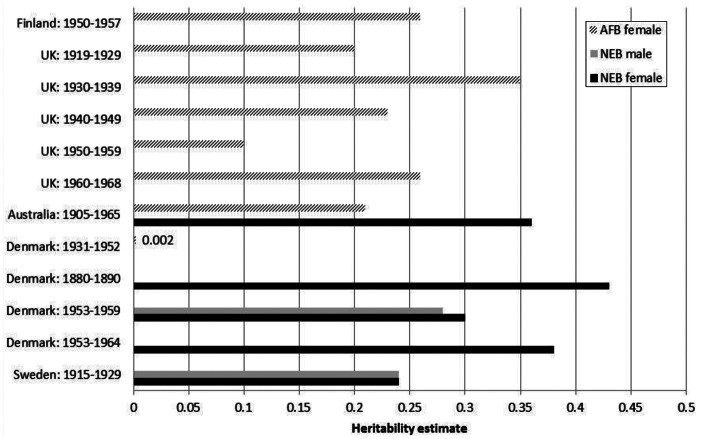
The social sciences have been reticent to integrate a biodemographic approach to the study of fertility choice and behaviour, resulting in theories and findings that are largely socially-deterministic. The aim of this paper is to first reflect on reasons for this lack of integration, provide a review of previous examinations, take stock of what we have learned until now and propose future research frontiers. We review the early foundations of proximate determinants followed by behavioural genetic (family and twin) studies that isolated the extent of genetic influence on fertility traits. We then discuss research that considers gene and environment interaction and the importance of cohort and country-specific estimates, followed by multivariate models that explore motivational precursors to fertility and education. The next section on molecular genetics reviews fertility-related candidate gene studies and their shortcomings and on-going work on genome wide association studies. Work in evolutionary anthropology and biology is then briefly examined, focusing on evidence for natural selection. Biological and genetic factors are relevant in explaining and predicting fertility traits, with socio-environmental factors and their interaction still key in understanding outcomes. Studying the interplay between genes and the environment, new data sources and integration of new methods will be central to understanding and predicting future fertility trends.
社会科学在将生物人口学方法纳入生育选择与行为研究方面一直较为保守,这导致相关理论和研究结果在很大程度上具有社会决定论的特点。本文旨在首先反思这种缺乏整合的原因,回顾以往的研究,总结我们目前所学到的内容,并提出未来的研究前沿方向。我们先回顾了近因决定因素的早期基础,接着是行为遗传学(家庭和双胞胎)研究,这些研究确定了基因对生育特征的影响程度。然后我们讨论了考虑基因与环境相互作用以及队列和国家特定估计重要性的研究,随后是探索生育和教育动机前因的多变量模型。关于分子遗传学的下一部分回顾了与生育相关的候选基因研究及其缺点,以及正在进行的全基因组关联研究工作。接着简要考察了进化人类学和生物学方面的研究,重点是自然选择的证据。生物和遗传因素在解释和预测生育特征方面具有相关性,而社会环境因素及其相互作用在理解结果方面仍然至关重要。研究基因与环境之间的相互作用、新的数据来源以及新方法的整合,将是理解和预测未来生育趋势的核心。