Amaya Clarissa N, Bryan Brad A
Department of Biomedical Sciences, Paul L. Foster School of Medicine, Texas Tech University Health Sciences Center, El Paso, TX USA.
BMC Clin Pathol. 2015 Sep 26;15:18. doi: 10.1186/s12907-015-0018-0. eCollection 2015.
The "stem cell theory of cancer" states that a subpopulation of cells with stem cell-like properties plays a central role in the formation, sustainment, spread, and drug resistant characteristics of malignant tumors. Recent studies have isolated distinct cell populations from infantile hemangiomas that display properties equivalent to aberrant progenitor cells, suggesting that, in addition to malignant tumors, benign tumors may also contain a stem cell-like component.
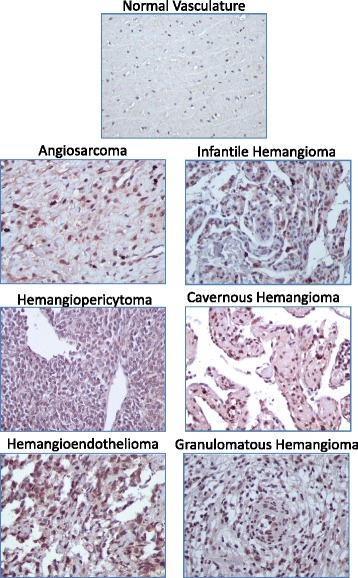
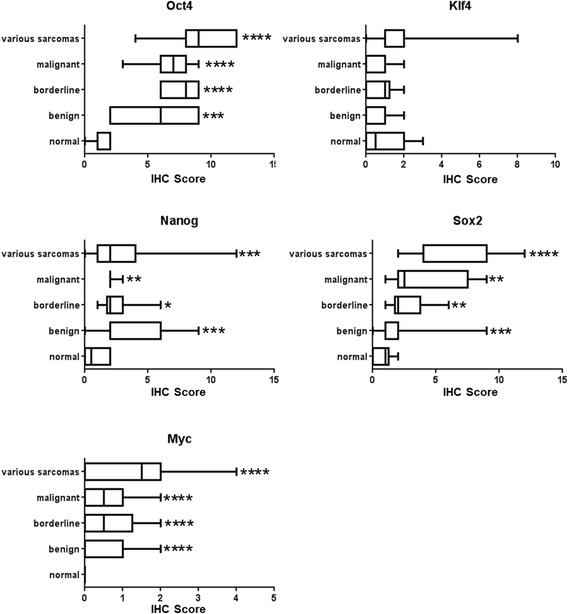
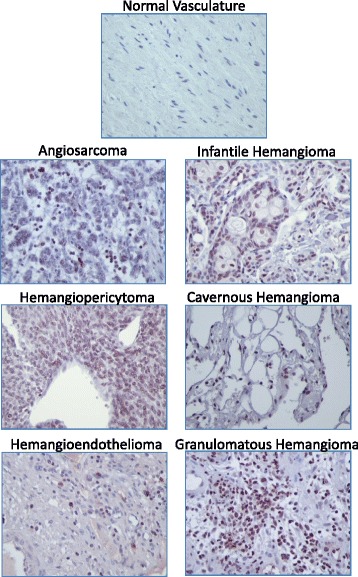
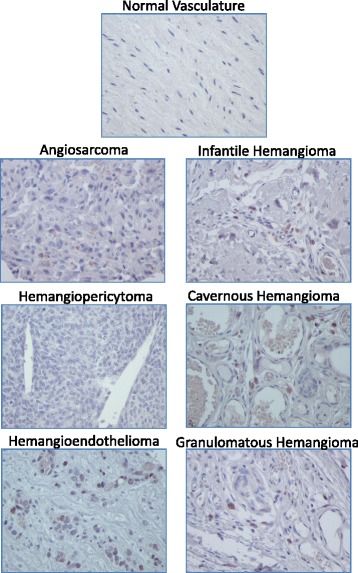
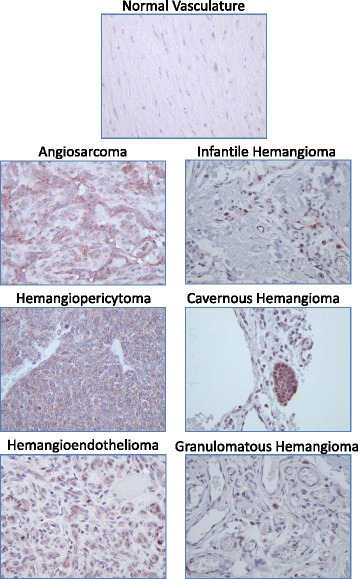
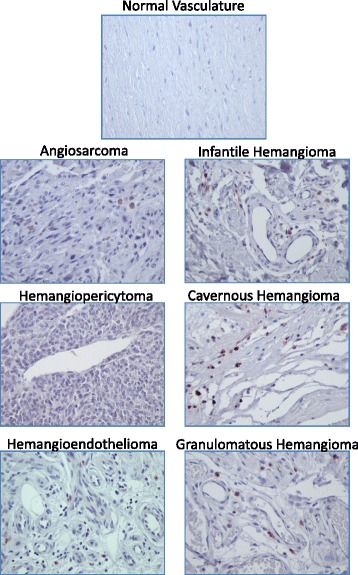
In this study, the expression levels of the embryonic stem cell reprogramming factors Oct4, Nanog, Myc, Sox2, and Klf4 were examined via immunohistochemistry in a panel of 71 benign, borderline, and malignant vascular tumors including capillary hemangioma, cavernous hemangioma, granulomatous hemangioma, venous hemangioma, hemangioendothelioma, hemangiopericytoma, and angiosarcoma. Antigenicity for each protein was quantified based on staining intensity and percentage of tissue positive for each antigen, and subsequently compared to data obtained from two control tissue sets: 10 vascular tissues and a panel of 58 various malignant sarcomas.
With the exception of Myc (which was only present in a subset of benign, borderline, and malignant tumors), Oct4, Nanog, Sox2, and Klf4 were detectable at variable levels across both normal and diseased tissues. Semi-quantitative evaluation of our immunohistochemical staining revealed that protein expression of Oct4, Nanog, Myc, and Sox2, but not Klf4, was significantly increased in benign, borderline, and malignant vascular tumors relative to non-diseased vascular tissue controls. Interestingly, the enhanced levels of Oct4, Nanog, Myc, and Sox2 protein were approximately equivalent between benign, borderline, and malignant vascular tumors.
These findings provide supporting evidence that enrichment for proteins involved in pluripotency is not restricted solely to malignant tumors as is suggested by the "stem cell theory of cancer", but additionally extends to common benign vascular tumors such as hemangiomas.
“癌症干细胞理论”指出,具有干细胞样特性的细胞亚群在恶性肿瘤的形成、维持、扩散及耐药特性中起核心作用。最近的研究从婴儿血管瘤中分离出了具有与异常祖细胞等效特性的不同细胞群,这表明除恶性肿瘤外,良性肿瘤可能也含有干细胞样成分。
在本研究中,通过免疫组织化学检测了71例良性、交界性和恶性血管肿瘤(包括毛细血管瘤、海绵状血管瘤、肉芽肿性血管瘤、静脉血管瘤、血管内皮瘤、血管外皮细胞瘤和血管肉瘤)中胚胎干细胞重编程因子Oct4、Nanog、Myc、Sox2和Klf4的表达水平。根据染色强度和每种抗原的组织阳性百分比对每种蛋白质的抗原性进行定量,随后与从两个对照组织组获得的数据进行比较:10个血管组织和一组58种不同的恶性肉瘤。
除Myc(仅存在于部分良性、交界性和恶性肿瘤中)外,Oct4、Nanog、Sox2和Klf4在正常和病变组织中均有不同程度的表达。对我们免疫组织化学染色的半定量评估显示,与非病变血管组织对照相比,Oct4、Nanog、Myc和Sox2的蛋白表达在良性、交界性和恶性血管肿瘤中显著增加,但Klf4没有。有趣的是,Oct4、Nanog、Myc和Sox2蛋白的增强水平在良性、交界性和恶性血管肿瘤之间大致相当。
这些发现提供了支持性证据,即参与多能性的蛋白质富集并不像“癌症干细胞理论”所暗示的那样仅局限于恶性肿瘤,而是还扩展到常见的良性血管肿瘤,如血管瘤。