Adlakha Nidhi, Pfau Thomas, Ebenhöh Oliver, Yazdani Syed Shams
Synthetic Biology and Biofuels Group, International Centre for Genetic Engineering and Biotechnology, Aruna Asaf Ali Marg, New Delhi, India.
Institute of Complex Systems and Mathematical Biology, University of Aberdeen, Aberdeen, UK.
Biotechnol Biofuels. 2015 Sep 25;8:159. doi: 10.1186/s13068-015-0338-4. eCollection 2015.
Paenibacillus polymyxa is a facultative anaerobe known for production of hydrolytic enzymes and various important biofuel molecules. Despite its wide industrial use and the availability of its genome sequence, very little is known about metabolic pathways operative in the Paenibacillus system. Here, we report metabolic insights of an insect gut symbiont, Paenibacillus polymyxa ICGEB2008, and reveal pathways playing an important role in the production of 2,3-butanediol and ethanol.
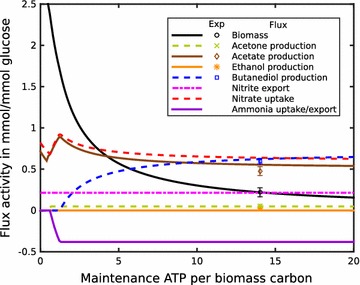
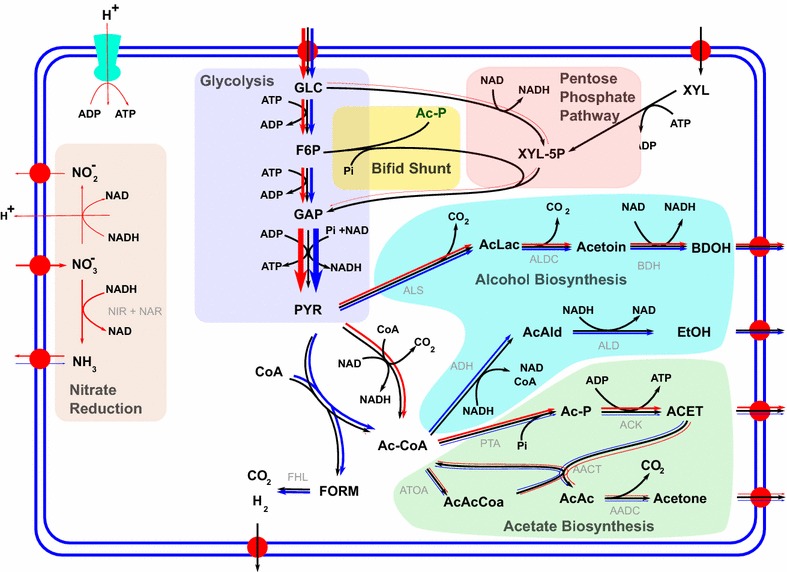
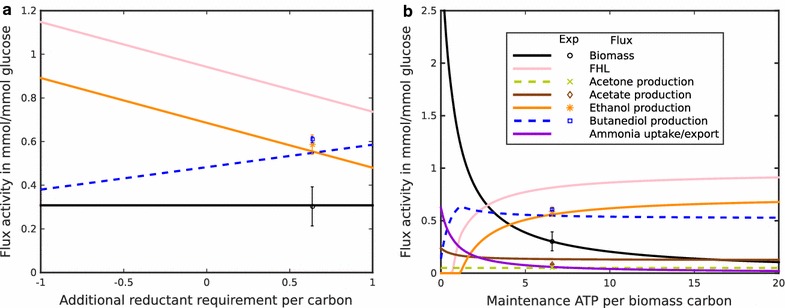
We developed a metabolic network model of P. polymyxa ICGEB2008 with 133 metabolites and 158 reactions. Flux balance analysis was employed to investigate the importance of redox balance in ICGEB2008. This led to the detection of the Bifid shunt, a pathway previously not described in Paenibacillus, which can uncouple the production of ATP from the generation of reducing equivalents. Using a combined experimental and modeling approach, we further studied pathways involved in 2,3-butanediol and ethanol production and also demonstrated the production of hydrogen by the organism. We could further show that the nitrogen source is critical for metabolite production by Paenibacillus, and correctly quantify the influence on the by-product metabolite profile of ICGEB2008. Both simulations and experiments showed that metabolic flux is diverted from ethanol to acetate production when an oxidized nitrogen source is utilized.
We have created a predictive model of the central carbon metabolism of P. polymyxa ICGEB2008 and could show the presence of the Bifid shunt and explain its role in ICGEB2008. An in-depth study has been performed to understand the metabolic pathways involved in ethanol, 2,3-butanediol and hydrogen production, which can be utilized as a basis for further metabolic engineering efforts to improve the efficiency of biofuel production by this P. polymyxa strain.
多粘芽孢杆菌是一种兼性厌氧菌,以产生水解酶和各种重要生物燃料分子而闻名。尽管它在工业上有广泛应用且其基因组序列已可得,但对于多粘芽孢杆菌系统中起作用的代谢途径却知之甚少。在此,我们报告了一种昆虫肠道共生菌——多粘芽孢杆菌ICGEB2008的代谢见解,并揭示了在2,3 - 丁二醇和乙醇生产中起重要作用的途径。
我们构建了一个包含133种代谢物和158个反应的多粘芽孢杆菌ICGEB2008代谢网络模型。采用通量平衡分析来研究ICGEB2008中氧化还原平衡的重要性。这导致发现了双歧分流途径,这是一种此前未在多粘芽孢杆菌中描述过的途径,它可以使ATP的产生与还原当量的生成解偶联。通过结合实验和建模方法,我们进一步研究了参与2,3 - 丁二醇和乙醇生产的途径,并且证明了该生物体可产生氢气。我们还能进一步表明氮源对于多粘芽孢杆菌的代谢物生产至关重要,并正确量化了其对ICGEB2008副产物代谢物谱的影响。模拟和实验均表明,当使用氧化型氮源时,代谢通量会从乙醇生产转向乙酸盐生产。
我们创建了多粘芽孢杆菌ICGEB2008中心碳代谢的预测模型,能够证明双歧分流途径的存在并解释其在ICGEB2008中的作用。已进行了深入研究以了解参与乙醇、2,3 - 丁二醇和氢气生产的代谢途径,这可为进一步的代谢工程努力提供基础,以提高该多粘芽孢杆菌菌株生物燃料生产的效率。